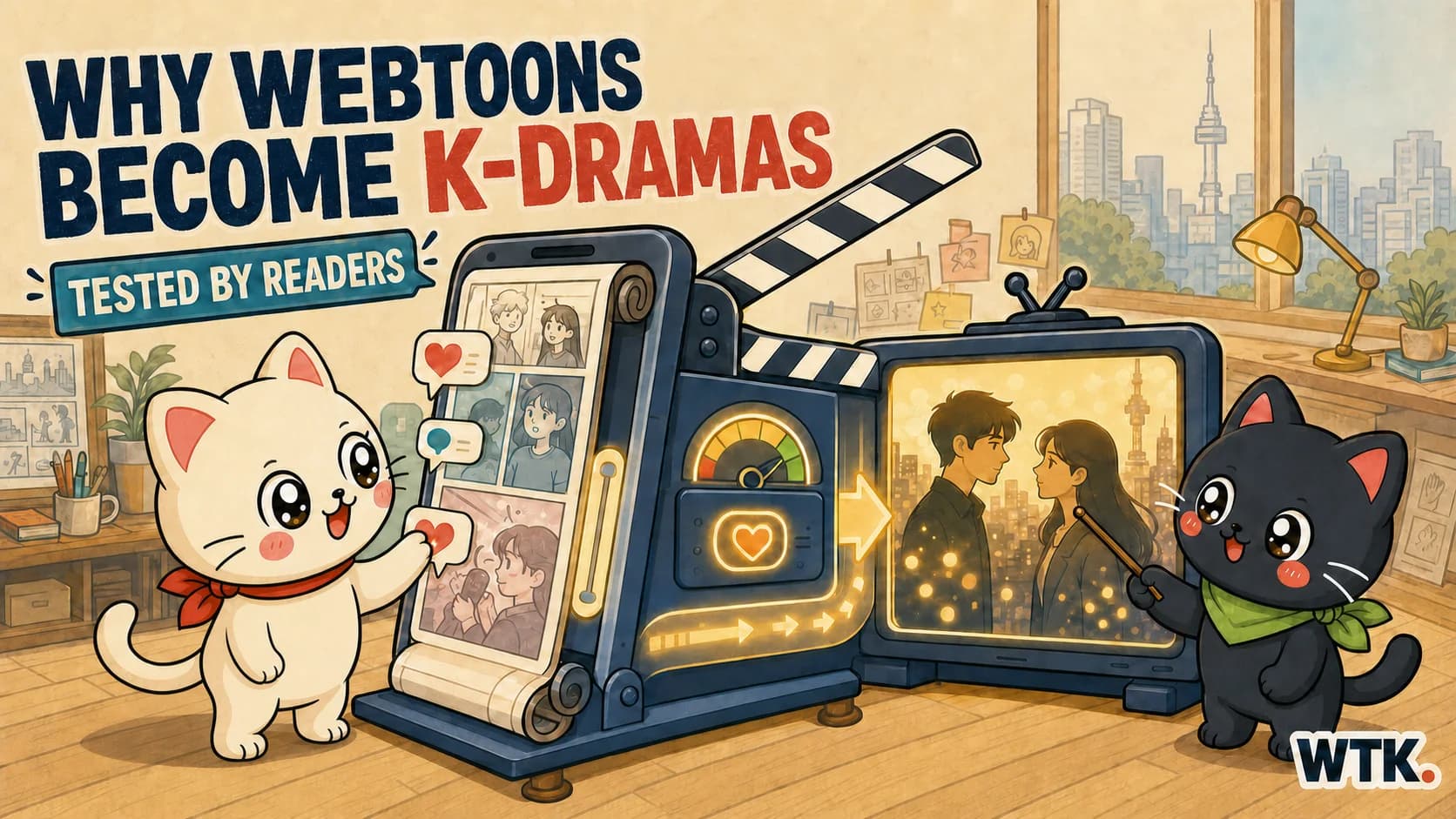
So many K-dramas are based on webtoons because Korea has built a giant public testing ground for stories. Before a production company spends months casting actors and building sets, millions of readers may already have tested the premise one episode at a time on their phones.
That does not make a popular webtoon a guaranteed hit. It makes it a once-tested story: an idea with visible audience response, established characters, and a body of material that producers can evaluate before cameras roll.
A webtoon is a story laboratory in public
A Korean webtoon (웹툰, digital comic) is usually released as a serialized vertical scroll. Readers encounter a new hwa (화, episode) each week, pay to read ahead, leave comments, recommend scenes, and sometimes stay with a story for years.
This process does something a private television script cannot. It creates evidence. A platform and an IP owner can see whether readers begin a series, return for later episodes, pay for early access, share it, and form a fandom around particular characters. Comments also expose which twists caused excitement and where readers lost interest.
The data is not a perfect forecast for television. Webtoon readers and drama viewers are not identical, and platform metrics are rarely public in full. Still, a producer choosing between two expensive projects can learn much more from a serialized work that has survived years of reader judgment than from a synopsis alone.
WEBTOON Entertainment describes its production approach as data-backed and audience-driven, linking creator platforms to television, film, and animation. The company reported about 145 million monthly active users across more than 150 countries as of March 2026. Korea's webtoon system is therefore not merely an online bookstore; it is a discovery engine for adaptable intellectual property.
Why webtoon IP lowers K-drama uncertainty
A drama is a high-cost bet. A webtoon can reduce several kinds of uncertainty before that bet is placed.
| What producers need to know | What a successful webtoon already provides |
|---|---|
| Does the premise attract attention? | Readership, rankings, sharing, and paid demand |
| Can the story sustain many episodes? | A serialized plot with tested cliffhangers |
| Do people care about the characters? | Comments, fan art, communities, and favorite scenes |
| What might the world look like? | Character designs, locations, costumes, and visual tone |
| Who will watch first? | An existing domestic or international fandom |
| How can the show be marketed? | A recognizable title, hook, and original-reader story |
This is why the industry calls the original an wonjak (원작, source work) and treats it as IP—jisik jaesangwon (지식재산권, intellectual property)—rather than simply a comic to reproduce. One story can move from web novel to webtoon, then to drama, film, animation, game, merchandise, or an overseas remake.
At a 2021 Korea Creative Content Agency forum, producers explained the logic plainly: popular webtoon characters and stories help market an adaptation and can reduce the risk of failure. As Korean webtoons gained readers abroad, the potential audience for screen versions also grew.
The visual head start matters too. A screenplay may describe a monster, office, or fantasy kingdom in words. A webtoon has already shown thousands of panels. Directors, production designers, casting teams, and investors can discuss something concrete—even when they later choose a different look.
From phone scroll to television screen
Korean viewers now recognize the pipeline: a web novel proves that a premise can hold readers, a webtoon turns it into a visible world, and a drama expands it with actors, music, locations, and motion. Not every title takes every step, but the chain makes it possible to test an idea at a relatively low cost before moving it into a much more expensive medium.
Adaptations also start with a marketing advantage. Original readers debate casting, compare trailers with famous panels, and explain the story to newcomers. That early conversation can give a new drama visibility before episode one. It resembles the concentrated fan energy behind K-pop ticketing: an organized core audience can create attention that spreads beyond the original community.
The traffic can run backward as well. When a drama becomes a hit, new viewers search for the webtoon, old episodes rise again, and the source IP gains another commercial life. KOCCA has highlighted this circular model: a screen adaptation can increase sales of an older web novel or webtoon, turning adaptation into a loop rather than a one-way sale.
This helps explain why webtoon platforms have moved closer to production. Naver Webtoon's Studio N, launched in 2018, exists specifically to connect webtoon stories with films, series, and animation. IP owners no longer have to wait passively for a broadcaster to call; they can participate in development and retain more of the value created on screen.
A proven webtoon is not a proven drama
Here is the important correction: reader popularity proves interest in the source, not the quality of the future show.
The two media ask audiences to experience time differently. A reader controls the scroll, pauses on a face, and finishes an episode in minutes. A television scene needs dialogue, rhythm, performance, and enough narrative weight to fill a longer runtime. The production must also translate drawings into real bodies, sets, effects, and budgets.
Common adaptation problems include:
- preserving every subplot until the drama becomes crowded
- changing too much and losing what original fans loved
- casting for appearance while ignoring a character's emotional energy
- stretching a compact webtoon arc across too many television episodes
- reducing imaginative fantasy because the effects budget cannot support it
- assuming the existing fandom is large enough to replace general viewers
This is why a good adaptation is not a photocopy. It is gaksaek (각색, adaptation): rebuilding a story for another medium. Characters may be combined, an ending may be changed, or a minor relationship may become the emotional center of the drama.
The release system then adds another test. A broadcast adaptation still has to survive ratings, weekly conversation, and cliffhangers. Our guide to why K-dramas release two episodes a week explains how that television schedule shapes pacing after the webtoon has already done its job as source material.
Why Korea became especially good at this pipeline
Korea's advantage is not simply that it has talented comic artists or drama writers. It connected phones, micropayments, weekly serialization, large platforms, production studios, broadcasters, and global streaming into one IP pipeline.
That system lets unusual premises find an audience before a conservative television buyer has to approve them. A story about a supernatural apartment, an office romance, a revenge fantasy, or an exhausted surgeon can first prove that readers understand its hook. By the time it reaches a drama meeting, the pitch is no longer only “trust the writer.” It is “people are already waiting for this world.”
There is a trade-off. When budgets rise and companies prefer familiar IP, original screenplays can face a harder path. Too much dependence on ranked webtoons may also encourage producers to chase the same genres and visible fandoms. A healthy drama industry still needs original television writers and risky ideas that have never been tested on a platform.
The webtoon boom did not remove risk from K-drama. It changed when part of that risk is tested. Korea learned to let readers audition stories first—and then let actors, directors, and screenwriters prove them all over again.
How to compare an adaptation without scorekeeping
Use four questions instead of asking only whether the drama is “faithful.” Did it preserve the story's central conflict? Which internal thoughts had to become dialogue, acting, or visual action? Which weekly cliffhangers were compressed for episode structure? And did the new ending solve a production constraint or change the work's argument? Record the webtoon episode and drama episode being compared, because adaptations may draw from different seasons or revised editions. This method explains why a scene changed and avoids treating two formats as interchangeable scripts.