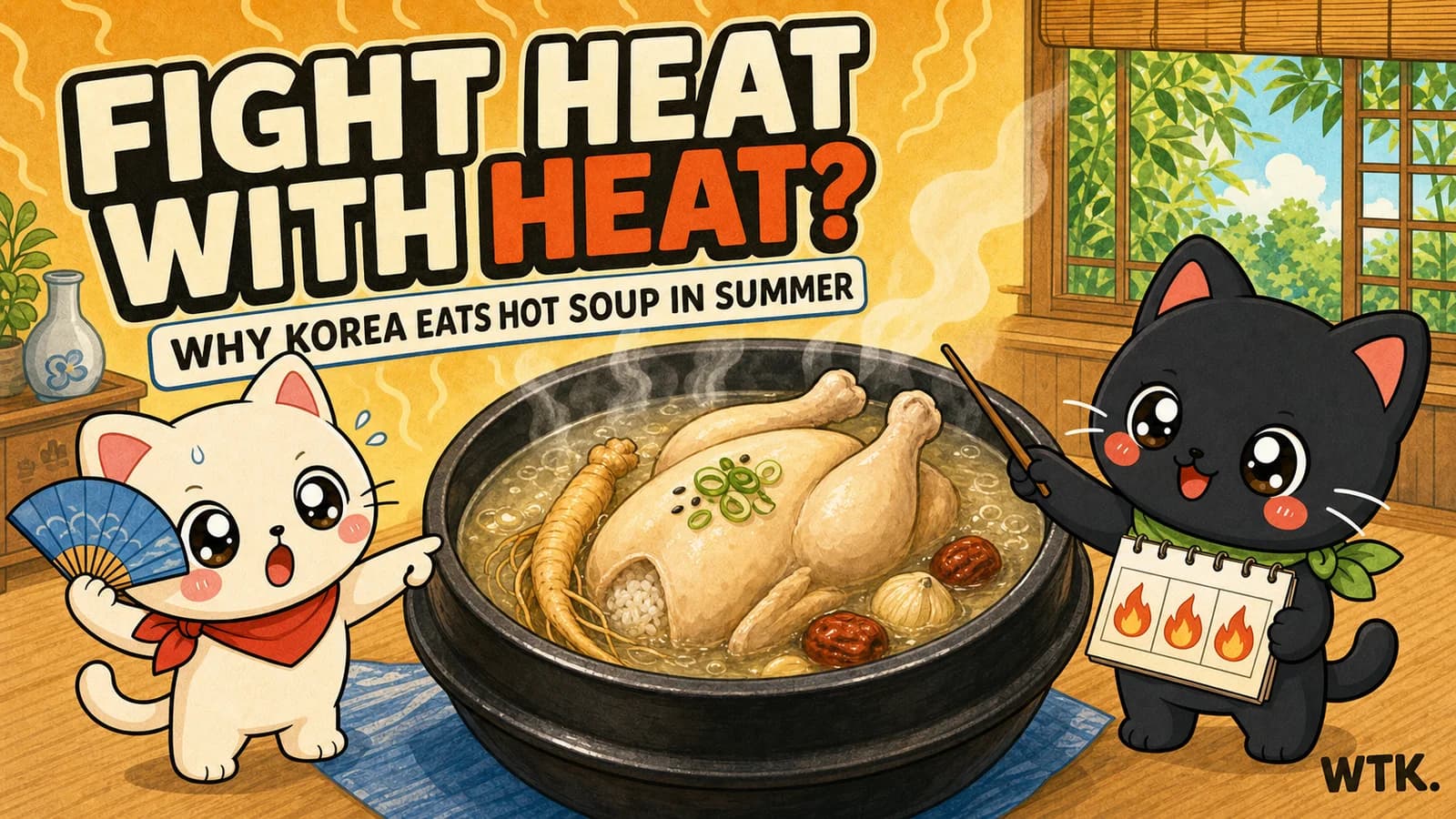
The weather app says 34°C. The humidity has turned the sidewalk into a steam room. You want ice, watermelon, and possibly permission to live inside a refrigerator.
Korea answers with a whole chicken boiling in a stone bowl.
Every summer, restaurants fill with people eating samgyetang (삼계탕, ginseng chicken soup) on the three boknal (복날), dates traditionally associated with the season's most exhausting heat. Diners sweat over steaming broth and call the idea iyeolchiyeol (이열치열): “fight heat with heat.”
It looks like a culinary prank. It is actually a calendar tradition, a modern comfort food, and a revealing example of how Koreans think about seasonal eating.
What are boknal and sambok?
Boknal means a “bok day.” The complete summer cycle is sambok (삼복, three bok days):
| Korean name | Meaning | 2026 date |
|---|---|---|
| Chobok (초복, 初伏) | First bok day | July 15 |
| Jungbok (중복, 中伏) | Middle bok day | July 25 |
| Malbok (말복, 末伏) | Final bok day | August 14 |
English articles often call them Korea's “dog days of summer,” which is a useful weather comparison but not a literal translation of everything Koreans do on the dates. The important idea is that sambok marks the long, draining center of summer.
The dates move every year. They are also more complicated than “three dates on the lunar calendar.” Traditional calendar makers combine solar markers with the ten Heavenly Stems assigned to days.
- Chobok is the third Gyeong day (경일, 庚日) after Haji (하지, the summer solstice).
- Jungbok is the fourth Gyeong day after Haji.
- Malbok is the first Gyeong day after Ipchu (입추, the traditional beginning of autumn).
Gyeong days repeat every ten days, so Chobok and Jungbok are normally ten days apart. Malbok can arrive ten or twenty days after Jungbok. When the longer gap occurs, Koreans call it wolbok (월복, 越伏). The year 2026 has that twenty-day interval between July 25 and August 14.
Nobody needs to calculate Heavenly Stems before lunch. Calendars, news reports, chicken restaurants, and food-delivery apps will remind the country that boknal has arrived.
What is inside a bowl of samgyetang?
Samgyetang literally puts its signature ingredients in the name:
- sam (삼, 蔘) = ginseng
- gye (계, 鷄) = chicken
- tang (탕, 湯) = soup
A typical restaurant serves one small whole chicken to each diner. The bird is stuffed with glutinous rice and simmered with ingredients such as fresh ginseng, garlic, and daechu (대추, jujube). Chestnuts, ginkgo nuts, milk vetch root, or other aromatics may appear depending on the house recipe.
The broth is usually gentler than foreigners expect. It is not automatically red or chili-hot. The chicken and ginseng create a mild, earthy soup, while salt and pepper often arrive separately so each diner can season the meat.
Eating it is a small project:
- Let the bowl stop furiously bubbling.
- Pull the tender chicken apart with chopsticks, a spoon, or the provided utensils.
- Dip pieces of meat into salt and pepper if desired.
- Open the center carefully; the rice stuffing retains heat.
- Alternate broth, chicken, rice, and kimchi until the bowl becomes mysteriously empty.
The ginseng root is edible, but its bitterness can surprise first-time diners. The jujube is not a date that accidentally fell into the soup; it is there for sweetness and aroma. People sometimes debate whether it should be eaten, but there is no national jujube police.
Samgyetang is generally an individual dish rather than a large communal stew. That makes the sight of an entire chicken less extravagant than it appears: the bird is young and small, sized to fit one earthenware bowl.
Is samgyetang an ancient Korean recipe?
The honest answer is more interesting than the marketing answer.
Koreans have a long history of eating chicken soups, dakguk (닭국), and whole boiled chicken known as dakbaeksuk (닭백숙). Food and medicine also overlapped in seasonal ideas about restoring strength. Samgyetang grew from that older family of dishes.
The exact bowl served today is much more modern. Korean agricultural and folk-culture sources place the popularization of whole-ginseng samgyetang around the 1960s, when ginseng production and refrigeration made the ingredient more widely available. Restaurants centered on the dish expanded in Seoul, and the name samgyetang overtook the older ingredient order gyesamtang (계삼탕, chicken-ginseng soup).
That does not make the tradition fake. It shows how food culture usually works. An older belief in summer restorative foods met modern farming, cold storage, restaurants, and urban schedules. The result became so familiar that it now feels timeless.
This is similar to the way Korean ramyeon became national comfort food without being an ancient royal recipe. Repetition can turn a modern dish into a cultural institution surprisingly quickly.
Iyeolchiyeol: why fight heat with heat?
Iyeolchiyeol is written 以熱治熱: “control heat with heat.” In everyday conversation, it means facing a difficult condition with more of the same force. In summer food culture, it means eating something hot enough to make your forehead reconsider its life choices.
The traditional logic has several layers.
First, summer was physically demanding. Agricultural work, high humidity, and reduced appetite could leave people feeling depleted. A chicken, rice, garlic, and ginseng meal represented concentrated nourishment when meat was not an everyday luxury.
Second, sweating creates a sensation of release. A hot soup makes the body feel even hotter, perspiration begins, and the air after the meal can feel comparatively cooler. The contrast is part of the experience.
Third, the dish is boyangshik (보양식), food eaten with the intention of supporting or restoring the body. That category is cultural rather than a precise medical prescription. It may include chicken, eel, duck, loach soup, or abalone depending on the family, region, budget, and decade.
Finally, the ritual gives summer a schedule. Heat can feel endless, but Chobok, Jungbok, and Malbok create three checkpoints: summer has begun, summer is peaking, and summer is finally supposed to leave.
Does the cooling explanation hold up scientifically?
There is a small piece of physiology inside the saying, but it should not be inflated into a medical claim.
Hot food can encourage sweating. When sweat evaporates from skin, it removes heat. That mechanism works better in dry, breezy conditions than in heavy humidity, where sweat may remain on the skin instead of evaporating efficiently.
Samgyetang also provides fluid, protein, carbohydrate, and sodium. Those may make a hungry person feel restored, but there is no need to call the soup a cure for heat exhaustion. A boiling meal does not cancel prolonged sun exposure, dehydration, or dangerous body temperature.
During severe heat:
- move to shade or an air-conditioned space
- drink appropriate fluids regularly
- reduce strenuous activity
- pay attention to dizziness, confusion, nausea, or unusual weakness
- seek medical help for signs of heat illness
Enjoy iyeolchiyeol as food culture, not as permission to ignore a heat warning.
Why restaurants still form lines on boknal
If samgyetang is available all year, why wait in a line on the most uncomfortable day? Because the date changes the meaning of the meal.
This is the same logic that makes birthday cake taste different from cake on an ordinary Tuesday. Boknal turns lunch into participation. Families suggest samgyetang in the group chat. Offices may choose a restorative team meal. Food apps promote chicken and soup specials. Restaurants prepare extra birds. News cameras film the queue, confirming to everyone watching that, yes, there is a queue.
The meal can also express care:
더위 먹지 말고 몸보신해.
Deowi meokji malgo mombosin-hae.
“Take care of yourself in the heat and eat something restorative.”
Mombosin (몸보신) means caring for or replenishing the body, often through nourishing food. A parent buying samgyetang for adult children may be communicating affection without making a speech about affection.
Korean meals frequently carry this social function. Food supports the body, but offering it also supports the relationship. Our guide to Korean food and alcohol pairings explores a different version of the same principle: the dish is not only flavor but also a reason for people to stay at the table.
Boknal food is changing with Korea
The chicken line is real, but Korea does not eat one national menu in perfect unison. Modern boknal choices reveal changing tastes, household sizes, prices, health concerns, and ideas about convenience.
Baeksuk: the larger family version
Dakbaeksuk (닭백숙) is a whole chicken simmered more simply, often in a larger pot for sharing. Mountain-valley restaurants may serve it with rice porridge made from the remaining broth. Where samgyetang feels like one compact bowl per person, baeksuk can become an afternoon group meal.
Eel, duck, loach, and abalone
Jangeo (장어, eel), ori (오리, duck), chueotang (추어탕, loach soup), and jeonbokjuk (전복죽, abalone porridge) all appear as summer restorative foods. The common theme is not temperature. It is the idea of eating something substantial or special when the weather drains energy.
Fried chicken: the younger joke with real sales
Some younger diners jokingly redefine “a chicken for boknal” as Korean fried chicken. It lacks ginseng and a stone bowl, but it satisfies the central requirement of being chicken. Delivery promotions encourage the reinterpretation.
Add beer and the meal becomes chimaek (치맥, chicken and beer), though alcohol is not a hydration strategy. Anyone curious about the social rules around that table can read our guide to Korean drinking culture.
Ready-made samgyetang
Single-person households do not always want to simmer a whole bird. Retort pouches, meal kits, convenience-store products, and smaller portions let people mark boknal without a restaurant queue.
This version may look less ceremonial, but it continues the tradition's basic talent: adapting old ideas of care to the time and kitchen people actually have.
Cold food has not been banned
Koreans absolutely eat cold food in summer. Naengmyeon (냉면, cold noodles), kongguksu (콩국수, noodles in chilled soybean broth), chogyetang (초계탕, chilled tangy chicken soup), bingsu (빙수, shaved ice), watermelon, and hwachae (화채, fruit punch) all belong to the season.
The contrast is what makes boknal memorable. Korea does not believe every July meal must be hot; it reserves particular dates for the dramatic bowl.
A first-timer's guide to ordering samgyetang
At a specialist restaurant, the menu may be shorter than expected. The standard bowl is usually enough for one person. Variations might include extra ginseng, abalone, black chicken, perilla, or medicinal herbs.
Useful words include:
| Korean | Romanization | Meaning |
|---|---|---|
| 삼계탕 | samgyetang | Ginseng chicken soup |
| 반계탕 | bangyetang | Half-chicken soup |
| 닭백숙 | dakbaeksuk | Whole boiled chicken |
| 소금 | sogeum | Salt |
| 인삼 | insam | Ginseng |
| 찹쌀 | chapssal | Glutinous rice |
| 몸보신 | mombosin | Restoring or caring for the body |
Three practical notes:
- Expect bones. The chicken is served whole, not as boneless pieces.
- Check the steam before the rice. The center can remain extremely hot.
- Ask about ingredients when necessary. Broths and medicinal-herb variations differ, and some restaurants may use nuts, shellfish, alcohol, or other additions.
Going exactly on Jungbok can provide the full cultural experience, including the full queue. Going one day earlier provides nearly identical chicken with a substantially shorter lesson in patience.
The bowl is hot because the memory is warm
Samgyetang's summer popularity cannot be reduced to one scientific trick. Sweating, nutrition, traditional food theory, restaurant culture, family care, and calendar ritual all contribute.
The custom also contains a very Korean contradiction. The weather is oppressive, so people gather around something even hotter. The individual bowl is difficult to eat gracefully, so everyone at the table becomes equally sweaty and informal. A meal intended to restore the body also becomes a yearly marker of shared endurance.
On July 25, 2026, Jungbok will bring another round of queues. Some people will choose samgyetang, some will order fried chicken, and others will stay beside the air conditioner with cold noodles. Traditions survive not because everyone obeys them in exactly the same way, but because everyone still knows what is being reinterpreted.
That is the real meaning of iyeolchiyeol. The soup does not defeat summer. It gives Koreans a delicious way to challenge it.
Read the boknal calendar without copying last year's dates
초복, 중복, and 말복 are calculated seasonal days, so their Gregorian dates change each
year. Verify the current year's dates with a Korean calendar or cultural institution before
publishing travel advice, and distinguish the date of the custom from a restaurant promotion that
may run for weeks. Heat safety also remains separate from food tradition: hot soup does not replace
water, cooling, rest, or medical guidance during dangerous heat. The cultural explanation answers
why the meal is meaningful; it should not be rewritten as a universal health prescription.
Sources
- National Folk Museum of Korea — Chobok, Jungbok, and Malbok calendar rules
- Aju Press — Korea's 2026 boknal dates and wolbok interval
- National Institute of Animal Science — Samgyetang history and popularization
- Korea.net — Samgyetang and traditional summer food philosophy
- Korea.net — Korean summer foods and iyeolchiyeol
- Korean Cultural Center — Seasonal Korean dishes
- Time — What thermoregulation science says about food and hot weather