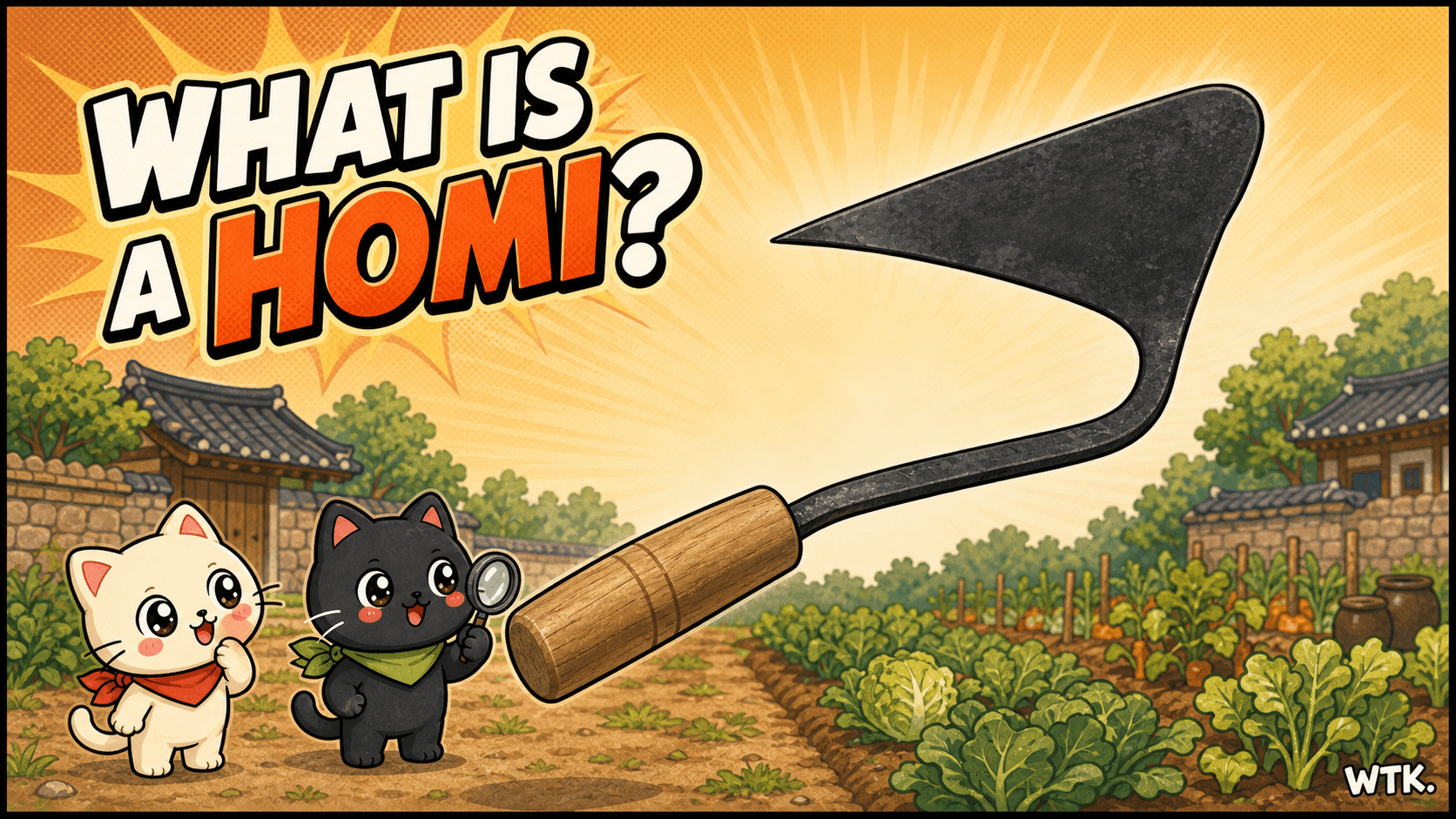
Sometime around 2019, American gardeners started leaving five-star reviews for a tool most of them couldn't pronounce. The homi (호미) — a small, bent-neck Korean hand hoe, hand-forged by a blacksmith in the town of Yeongju — climbed Amazon's gardening bestseller lists as reviewers marveled that one odd-looking tool had replaced half their shed. In Korea, the reaction was amused disbelief: the world had just discovered the thing grandma keeps by the kimchi garden.
Why the homi works: one tool, four jobs
The homi's genius is the bend. The blade meets the handle through a curved "goose neck," setting the sharp triangular head at an angle to your grip. That geometry turns a flick of the wrist into whatever the soil needs:
- Point down — it's a pick that digs and cuts roots.
- Edge sideways — it's a weeder that slices just under the surface (Koreans call the endless summer chore gimmaegi 김매기).
- Flat face — it's a mini plow that draws furrows and hills up soil around plants.
- Backside — it tamps and levels.
A Western trowel digs, and that's it. The homi is a complete cultivation system that costs less than a pizza — the same do-everything-with-one-object philosophy behind the yangeun pot and the sotdukkeong grill.
Forged, not factory-made
The Amazon-famous version comes from Yeongju Daejanggan (대장간, blacksmith shop) in North Gyeongsang Province, where master Seok No-gi — who started smithing as a teenager and has hammered homi for more than 50 years — still forges each one as a single piece of steel. Many are made from recycled automotive leaf springs: thick, high-carbon steel that's heated, hammered, and quenched repeatedly for a blade that holds an edge but doesn't shatter. No welds, no rivets, no handle that wobbles loose after a season.
That one-piece forging is what separates the real thing from the stamped copies that followed the hype — and it's why a hand tool from a rural Korean smithy out-reviewed products from global garden brands.
An old tool — and the country that outgrew it
Here's the twist the bestseller lists don't show. The homi is ancient — iron homi have been excavated from Korean sites over a thousand years old, and for most of Korean history it defined farm labor alongside the plow (jaenggi 쟁기) and sickle (nat 낫). As late as the 1950s, Korean farms ran almost entirely on those hand tools.
Then Korea industrialized farming at a sprint. Government mechanization drives from the 1960s-80s put motorized tillers in the fields — the first domestic tillers rolled out in 1962 — and by 1997, rice farming was about 98% mechanized, according to Korea's policy archives. Today the agriculture ministry showcases remote-controlled, AI-assisted tractors. In the span of one lifetime, the homi went from the center of Korean agriculture to a memory of it.
So the homi's global fame carries a quiet irony: the world adopted the tool just as Korean agriculture mechanized. The tool did not disappear from Korea, but its compact scale also turned out to suit home gardens, raised beds, and small urban plots abroad.
Buying one (and not getting a knockoff)
- Look for "one-piece forged" and verify the maker rather than trusting a marketplace title alone. Prices and authenticity claims change by seller.
- Pick your size. The standard homi fits most gardening; mini versions suit houseplants and raised beds.
- Care is simple: knock off soil, keep it dry, wipe the blade with oil once a season. A well-made forged tool can last for years when kept clean and dry.
Blade shapes are not all interchangeable
There is no single homi profile for every soil and task. Sellers use labels such as pointed, wide-blade, left-handed, right-handed, hand-forged, or mass-produced, sometimes inconsistently. A narrow point can enter compact soil and work close to roots; a broader blade moves more loose soil and weeds faster. The angle between handle and blade also changes wrist position and pulling action.
Choose by the work you actually do. A compact garden bed does not need the heaviest forged head, and a tiny indoor planter does not benefit from a full farm-sized blade. If handedness is listed, check the blade orientation in the product photo rather than relying only on the title.
Using a homi without fighting the tool
The characteristic motion is usually a short pull toward the body, not a full-force downward chop. Let the point enter the soil, then use the angled face to loosen or draw material back. Work in small strokes around established roots. Wear gloves, keep the free hand behind the cutting edge, and do not swing toward another person.
After use, remove soil and dry the steel. Light surface rust can happen on carbon steel and does not mean the tool is fake, but leaving wet soil on the blade accelerates corrosion. Store it with the edge covered or facing away from hands. Sharpen only the working bevel shown by the maker; turning the entire edge into a thin knife can reduce durability.
Authenticity is less important than honest construction
“Korean homi” can describe a tool type, a country of manufacture, or a marketing style. Those are not the same claim. A documented Yeongju-made tool has a specific craft story, but a clearly labeled factory-made homi can still be useful. What matters is that the seller accurately states the maker, material, construction method, dimensions, and origin. Avoid paying a handmade premium for a listing that provides none of those details.
The homi never needed a redesign, an app, or a Kickstarter. It needed fifteen centuries of Korean soil, one stubborn blacksmith, and a review section. Some objects are just finished.
When another garden tool is the better choice
A homi is versatile, but it does not replace every tool. A transplanting trowel makes a cleaner, measurable hole for bulbs. A long-handled hoe lets you weed without kneeling. Pruners cut woody stems more safely, and a garden fork loosens a broad area without concentrating force at one point.
Choose the homi for close, controlled pulling work: opening a short furrow, disturbing young weeds, mixing a small patch, or shaping soil around a plant. Stop if the blade repeatedly glances off stone or if the motion strains your wrist. The tool’s cultural story is interesting; ergonomic fit still matters more during an hour in the garden.
A five-minute fit test before committing
Measure the handle and blade instead of relying on a listing photo. With a glove on, check whether your wrist can stay close to neutral while the blade meets the soil. Try a short pulling stroke in loose earth before using force. The tang and handle should not shift, the blade should not have a sharp unfinished edge where your hand can reach it, and the tool should return to storage clean and dry. Left- and right-curving regional forms may feel different in the same hand, so “authentic Korean shape” is less useful than dimensions, construction, and a return policy.