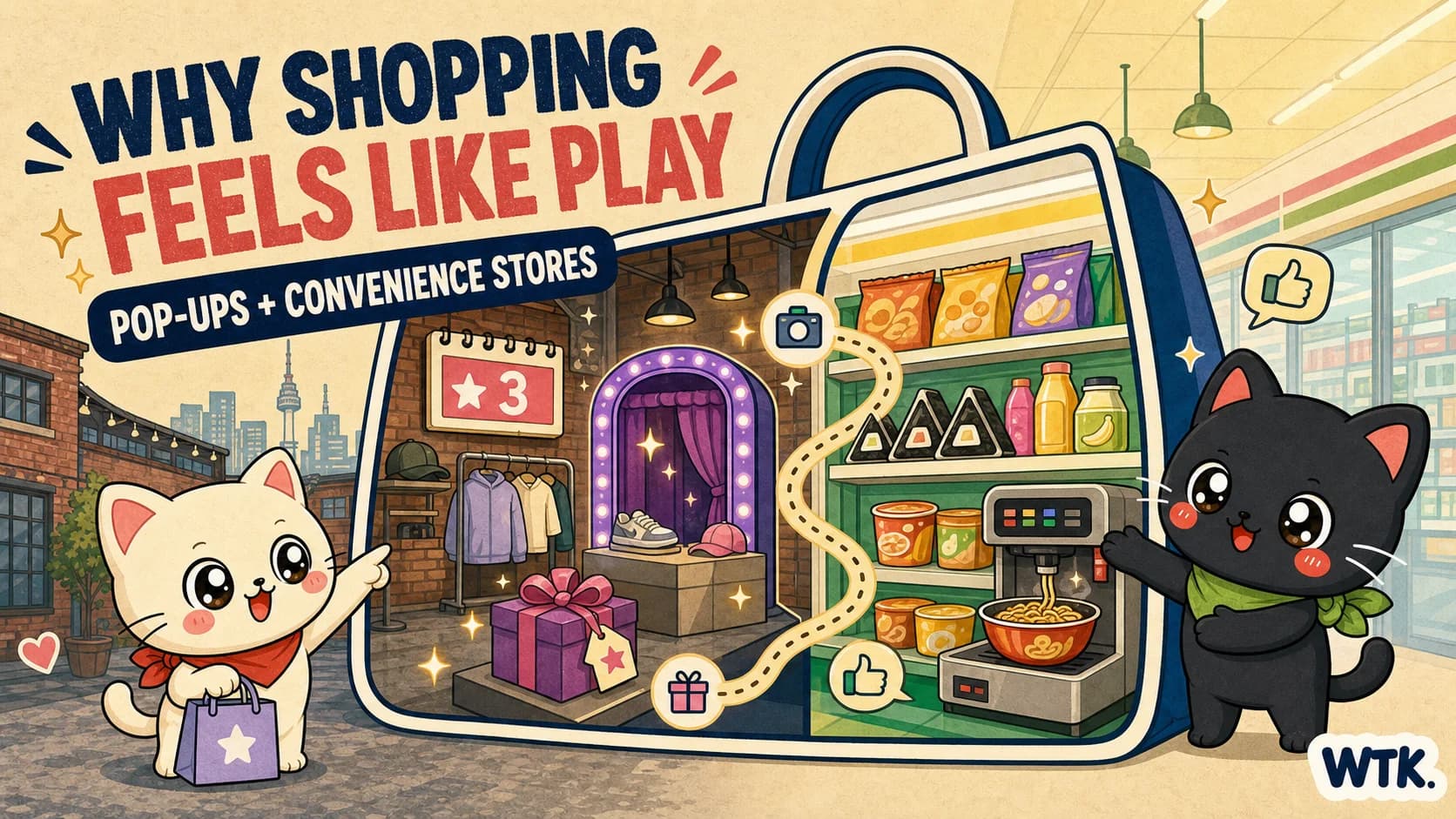
One of Seoul's hottest shopping districts is full of stores designed to disappear. Meanwhile, one of Korea's biggest tourist attractions may be the convenience store under your hotel—designed to look almost ordinary.
Seongsu pop-ups and Korean convenience stores appear to be opposites. One offers a limited event people cross the city to see; the other offers instant noodles twenty-four hours a day. Together, they reveal the same idea: in Korea, shopping works best when it feels like something to do, photograph, taste, and share.
Two doors into the Korea of right now
Walk through Seongsu and an old warehouse may contain a beauty laboratory, character exhibition, fashion game, listening room, or free photo booth. Return a month later and the entire concept may be gone. This is the Korean papeueop seutoreo (팝업스토어, pop-up store): temporary retail presented as an event.
Then walk into a pyeonuijeom (편의점, convenience store). The fluorescent lights and compact aisles seem less theatrical, but the shelves change constantly. A dessert seen on social media appears in several new forms. A character lands on drinks and snacks. A famous restaurant becomes a microwave meal. Customers combine noodles, cheese, eggs, and sausages into recipes the store never officially printed.
Both spaces answer the same tourist question: What are Koreans interested in this week?
The Korea Tourism Organization now describes convenience stores as must-visit places for foreign travelers because they collect current K-food, desserts, drinks, character collaborations, and entertainment products in one accessible space. Seongsu plays a larger, more dramatic version of the same role. Its alleys have become a live index of K-fashion, K-beauty, cafés, and brand experiments.
Koreans call a fashionable destination a hatpeul (핫플), shortened from “hot place.” The useful thing about that borrowed word is that it describes more than a location. A hatpeul is somewhere worth making a trip to—and proving you visited.
Why Seongsu became Korea's pop-up laboratory
Seongsu was once known for factories, auto-repair shops, warehouses, and handmade-shoe workshops. Its industrial buildings offered high ceilings, wide floors, and rough textures that could be converted without erasing their history. Cafés and creative businesses arrived, followed by fashion and beauty brands that wanted an alternative to the polished department store.
The neighborhood now offers a valuable combination:
- reusable warehouse-like spaces
- heavy pedestrian traffic from young Koreans and tourists
- Seoul Forest, cafés, restaurants, and shopping within one walkable area
- an industrial visual identity that photographs well
- social-media accounts devoted to tracking new openings
- consumers willing to queue for a temporary experience
For a brand, a Seongsu pop-up is both marketing and research. It can test whether people understand a new identity, which product they touch, where they take photos, what sells out, and whether online attention becomes physical traffic. The shop may close, but the consumer data and social posts remain.
That testing role is becoming more important. In July 2026, Cushman & Wakefield Korea described Seongsu as evolving from a pop-up testing ground into a hub where successful experiments lead to permanent flagship stores. Temporary retail is not necessarily the opposite of permanence; it can be the audition for it.
Foreign spending shows how far the neighborhood has traveled. Musinsa reported that its large Seongsu store generated about 7 billion won in its first fifty days in 2026, with roughly 3 billion won coming from overseas customers. During one June week, foreign customers accounted for 56% of purchases. A district built around fast-changing Korean taste has become a place where international visitors shop for that taste directly.
Why Korean convenience stores became tourist stops
A pop-up says, “Come now or miss it.” A convenience store says, “Come whenever you want.” Its power is not architectural spectacle but density: thousands of affordable experiments placed beside homes, offices, schools, subway stations, and hotels.
Korean convenience stores do much more than sell emergency groceries. Depending on the location, customers can:
- heat a meal and eat it at an indoor or outdoor counter
- cook packet ramyeon in a self-service machine
- buy coffee, fried food, ice, alcohol, medicine-like household goods, and travel basics
- receive deliveries or use parcel services
- discover chain-exclusive products and collaborations
- find albums, photocards, or goods linked to entertainment events
- sample a viral dessert without visiting the original bakery
K-dramas helped make this familiar. Viewers saw characters eat cup noodles outside a store, share canned coffee after work, or buy late-night beer and anju (안주, food eaten with alcohol). Tourists can reproduce the scene without a reservation, language skills, or a large budget.
That low barrier matters. A luxury flagship tells visitors what a brand believes Korea should look like. A convenience store shows what ordinary people actually grab on the way home—although even that “ordinary” shelf is carefully engineered.
Chains compete through private-label meals, oversized products, restaurant collaborations, novelty flavors, and limited editions. Social media turns scarcity into a game: find the item, visit another branch if it is sold out, film the first bite, and post a rating. The shopper becomes product tester and distributor at once.
The cycle moves quickly. In early 2026, Korea Tourism Organization coverage showed how the Dubai chewy-cookie craze had already expanded into convenience-store rice cakes, ice cream, cakes, and other variations. The original trend did not merely reach the shelf; the shelf multiplied it.
Pop-up versus convenience store: the same retail engine
| Element | Seongsu pop-up | Korean convenience store |
|---|---|---|
| Main promise | “You can only experience this now” | “You can experience Korea anytime” |
| Typical price | Free entry to premium shopping | Mostly low-cost individual items |
| Space | Large, themed, highly designed | Compact, standardized, product-dense |
| Discovery | Planned trip or social-media recommendation | Accidental visit or routine stop |
| Scarcity | The entire store has an end date | A specific product may sell out or disappear |
| Participation | Games, samples, photo zones, customization | Cooking, mixing products, tasting, collecting |
| Brand feedback | Queues, dwell time, photos, conversion | Sales velocity, repeat purchase, recipe virality |
| Tourist reward | “I found the hottest place” | “I lived like a Korean for ten minutes” |
Under those differences sits the same five-part engine.
1. Constant novelty
Korean retail gives people a reason to return before they need anything. The next visit may contain a new collaboration, flavor, character, gift, or room design.
2. Participation instead of passive browsing
At a pop-up, visitors stamp a card, take a quiz, customize an item, or enter a photo set. At a convenience store, they cook noodles, assemble a meal, or invent a recipe. The purchase becomes the end of an activity rather than the whole activity.
3. Social proof built into the space
Photo zones and limited packaging make sharing predictable. A long queue can be inconvenient, but it also signals that something matters. Online attention produces foot traffic, which produces more online attention.
4. Collaboration as a shortcut
A beauty brand borrows a character; a convenience-store chain borrows a restaurant; a K-pop act adds exclusive merchandise. Each partner brings an audience the other did not have. This is why a small product can suddenly behave like a fandom event. Our guide to K-pop photocards explains how a tiny collectible can motivate multiple purchases.
5. Fast consumer feedback
Neither format needs to wait a year for a formal research report. Queues, sold-out products, QR registrations, user videos, and resale activity reveal interest almost immediately. Weak ideas disappear; strong ones receive a second edition, wider release, or permanent store.
Why foreign visitors love both experiences
Traditional tourism separates sightseeing from shopping. Korea increasingly combines them. Visitors do not merely buy cosmetics or snacks; they use retail to understand the speed, visual language, and everyday habits of the country.
Seongsu offers aspirational Korea: new fashion, elaborate interiors, experimental brands, and the feeling of arriving before a trend becomes global. Convenience stores offer repeatable Korea: breakfast after jet lag, a late-night snack, rain-day supplies, and the exact drink seen in a drama.
This fits a broader travel shift sometimes called dailycation: experiencing ordinary local routines as part of a vacation. Sitting outside a convenience store or walking between Seongsu warehouses can feel more revealing than checking off another monument.
It also helps that both formats are relatively approachable. Many pop-ups are free even when they require a wait. A convenience-store experiment may cost only a few thousand won. Visitors can participate without understanding a luxury sales conversation.
There is a related social comfort in Korea's cafés. Our article on why Koreans leave laptops unattended in cafés explores how shared expectations turn commercial spaces into extensions of daily life.
How to explore without chasing yesterday's trend
A useful article cannot give a permanent list of temporary stores. Instead, use a method that survives the closing dates.
For Seongsu pop-ups
- Search
성수 팝업(Seongsu papeueop) shortly before your visit. - Check the brand's official Korean social account for dates and entry rules.
- Distinguish advance reservation from on-site QR waiting.
- Arrive on a weekday or near opening time for high-demand events.
- Build a flexible route; one closed or full pop-up should not ruin the neighborhood.
- Combine the visit with Seoul Forest, cafés, permanent stores, or the shoe district.
For convenience stores
- Try more than one chain because exclusive products differ.
- Look for seating before heating food; not every branch has an eating area.
- Follow the cooking instructions and use the correct waste bins.
- Treat “1+1” as buy one, get one—not a 50% discount on a single item.
- Check allergens and ingredient labels instead of guessing from package art.
- Ask before filming staff or other customers.
Famous products are a starting point, not a mandatory checklist. A spicy noodle such as Buldak ramyeon may be globally recognizable, but the more interesting discovery may be the item that has not yet reached overseas shelves.
The shop is no longer just where the product waits
Seongsu pop-ups and convenience stores succeed at different scales, but both reject the old idea that a shop is simply storage with a cash register.
The pop-up turns a product into a temporary world. The convenience store turns products into an always-changing portrait of ordinary life. One creates urgency through an end date; the other creates habit through proximity. Both invite the customer to complete the experience by photographing, tasting, combining, reviewing, and sharing it.
That is why tourists now travel to a neighborhood full of stores that will vanish—and why they return to the convenience store below the hotel every night. They are not only shopping. They are checking the live version of Korea.
Sources
- Cushman & Wakefield Korea — Seongsu from pop-ups to flagship stores
- Asia Business Daily — Foreign tourists experience daily life in Seongsu
- Maeil Business Newspaper — Foreign spending at Musinsa Megastore Seongsu
- VISITKOREA — Keeping Up with the Convenience Stores in Korea
- VISITKOREA — Why K-convenience stores became tourist destinations
- VISITKOREA — Korea's Dubai chewy-cookie trend