When the National Museum of Korea appointed RM of BTS as a global public relations ambassador in June 2026, the museum documented his visit to a special exhibition of Kim Hong-do (김홍도). The exhibition closed on August 10 after an extension, but the connection remains a useful doorway: who was this late-Joseon painter, and what should a first-time viewer look for in his work?
This is an art guide, not evidence that one celebrity visit caused museum attendance. It uses the museum's collection records and exhibition archive to separate what can be verified from the broader “RM effect” often discussed by fans.
Joseon's superstar painter
Kim Hong-do (1745-1806), better known by his pen name Danwon (단원), was the defining painter of late Joseon Korea. He had the royal gig — court painter to King Jeongjo, trusted with state ceremonies and royal portraits — and the range: landscapes, flowers and birds, Buddhist subjects, and documentary court scenes. The National Museum of Korea's 2026 retrospective gathered 96 works, from landscapes to a large documentary painting of a Pyongyang governor's banquet. That temporary display is now part of the exhibition archive rather than a current visitor offer.
But that's not why Koreans love him.
The painter of ordinary people
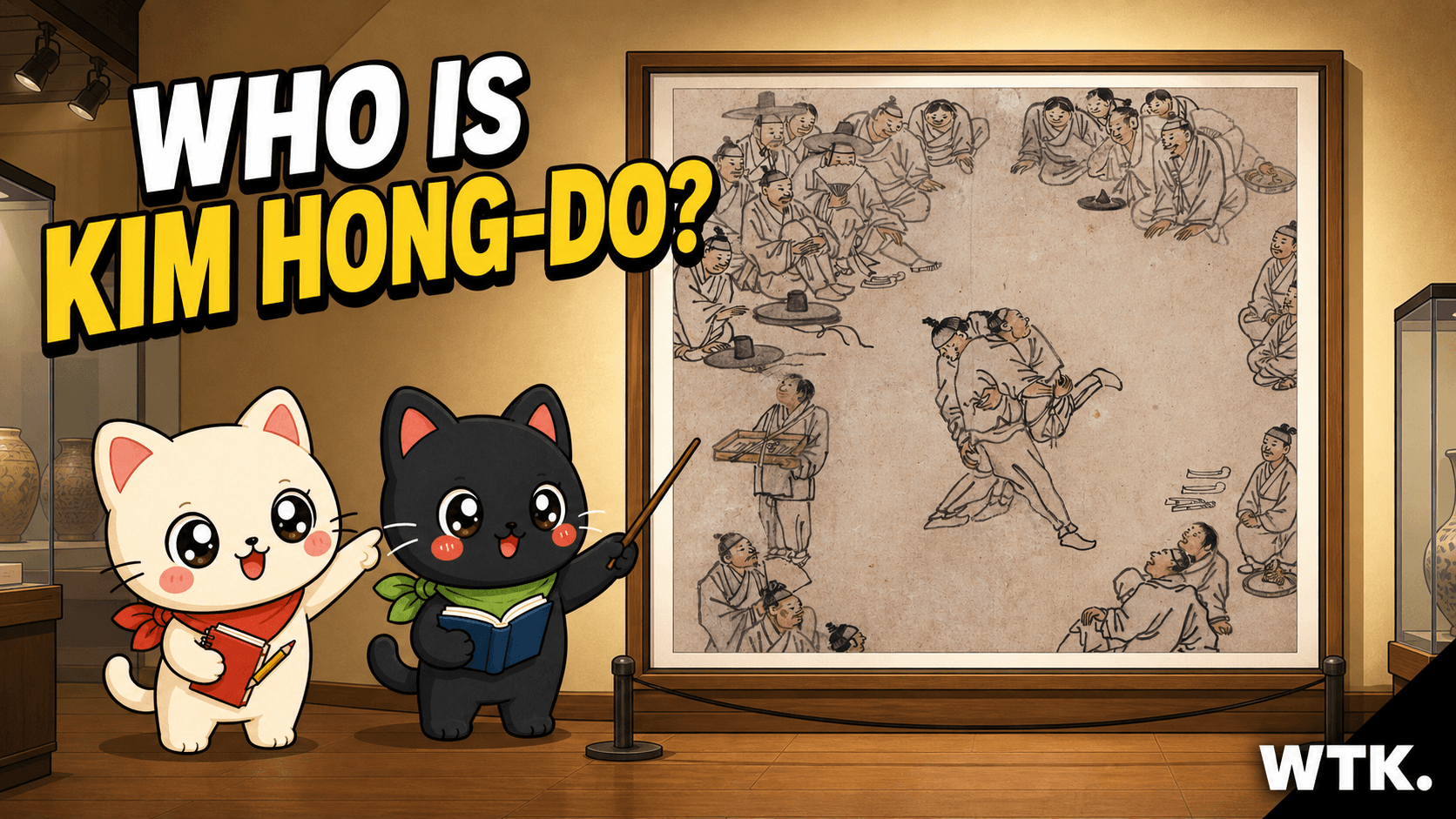
 Ssireum (씨름, Wrestling), from Kim Hong-do's Treasure-designated genre album.
National Museum of Korea collection — public domain.
Ssireum (씨름, Wrestling), from Kim Hong-do's Treasure-designated genre album.
National Museum of Korea collection — public domain.
Kim Hong-do's immortal works are his pungsokhwa (풍속화, genre paintings) — quick, warm, funny scenes of everyday Joseon life. The Treasure-designated Danwon pungsokdocheop album includes the two images every Korean grows up with: Ssireum (씨름), where a ring of spectators leans into a wrestling match — including one distracted snack vendor — and Mudong (무동), a boy dancing mid-leap to a folk band.
No kings. No idealized mountains borrowed from Chinese manuals. Just people — laughing, straining, showing off. In an era when "serious" art meant looking away from daily life, Kim Hong-do pointed straight at it and found it worth painting. That attention to work, performance, and spectators makes the paintings approachable to viewers who arrived through contemporary Korean popular culture. The connection is an interpretive bridge, not a claim that modern music videos descend directly from his work.
BTS's ARIRANG album and world tour build another bridge between contemporary fandom
and Korean heritage. Our guide to
what Arirang means explains why the name
represents not one fixed song but thousands of regional and historical variations.
What the RM connection proves—and what it does not
The museum's announcement proves two limited facts: it appointed RM as an ambassador, and his documented exhibition visit was part of that role. It does not, by itself, prove how many visitors came because of him. Attendance would require ticketing or visitor research that the cited announcement does not provide.
The defensible takeaway is about discovery. A fan may encounter Kim Hong-do through RM, then use the museum record to learn about the painter. That path resembles how a photocard guide can lead from collecting culture to questions about manufacturing and distribution: the pop-culture hook is the beginning of the research, not the evidence for every later claim.
How to read a Kim Hong-do genre scene
His best-known images reward slow looking because the story is distributed across a crowd. Start with the strongest action—the wrestlers in Ssireum or the dancer in Mudong—then follow the faces, hands, and empty spaces around it. Spectators lean, laugh, eat, play instruments, or look away. Those reactions tell you how the central event feels without a written caption.
Composition matters too. Kim often uses open paper as active space rather than filling every corner with architecture or landscape. A loose circle of figures can become an arena; a few diagonal bodies can imply rhythm. Clothing and posture help distinguish occupations and social roles, but the scenes should not be read as camera-like transcripts of one afternoon. They are composed works shaped by an artist’s observation, selection, and humor.
Kim Hong-do is more than the schoolbook album
Foreign introductions often reduce him to a “painter of ordinary people.” The museum record is broader: he worked within the royal painting bureau and produced landscapes, portraits, Buddhist subjects, flowers and animals, documentary images, and court commissions. Genre scenes are the easiest entry point, not his entire career.
That distinction also explains his historical importance. Kim Hong-do could operate inside an elite court system while giving visual attention to work, play, music, and public gathering. Modern viewers encounter late-Joseon society through those images, but responsible viewing keeps two ideas together: they contain valuable observations, and they remain artworks rather than neutral photographs.
How to see the work after the exhibition
- Do not use the old end date as a plan. Danwon Kim Hong-do: Painting an Era closed on August 10, 2026 after an eight-day extension. Its page is now useful as an exhibition record.
- Check before visiting. Search the National Museum of Korea's current exhibitions and collection display information. Works on paper may rotate for conservation.
- Research from abroad. Start with the museum's object page for Ssireum, then use its title, artist, material, and collection details to identify reliable reproductions.
- Keep a concert trip separate. If you are also planning a show, use our Korean ticketing guide for that logistics question rather than assuming the archived exhibition is still available.
A museum checklist for first-time viewers
Begin with the object label: title, approximate date, material, format, and collection. English translations of Korean titles can vary, so note the Korean title or accession information when you want to find the same work later. Look at scale before relying on a phone image; an album leaf, screen, hanging scroll, and documentary painting create different viewing experiences.
Then separate what is visible from what is interpretation. You can describe a figure’s posture, placement, clothing, or relationship to the crowd directly. Claims about identity, class, humor, or historical custom should be checked against the museum’s curatorial explanation rather than inferred from one detail. Genre paintings are rich evidence, but they do not represent every person or province in late Joseon.
If the temporary exhibition has ended, search the National Museum of Korea’s collection and exhibition archives rather than relying on an old travel post. Works may rotate for conservation, and an online image does not guarantee that the original is currently on view. Continue the wider heritage connection with our explanation of Arirang and BTS’s tour title, another case where a modern fandom doorway leads to a much older Korean tradition.
Sources
- National Museum of Korea: RM appointed global public relations ambassador
- National Museum of Korea: Kim Hongdo: Painting His Era exhibition details
- National Museum of Korea: Korean Traditional Wrestling collection record
- National Museum of Korea: curator's guide to the Album of Genre Paintings
- Encyclopedia of Korean Culture: Kim Hong-do biography (Korean)