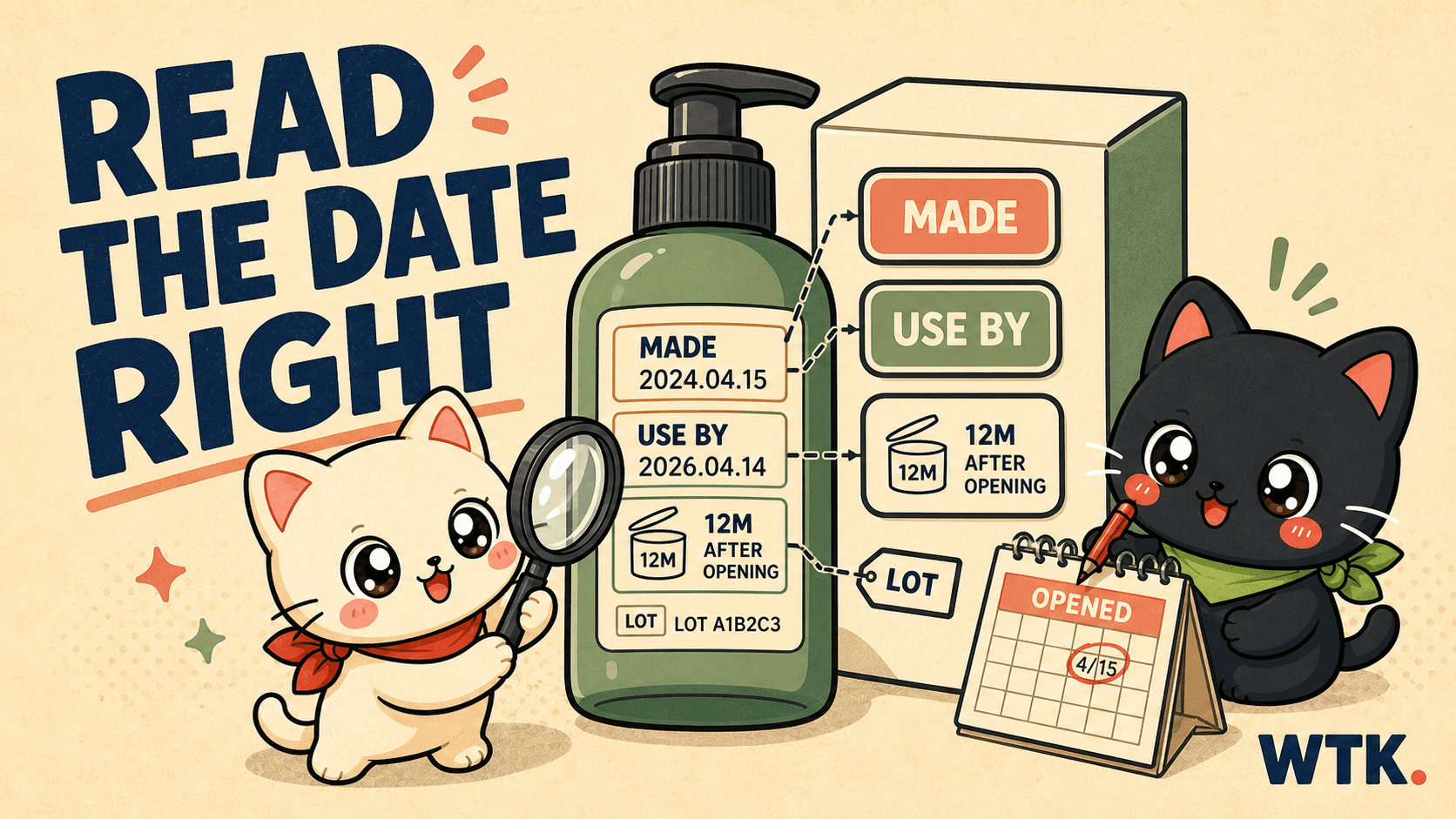
An online skincare listing can mention 36 months, 18 months, and 12 months without contradicting itself. The important question is what starts each clock: manufacture, dispatch, or opening. Here is a comparison of two COSRX product instructions, followed by a way to turn them into a usable note for your own bottle.
We checked the brand's Korean and U.S. storefronts on September 4, 2026. This is a comparison of manufacturer-published information, not an inspection of purchased packaging, a stability test, or a recommendation to buy either product.
One Korean listing contains three different promises
COSRX's Korean disclosure for Advanced Snail 96 Mucin Power Essence, 100ml gives three periods in the same field. Our breakdown keeps their starting points separate. See the brand's product information, under More Information.
| Published period | What starts the clock? | What it does not tell you |
|---|---|---|
| 36-month shelf life | The product's shelf-life basis, not your purchase | The exact expiry of the bottle you will receive |
| At least 18 months remaining when dispatched | The seller's dispatch date | Permission to use an opened bottle for 18 months |
| Recommended use within 12 months after opening | First opening | A new 12-month period each time you reopen it |
The practical result is that 18 months remaining at dispatch and 12 months after opening answer different questions. The first helps assess stock supplied by that Korean storefront; the second helps plan use once opened. Neither supplies a missing batch-specific date. Do not transfer the dispatch promise to another retailer.
The brand's U.S. Snail 96 page expressly describes its 36-month period as starting at manufacture and separately lists 12 months after opening. This cross-check clarifies the terminology; it does not prove that every market's bottle or every size has identical printing.
A second product changes the opening deadline
The U.S. page headed Advanced The Vitamin C 23 Serum lists 24 months from manufacture and two months after opening. Its storage FAQ specifies refrigeration at 3–10°C. Those are instructions for that named product and storefront, not a rule for all vitamin C skincare. COSRX product fact pack and storage FAQ.
Opening both products on the same day would therefore create different reminder dates. The following is our hypothetical calendar exercise, not dates read from a real batch. It assumes the relevant product instructions match the bottle and that no earlier printed deadline applies.
| Example opening date | Product instruction used | Calendar reminder from that opening |
|---|---|---|
| September 4, 2026 | Snail 96: 12 months | September 4, 2027 |
| September 4, 2026 | Advanced Vitamin C 23: 2 months | November 4, 2026 |
We added calendar months, not a blanket 30-day multiplier. These reminders are prompts to follow the product's instructions, not independent safety guarantees. If your pack expires sooner, do not use this exercise to extend it. If the pack and website disagree, ask the brand about the exact product and batch before relying on either calculation.
There is another reason to keep the physical pack: the Vitamin C page's size heading uses 20ml, while its fact pack uses 20g. We did not silently treat those units as equivalent or use them to calculate a daily dose. The inconsistency needs brand clarification if it affects your purchase. The same COSRX listing.
Read the word beside the number
These are our translations of useful Korean label terms, not a universal decoding system for every manufacturer's stamp:
제조연월일— manufacture year, month, and day. It tells you when something was made.사용기한— use-by period or deadline; inspect the accompanying date or instruction.개봉 후 사용기간— period of use after opening.개봉 후 12개월starts at opening.제조번호— manufacturing/batch number. A date-like substring is not enough to decode it.별도 표기— marked separately. Look for the location the package identifies.
The MFDS packaging guide lists the batch number separately from the use-by period or period after opening. That separation is why a batch code alone cannot answer the expiry question. MFDS cosmetic labeling items.
For an unreadable stamp, a useful message is: 이 표시가 제조일자인가요, 사용기한인가요? 개봉 후 사용기간도 알려 주세요. — “Is this the manufacture date or the use-by date? Please also tell me the period after opening.” This is our practice sentence, not a transcript of a customer-service reply. Attach clear pictures of the stamp and full product name, plus the retailer and market, rather than asking the brand to decode an isolated number.
Make one record for the bottle you actually own
Record the printed deadline, first opening date, stated opening period, and storage instruction together. Preserve the box or photograph its information before discarding it. An unopened backup and the bottle already on your shelf need separate records; moving the older product to a new container does not create a new first-opening date.
Storage is part of the instruction, not an optional extra. FDA explains that heat, moisture, contamination, and repeated exposure can affect cosmetic shelf life. Its consumer advice includes keeping containers clean and avoiding hot storage locations. FDA shelf-life guidance.
Missing U.S. date printing is not by itself proof of a fake product: FDA says ordinary cosmetics do not have a general expiration-label requirement. It distinguishes products regulated as drugs, including sunscreens, so do not extend that statement to every item sold in the beauty aisle. FDA's cosmetics-versus-drugs distinction.
If you are comparing shopping advice, our Olive Young and TikTok guide addresses a different question: where product attention comes from. Popularity cannot decode a batch or resolve conflicting directions. More label and shopping explainers are collected in K-Beauty.
Sources
Manufacturer pages were read on September 4, 2026. The examples are deliberately narrow: two products from one brand, using the named markets above. No original package photos, purchase records, manufacturer correspondence, or laboratory results were available. The comparison does not authenticate a product or assess its skincare benefits.