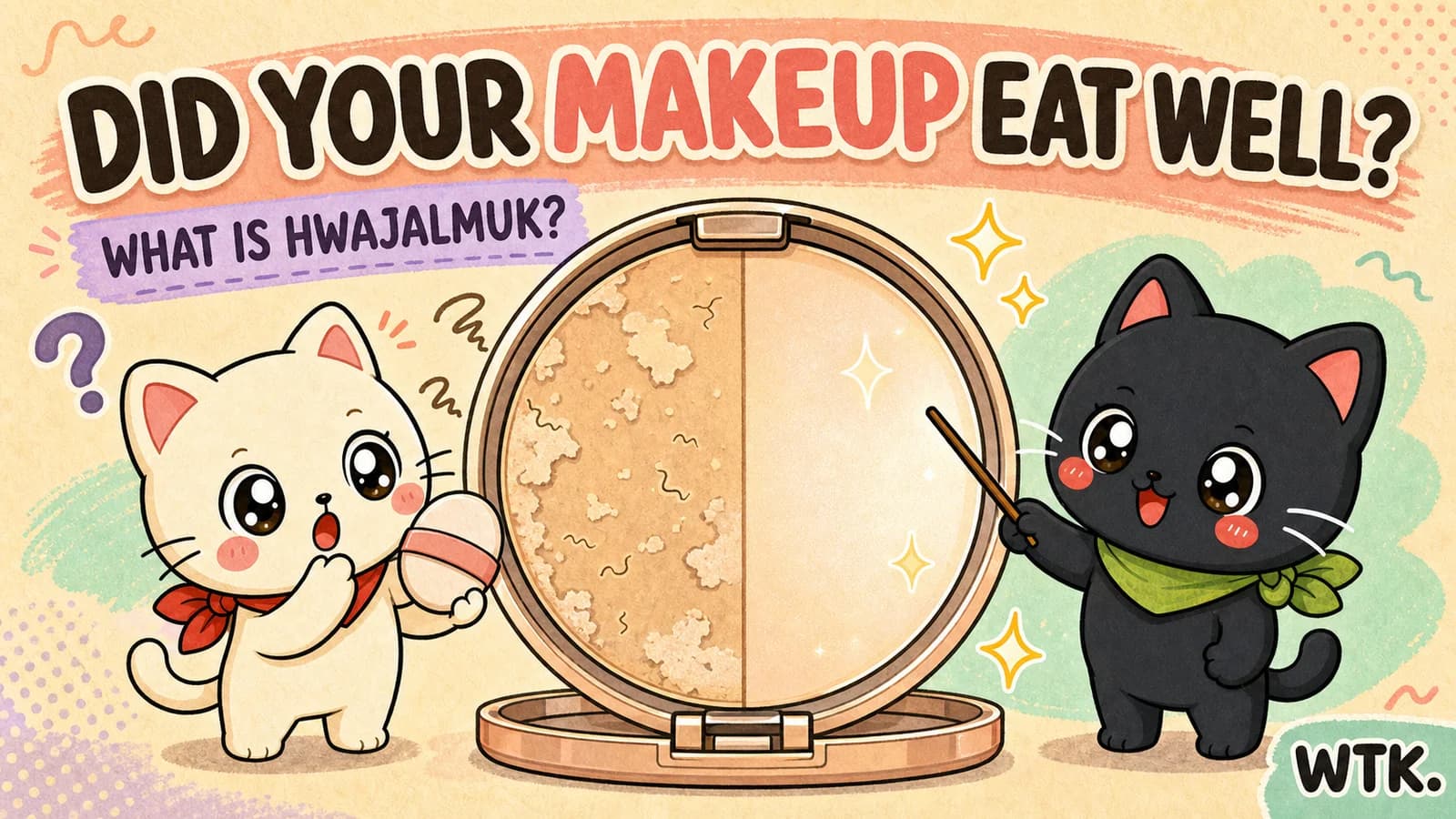
You finish your makeup, lean toward the mirror, and something miraculous has happened. The cushion is smooth. The concealer has not formed a tiny desert under your eyes. Your nose is not peeling. Your face looks like your face—just suspiciously well rested.
A Korean friend sees you and says:
오늘 화장 진짜 잘 먹었다!
Oneul hwajang jinjja jal meogeotda!
“Your makeup really took well today!”
Literally, however, they just said your makeup ate well.
Welcome to hwajalmuk (화잘먹), one of K-beauty's funniest and most useful words. It is not a product, technique, or skin type. It is the rare good day when your skincare, foundation, weather, sleep, and possibly the alignment of the planets decide to cooperate.
Hwajalmuk: when your makeup eats and leaves no crumbs
Hwajalmuk is internet-style shorthand:
- hwajang (화장) = makeup
- jal (잘) = well
- meokda (먹다) = to eat, take, or absorb
The full expression is hwajang-i jal meokda (화장이 잘 먹다), “makeup takes well.” The National Institute of Korean Language includes “makeup does not take well on the face” among its examples of the many extended uses of meokda. Korean can say that dye, oil, water, medicine, or even a bribe “eats” when it takes hold or has an effect.
So your face is not literally hungry. The phrase means the products have settled into the skin so naturally that they appear to belong there.
The opposite is hwajang-i an meokda (화장이 안 먹다): makeup refuses dinner. It sits on top, separates, catches on flakes, gathers in pores, or slides away before lunch. You can use a beloved foundation for months and still wake up to one of these betrayal days.
That unpredictability is why the phrase feels so satisfying. “My foundation performed according to specification” is not a celebration. “Today, my makeup ate!” is.
The five villains of a bad Korean base day
Korean beauty language has a surprisingly dramatic vocabulary for foundation failure.
| Korean expression | Literal feeling | What happened to your makeup |
|---|---|---|
| tteuda (뜨다) | to float or lift | Foundation sits above dry flakes instead of blending |
| kkida (끼다) | to get stuck | Product collects in pores, lines, or around the nose |
| millida (밀리다) | to be pushed | Layers pill or roll away when rubbed |
| muneojida (무너지다) | to collapse | The base breaks down through sweat, oil, or time |
| dakeoning (다크닝) | darkening | Foundation becomes duller or deeper after wear |
On a true hwajalmuk day, none of them gets the leading role. The base is thin but even, skin texture is still human, and light reflects without turning the face into a glazed doughnut.
This explains why hwajalmuk is different from glass skin. Glass skin is an ideal finish associated with intense hydration and translucency. Hwajalmuk is a relationship status: your makeup and your skin are getting along today. Matte makeup can eat well. Dewy makeup can fail spectacularly.
Why Korean makeup starts before the makeup
Korean base makeup often aims to look thin, close, and skin-like. The less coverage you use, the more the condition underneath matters. A thick layer can hide some unevenness; a thin cushion layer politely reveals every dry patch you forgot existed.
That is why Korean beauty content treats seukin peurep (스킨 프렙, skin prep) as part of makeup rather than a completely separate skincare hobby. In 2026, Korean beauty coverage increasingly used “hwajalmuk prep” for products and routines designed to smooth texture, add appropriate moisture, and help makeup adhere through heat and humidity.
The basic logic is not mysterious:
- remove loose flakes without attacking the face
- add enough hydration that the base does not catch
- let skincare settle instead of applying five wet layers at once
- use less base product than your panic suggests
- press and build only where coverage is needed
There is no compulsory ten-step ritual. In fact, too much skincare can cause millim (밀림, pilling or product rolling). A watery toner, suitable moisturizer, sunscreen, and enough waiting time may create a better base than an ambitious tower of seven serums.
This is the gentle side of the same Korean “step zero” culture behind Reedle Shot and spicule skincare. One trend uses a prickly booster; the casual everyday goal is simply getting the next layer to behave.
The night-before ritual: sheet mask or superstition?
Have an interview, wedding, first date, passport photo, or morning when you absolutely cannot look like a croissant? Korean beauty logic says the mission begins the night before.
The classic move is a moisturizing sheet mask followed by a familiar cream. The goal is not to transform the face overnight. It is to avoid waking up excessively dry, irritated, or tempted to perform an emergency peel at 7 a.m.
The funniest part is how quickly reasonable preparation becomes ritual:
- the sheet mask that is “the only one my makeup respects”
- the pillow position believed to prevent morning puffiness
- the forbidden late-night ramyeon because tomorrow's face “will know”
- the ice roller waiting in the refrigerator like emergency equipment
- the cushion puff washed with more care than some people's dishes
Do all of these guarantee hwajalmuk? Absolutely not. But they create a sense that tomorrow has been negotiated with.
The most reliable rule is boring: do not introduce a harsh new product before an important day. A trending acid, retinoid, PDRN mask, or spicule serum can wait. Our PDRN guide explains why a fashionable headline ingredient is never more important than the finished formula your skin already tolerates.
A five-minute hwajalmuk rescue
It is 8:12 a.m. Your foundation is floating. You need to leave at 8:17. This is not the time for a new skincare philosophy.
Try the Korean-base emergency sequence:
- Stop adding foundation. More product usually gives the problem more employees.
- Lift the worst patch gently. Use a clean damp puff or cotton swab rather than sanding it with a finger.
- Add a pinhead of moisturizer. Tap only onto the dry area and give it a moment.
- Reapply a tiny amount. Press from the edge of the missing patch inward.
- Powder strategically. Set the places that move or shine, not every square millimeter by default.
If the entire base is pilling, wiping off the affected zone and rebuilding one thin layer is faster than trying to glue the crumbs back onto your face. Sometimes the most advanced K-beauty technique is accepting defeat early.
How to use hwajalmuk without sounding like a textbook
The phrase is casual, friendly, and perfect for messages, beauty videos, and mirror self-talk.
Talking about yourself
오늘 화장 잘 먹었다.
Oneul hwajang jal meogeotda.
My makeup took well today.
Short caption
오늘 화잘먹!
Oneul hwajalmuk!
Good makeup day today!
Complimenting a friend
오늘 베이스 진짜 잘 먹었네.
Oneul beiseu jinjja jal meogeonne.
Your base looks really good today.
When the universe says no
오늘 왜 이렇게 화장이 안 먹지?
Oneul wae ireoke hwajang-i an meokji?
Why won't my makeup cooperate today?
Use it when makeup is actually part of the conversation. Announcing “your makeup ate well” to someone who is not wearing makeup may create a different Korean phrase: gapbunssa (갑분싸)—the atmosphere suddenly becomes awkward. The awkwardness will be real even if your pronunciation is not perfect.
Hwajalmuk is a tiny phrase with an entire K-beauty worldview inside it. Good makeup is not only the expensive cushion or the skill of the hand. It is the moment when skin condition, preparation, texture, weather, and product layers briefly agree to become a team.
Enjoy it when it happens. Take the selfie immediately. Tomorrow, your foundation may decide it is fasting.
Diagnose the layer before replacing the product
When base makeup fails, record where it fails and when. Pilling during application points to layer
compatibility or excess product; separation around the nose later in the day may involve oil,
movement, or rubbing; tight flakes suggest a different problem from surface shine. Change one
variable—skin-prep amount, drying time, tool, foundation quantity, or setting product—and compare
under the same light. 화잘먹 describes the successful appearance, but this simple test turns the
slang into a useful troubleshooting method instead of an excuse to buy an entirely new routine.