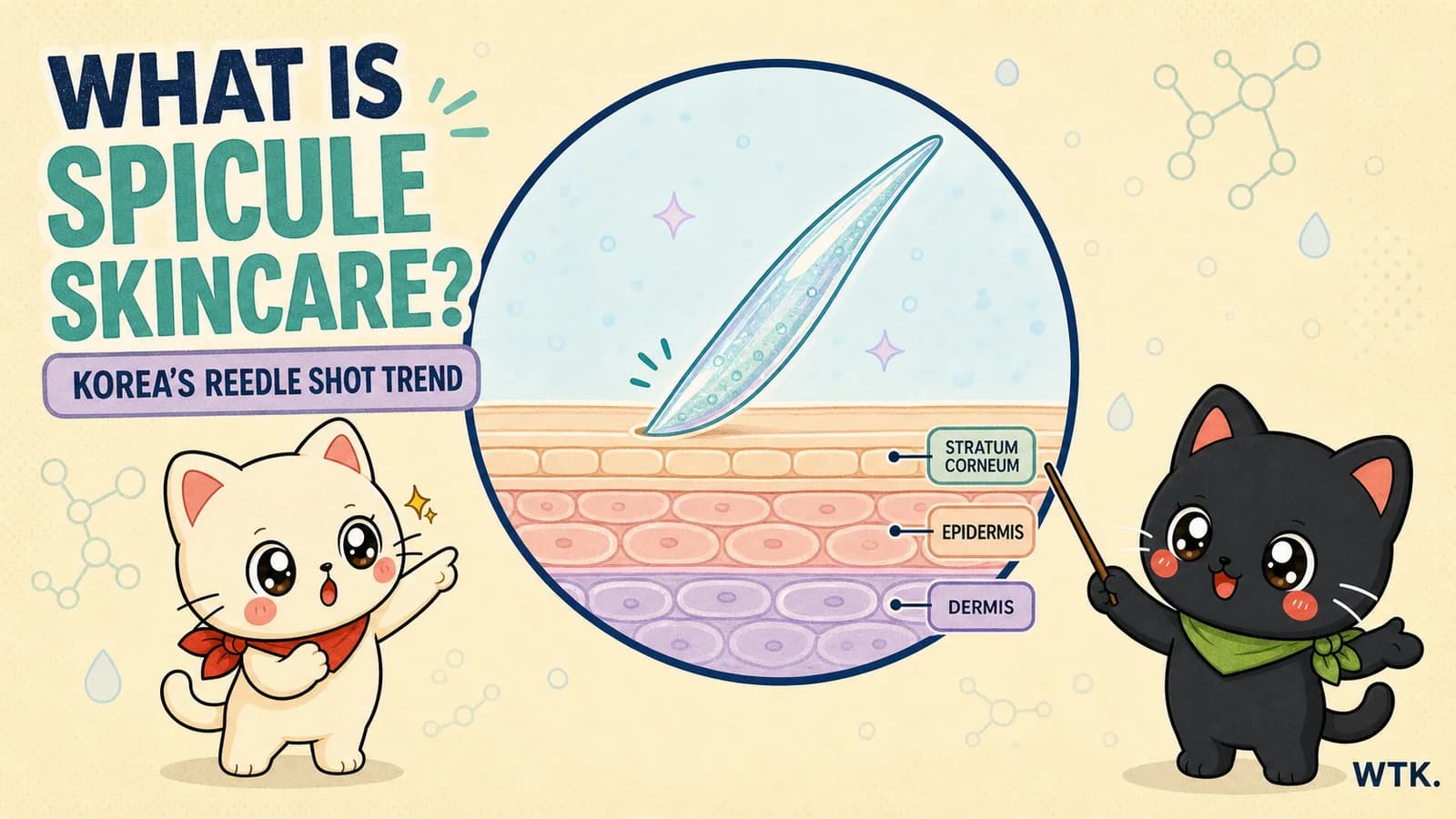
In Korea, a prickly face serum escaped the beauty counter and became an everyday shopping item. Reedle Shot moved through Olive Young, Daiso, TV home shopping, and even CU convenience stores. Its tiny particles inspired PDRN versions, retinol versions, masks, hair products, and color-coded mini products for different skin concerns.
That distribution story explains more than the phrase “liquid microneedling” ever could. Reedle Shot became a Korean hit because it connects three worlds that Korean consumers already understand: the dermatologist's skin booster, the carefully ordered home routine, and the thrill of finding a technical product at an ordinary neighborhood shop.
Spicules are the technology. Korea's beauty culture turned them into a habit.
Reedle Shot translated the Korean clinic into home care
Korean beauty shoppers are familiar with seukin buseuteo (스킨부스터, skin booster), a broad retail and clinic term for something intended to improve skin condition or help other care work better. In a clinic it may refer to an injectable or device-assisted procedure. At the cosmetics counter it can mean the first product used after cleansing.
Reedle Shot sits directly between those meanings. It borrows the technical language of microneedles and absorption, but packages the experience as homkeeo (홈케어, home care): open the bottle, massage a small amount onto clean skin, feel an immediate prickling sensation, then finish the routine yourself.
That was a powerful translation. A clinic procedure requires an appointment, money, recovery planning, and professional judgment. A cosmetic booster can be tried tonight. It offers the feeling of advanced care without asking the customer to learn a complicated device or perform an actual medical procedure.
The result is recognizably Korean not because spicules exist only in Korea—they do not— but because Korean brands are unusually fast at converting professional beauty language into a low-friction daily format. The same clinic-to-counter movement now drives PDRN skincare, exosome-inspired products, peptide ampoules, and barrier-recovery masks.
The real Korean goal is pibu-gyeol, not pain
International coverage often focuses on the shock value: people are voluntarily rubbing tiny sharp particles onto their faces. Korean product language focuses on a quieter word, pibu-gyeol (피부결, skin texture).
Pibu-gyeol is how smooth, even, hydrated, and orderly the skin surface appears. It matters with no makeup, but it also affects whether foundation sits cleanly instead of catching on dry or uneven areas. Korean beauty slang calls a good makeup day hwajalmuk (화잘먹), short for hwajang-i jal meokda (화장이 잘 먹다)—makeup “takes” or applies well.
This makes a texture-focused booster easy to understand. It does not need to promise a dramatic new face. It promises that tomorrow's skin and makeup may behave a little better. That practical, repeatable goal fits Korea's preference for condition management: hydrating before makeup, calming after irritation, and adjusting the routine to how the skin feels that day.
The prickling sensation adds instant feedback. Most moisturizers ask users to wait weeks and trust the label. A spicule product announces itself immediately. That sensation can make the technology feel visible—“I can feel it doing something”—and makes the experience easy to describe in a short review or video.
But feeling is not efficacy. Stronger prickling does not prove deeper repair, more collagen, or better absorption. Korea's Reedle Shot boom is partly a story of excellent sensory design; consumers should not turn discomfort into a performance score.
How Olive Young, Daiso, CU, and home shopping built the boom
The most Korean part of the story may be where the product was sold. Instead of remaining a premium specialty serum, Reedle Shot became available at several price points and in several shopping situations.
VT's company-reported 2025 second-quarter investor materials show how wide the ladder had become:
| Korean channel | Company-reported presence in mid-2025 | What the channel did |
|---|---|---|
| Olive Young | 38 SKUs across 1,770 stores | Made the full line visible and comparable inside Korea's dominant health-and-beauty chain |
| Daiso | 7 SKUs across 1,351 stores | Turned a technical serum into an inexpensive trial and impulse purchase |
| CU convenience stores | About 20 SKUs across roughly 3,500 stores | Put mini, color-coded beauty beside drinks and daily necessities |
| TV and mobile home shopping | 22 broadcasts in the second quarter | Sold demonstrations, explanations, and sets rather than a silent bottle |
These figures come from the company, not an independent retail audit, and describe the 2025 rollout rather than today's exact store inventory. They still reveal the strategy: do not make one customer climb to the premium product; bring the concept down through every shopping layer.
Daiso was especially important because trial size changes the risk calculation. A shopper curious about a strange prickly serum does not have to commit to a full bottle. Olive Young then provides the larger product, related versions, reviews, promotions, and staff visibility. Home shopping demonstrates the routine to viewers who want more explanation. CU catches commuters, young shoppers, and foreign tourists with portable versions.
By late 2025, Reedle Shot 100 had been recognized in both Olive Young and Daiso year-end lists, according to Korean cosmetics trade coverage. What began as a hero serum had become a product ecosystem. This same channel-hopping behavior helps explain why Korea turns shopping into entertainment: discovery, trial, collecting, and social proof are designed into the retail experience.
Why the numbers 50, 100, 300, and 700 worked
Korean consumers did not encounter a single bottle. They encountered a visible ladder. Numbers such as 50, 100, 300, and 700 sort the same basic idea into beginner, daily, and more intensive tiers within the brand's system.
That is clever product education. “Spicule concentration, particle geometry, and barrier disruption” sound difficult. “Start at 50 or 100; move higher only if appropriate” sounds like a level system. The shopper immediately knows where to enter and what might come next.
The ladder also creates conversation. Users compare which number they tolerate, how often they apply it, and what they put on afterward. Each new tier becomes both a product and a story about experience. It resembles the step-up structure found in spicy Korean foods: the number gives people an identity and a challenge, even when intensity is not the same thing as quality.
There is one crucial limitation: the numbers are not a scientific unit. They should not be compared across different brands, and a larger number should not override the frequency and warnings on the actual package. Buying every strength at once defeats the purpose of a gradual system.
From one serum to a Korean beauty platform
Once Korean shoppers understood “Reedle Shot,” the name could carry many other ideas. The line expanded from its original cica-centered booster into versions associated with PDRN, retinol, collagen, brightening, hydration, masks, lip products, and hair care.
This is more than ordinary flavor expansion. Spicules turned into a delivery platform: the “reedle” supplies the recognizable sensation and technical story; a second ingredient supplies the new skin concern. Someone who already understands the first bottle needs less education for the next one.
Color coding made the system even easier in Korean convenience retail. CU introduced mini Color Reedle Shot products framed around concerns such as calming, moisture, or brightening. The customer could shop by color and concern rather than reading a laboratory explanation under fluorescent convenience-store lights.
The expansion also matches Korea's fast product cycle. A hero item rarely remains alone. It becomes a line, a limited set, a small format, a mask pairing, a pop-up demonstration, and a tourist souvenir. Foreign visitors looking for this kind of launch culture can use our guide to finding Seongsu beauty pop-ups.
What the spicule science does—and does not—prove
The cultural story would not have lasted without a plausible mechanism. A spicule is a microscopic needle-like structure. Many research systems use purified silica skeleton elements from freshwater or marine sponges. When massaged across skin, they can physically disrupt parts of the outer barrier and increase delivery of another material.
A 2022 study using porcine skin and laboratory diffusion systems found that natural spicules improved dermal delivery of a model ingredient. Other preclinical studies have also shown dose-dependent barrier disruption and increased movement of molecules that normally cross skin poorly.
That proves the delivery idea is plausible. It does not prove that every retail serum shrinks pores, treats scars, or reproduces a clinic procedure. A 2025 study of a specialized secretome-coated spicule system included a small single-arm human evaluation, but it had no control group and did not test every commercial Reedle Shot formula.
Professional microneedling is also not the same thing. It uses a sterile device with organized metal needles and a controlled depth. Spicule cosmetics distribute particles through a formula at varied angles and depths. “Liquid microneedling” is a useful nickname, not clinical equivalence.
In 2026, dermatologists writing in the Journal of the American Academy of Dermatology raised concerns about hidden risks from cosmetic silica spicules, including possible foreign-material reactions. The publication was an editorial warning, not a study of how often injury occurs. It is a reminder that better delivery can also mean better delivery of an irritant—and that long-term commercial-product safety data remain limited.
A foreigner's guide to buying Reedle Shot in Korea
If you want to try the trend while visiting Korea, treat the country's enormous selection as a reason to slow down.
- Start with one low-intensity product. A Daiso or official mini size can be a lower- commitment trial, but it is still an active cosmetic experience.
- Buy from an authorized channel. Official brand shops, Olive Young, Daiso, and the named convenience-store collaboration reduce uncertainty about storage and authenticity.
- Read the exact Korean or translated label. Do not copy the frequency for “100” onto “300” or assume another brand's numbers mean the same thing.
- Use it alone at first. Do not immediately stack acids, a strong retinoid, a scrub, another spicule product, or an absorption-enhancing device.
- Avoid wounded or recently treated skin. The official product instructions warn against use with beauty devices, immediately after dermatology procedures, and on wounded areas.
- Stop if the response escalates. Brief mild prickling may be expected; strong burning, swelling, hives, or persistent redness is not a challenge to complete.
A gentle cleanser, familiar moisturizer, and broad-spectrum sunscreen remain more important than a novelty booster. People with active eczema, rosacea flares, a damaged barrier, or a history of severe reactions should consult a qualified dermatologist before experimenting.
Reedle Shot is Korean content not because Korea invented every microscopic silica particle. It is Korean because the country built a complete culture around the product: clinic language translated into home care, pibu-gyeol turned into a daily goal, numbered levels turned into social conversation, and one strange serum distributed from prestige beauty aisles to the convenience store downstairs.
That is the real K-beauty innovation. The technology matters—but the system that made millions of people willing to try it matters even more.
A safe comparison between numbered products
Do not treat 50, 100, 300, or 700 as a universal concentration scale across brands. First confirm what the manufacturer says the number represents, the instructed frequency, the amount per use, and the areas to avoid. Compare products only after matching those conditions. Record tingling, redness, swelling, and how long discomfort lasts rather than calling every sensation “working.” Avoid introducing another strong active on the same day, and stop following social-media technique if it conflicts with the product label. Persistent pain or a significant reaction belongs with a qualified health professional, not a higher-number challenge.
Sources
- VT — 2025 second-quarter investor relations report (Korean; company-reported channel data)
- VT Cosmetics — Reedle Shot 100 official instructions and cautions
- Kyunghyang Shinmun — Reedle Shot expands into CU convenience stores (Korean)
- CMN — 2025 Korean cosmetics awards and Reedle Shot retail performance (Korean)
- PubMed — A novel dermal delivery system using natural spicules
- PubMed — Nano-encapsulated spicule system: preclinical and single-arm evaluation
- PMC — Enhanced skin delivery of therapeutic peptides using spicule systems
- PubMed — Hidden risks behind cosmetic silica spicules