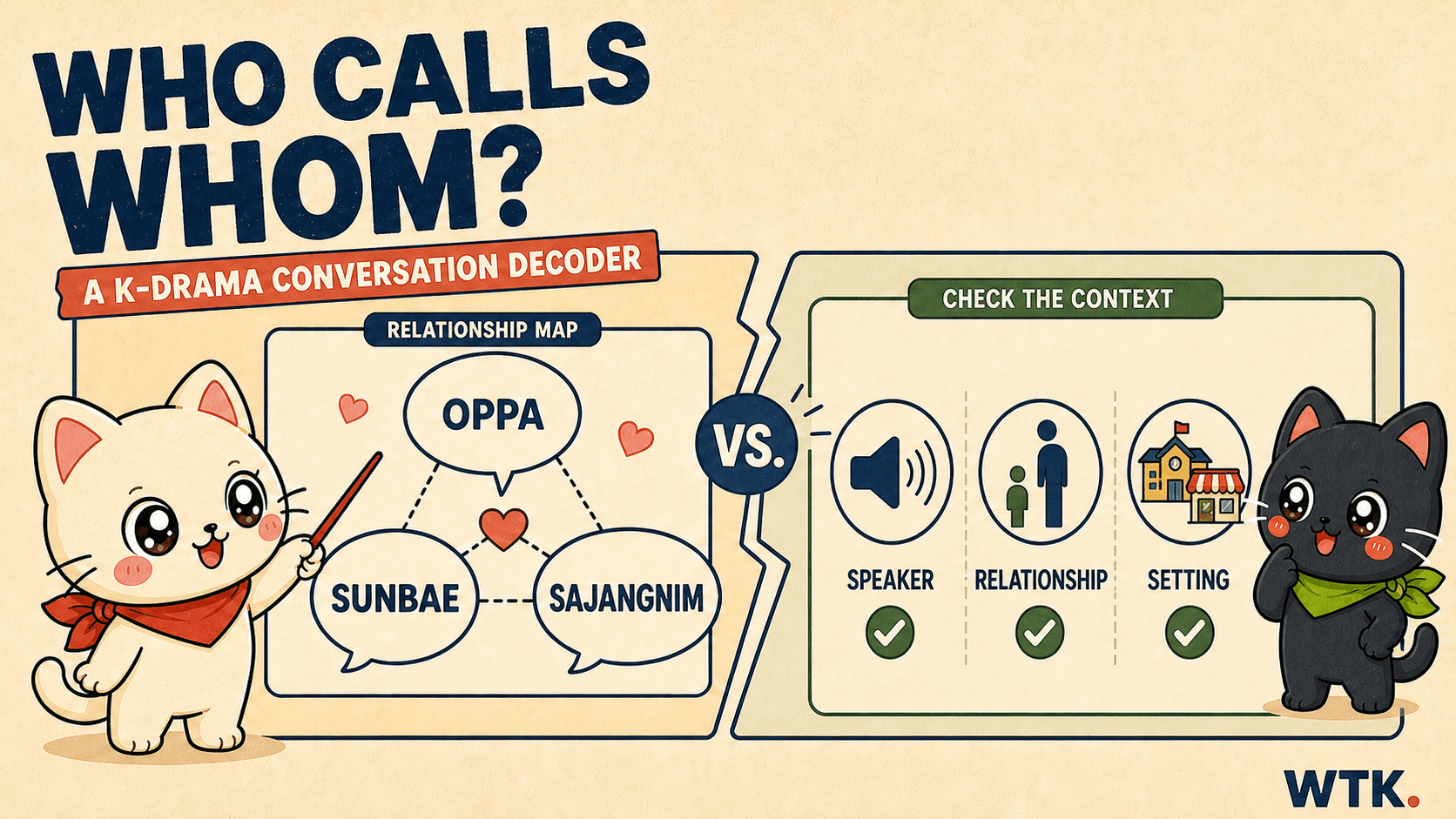
Does oppa mean boyfriend? Is a sunbae necessarily older? Does sajangnim prove that someone runs a company? The useful answer starts with a smaller question: who is calling whom, and which relationship is already established?
Below, we compare the National Institute of Korean Language's dictionary entries with explicitly fictional situations, then test the job-title assumption against an official survey. These are reading exercises, not transcripts from a drama or a claim that every Korean speaker makes the same choice.
Oppa: the missing fact is the relationship
The dictionary gives 오빠, oppa, two relevant senses: a female speaker's older male sibling or cousin, and an affectionate way for a female speaker to address an older male. The second definition is not restricted to a boyfriend. NIKL: 오빠, senses 1–2.
Consider our invented line: “오빠, 이 사진 좀 봐요.” Our English rendering is “Have a look at this photo.” We deliberately leave the address out of that translation so that the missing relationship becomes visible.
| Fictional speaker and listener | Background supplied in this exercise | What the address can establish here |
|---|---|---|
| A 22-year-old woman → a 29-year-old man | They are siblings | The kinship sense fits; translating it as “boyfriend” would contradict the stated relationship |
| A 22-year-old woman → a 29-year-old man | They are familiar friends who already use this address | The affectionate non-kin sense fits; nothing in the line establishes whether they are dating |
The ages, people and relationships are invented. The exercise holds the words and ages constant while changing one fact: kinship. This is why the term alone cannot settle the relationship. In a drama, look for an explicit introduction, family connection or other scene evidence before adding a romantic interpretation.
Nor does oppa automatically mean the speaker has switched to casual sentence endings. The dictionary itself supplies “오빠! 그동안 잘 지내셨어요?”, combining the address with a polite ending. That is a dictionary example, not our dialogue or a quotation from television. NIKL example under sense 2.
Sunbae: age and entry order are different facts
For 선배, sunbae, the Korean entry first describes someone who started in the same field earlier and is ahead in experience or standing. Its school sense describes someone who entered the same school earlier. NIKL: 선배, senses 1–2.
There is a useful translation warning on that very page: the Korean school definition says 입학한, meaning “entered,” while the English definition says “graduated.” Those are different events. We follow the Korean wording here; graduation order is not the criterion supplied by that Korean definition. Compare the two language panels, sense 2.
Our fictional workplace example separates the two timelines. A is 30 and joined in 2022; B is 35 and joined in 2025. If B says “선배님, 이 파일 좀 봐 주세요.” to A—our rendering: “Could you look at this file?”—the younger person is the earlier joiner. This is not just a reversed-age puzzle: in an August 18, 2026 answer to a question about a 30-year-old earlier hire and a 35-year-old later hire, NIKL explicitly accepted sunbae for the younger earlier hire. That answer addresses the stated situation, not every workplace's preferred etiquette. NIKL Online Q&A.
The suffix -님, -nim, adds an honorific meaning to certain position or status nouns. That explains the form sunbaenim; the suffix alone cannot prove sincere admiration or a character's private feelings. NIKL: -님, sense 1. If the scene instead hinges on formal corporate rank, use our separate guide to bujang and Korean company titles.
Sajangnim: check who is addressing whom
The dictionary defines 사장님, sajangnim, as an honorific form for the head of a shop or company. Its English heading is “president”; that is a dictionary gloss, not proof of the listener's legal job title. NIKL: 사장님.
A survey supplies a useful counterexample to reading every occurrence as a job description. NIKL's 2022 Survey of Korean Language Use, published in 2023, asked how a shopkeeper addresses the respondent as a customer. The weighted response share for sajangnim was 26.7%. This is the shopkeeper → customer direction, not customers calling the owner sajangnim. NIKL report, question 7, printed pp. 73–74.
Despite “2022” in the title, its 2,000 respondents aged 20–69 were interviewed through household visits from January 2 to February 7, 2023. Percentages were weighted. They are reported answers, not the share of shop conversations recorded by researchers. The report also warns that the shop and shopkeeper's age imagined by respondents can affect this question's answers. It does not establish a 2026 usage rate or tell us how a particular actor intends a line. NIKL report: method pp. 3, 23; limitation p. 248.
For a scene, the practical distinction is therefore address versus verified role. If a shopkeeper says sajangnim to someone browsing, do not invent a company biography from the word. Check the speaker's role and any independently established occupation first.
Our two-line translation experiment
Here is a second invented situation: a woman and an older man are already familiar university friends, and he entered their university earlier. We write two alternative lines, changing only the address. They are not a before-and-after scene from a show.
| Our Korean line | Our deliberately identical English rendering | Relationship selected by the address |
|---|---|---|
| 선배님, 같이 가요. | Let's go together. | Earlier university entry, with the honorific suffix |
| 오빠, 같이 가요. | Let's go together. | Familiar older male, from this female speaker's perspective |
The rest of the sentence stays the same. The two readings follow the dictionary senses above; we, not a streaming platform, have chosen to omit the address in English. This demonstrates one possible loss of information in translation, not how frequently professional subtitles do it. It also does not establish a romantic confession: both lines fit the background we supplied.
When watching an actual episode, keep the audible address, the established relationship and the subtitle as separate observations. If only the address changes, ask what additional scene evidence supports a new relationship. These exercises are not permission to call an unfamiliar person oppa. For more context-focused reading, browse the K-drama guide collection.
How this guide was researched
We checked the linked Korean and English dictionary panels, the case-specific NIKL answer and the original survey PDF on September 4, 2026. Dictionary meanings, survey answers and our invented examples have different jobs here: definitions bound the readings; the survey challenges a literal job-title inference; the examples let readers compare the same words under stated conditions.
We did not analyze an episode sample, interview speakers, audit a subtitle service or test these lines in conversation. The examples cannot establish usage frequency, intonation, a character's intentions or what any particular person wishes to be called. The cover is a mascot illustration, not evidence of field research.
Sources
- National Institute of Korean Language, Korean–English Learners' Dictionary: 오빠, 선배, -님, 사장님.
- National Institute of Korean Language, Online Q&A on an earlier but younger colleague, answered August 18, 2026.
- National Institute of Korean Language, 2022 Survey of Korean Language Use, published 2023. See the attached report's printed pp. 3, 23, 73–74 and 248. Survey figures attributed to NIKL; comparison examples and English renderings are our own.