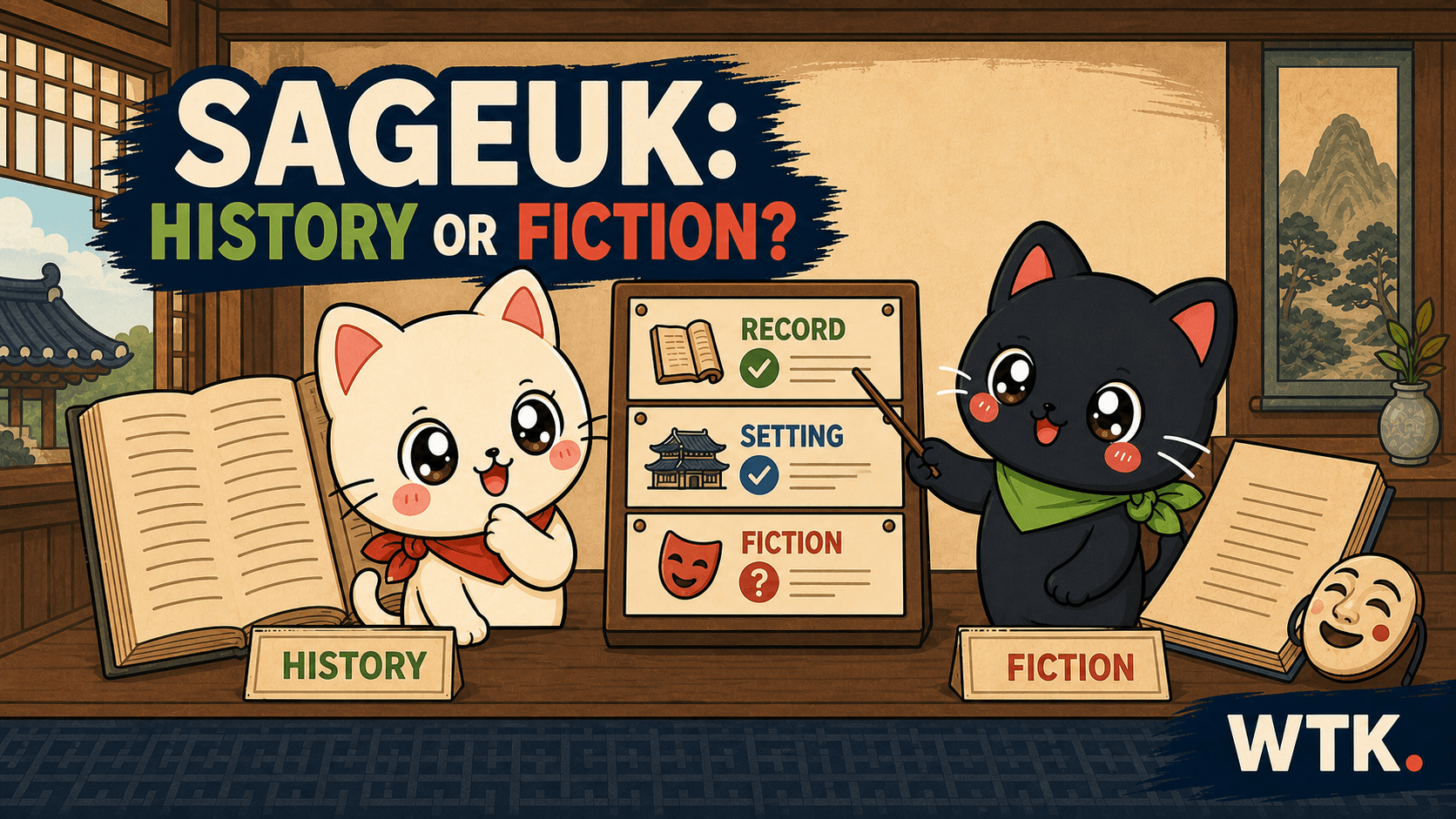
A king signs a death order. A crown prince escapes the palace. A court lady overhears a conversation that changes the dynasty. Which part is history?
The useful answer is rarely “all of it” or “none of it.” A Korean historical drama can place a documented ruler inside a carefully researched palace and still invent the private conversation that drives the episode. This guide offers a three-layer method for separating those elements without treating entertainment as a textbook—or dismissing everything on screen as fantasy.
What sageuk means
Sageuk (사극) combines sa (사, history) and geuk (극, drama). In everyday media use, it means a drama or film set in a historical period. The boundary is flexible. Some works reconstruct named rulers and political events; others borrow the clothes, institutions, and social constraints of an era for a largely invented story.
You may also see sidaegeuk (시대극), literally “period drama.” The two labels overlap, but sidaegeuk can emphasize an era or social period rather than famous court history. Neither word promises documentary accuracy.
Modern promotion often uses fusion sageuk (퓨전 사극). Korean Film Council writing on the genre describes how historical productions have mixed period settings with action, romance, comedy, fantasy, and contemporary storytelling. “Fusion” is therefore a clue about the work's creative contract: watch for the past as a designed setting and source of conflict, not as a scene-by-scene transcript.
That same genre mixing helps explain why supernatural beliefs appear so naturally in period stories. Our guide to ghosts and shamans in K-dramas separates religious history, folklore, and modern genre devices.
The three layers inside one scene
Instead of asking whether a whole drama is “accurate,” audit one claim at a time.
| Layer | What appears on screen | What you can verify |
|---|---|---|
| Recorded history | A named ruler, accession, war, law, execution, diplomatic mission, or office | Whether the person or event appears in contemporary records and when it occurred |
| Plausible historical setting | Palace hierarchy, clothing silhouette, title, ritual, food, housing, or travel constraint | Whether the institution or object existed in that period; details may vary by rank and date |
| Dramatic invention | Private dialogue, secret romance, composite villain, hidden identity, perfect coincidence | Usually the drama's own storytelling unless the production cites a source |
The layers can coexist in one minute. A real king may conduct a documented ceremony in a recreated hall, then speak words no surviving record preserves. The absence of a recorded conversation does not prove it happened, but it also does not make the documented ruler fictional. The correct conclusion is narrower: the dialogue is a dramatization.
Korean cinema sometimes uses the borrowed term faction—fact plus fiction—for this blend. That label should not be read as a percentage score. One plot can stay close to a chronology while freely imagining motives; another can invent every central character inside a well-researched material world.
Why the Annals matter—and what they cannot do
For Joseon stories, viewers often encounter the Joseon Wangjo Sillok (조선왕조실록), the Annals of the Joseon Dynasty. The official English introduction describes 28 chronological sets covering 25 rulers from Taejo through Cheoljong across 472 years. The records were compiled after each ruler's death from materials maintained by court historians. UNESCO lists the Annals in the Memory of the World register.
This is an unusually rich record, but “the Annals exist” does not mean every palace moment was recorded. The database is strongest for matters the state documented: court appointments, policy debates, ritual, diplomacy, punishments, weather, and events judged worthy of entry. It is not a camera in every room. Private affection, domestic routines, and the inner motive behind a public decision may remain inaccessible.
The National Institute of Korean History also provides databases beyond the Annals. Searching only an English character name can miss results, so record the Korean name, title, reign, and alternate romanizations. For art and everyday material culture, the Academy of Korean Studies encyclopedia and museum collection pages may be more useful. Our profile of painter Kim Hong-do demonstrates why an identified work and museum record are stronger than a repeated social-media caption.
A five-step fact-check while watching
1. Identify the show's claim
Write a complete, testable sentence: “Person X held Office Y in Year Z” is searchable. “The court was cruel” is an interpretation. Do not try to verify mood, costume, politics, and biography in one search.
2. Fix the period before the person
Note the dynasty, ruler, and approximate year. Korean royal names, personal names, temple names, and titles can refer to the same person in different contexts. A wang (왕, king), seja (세자, crown prince), and later posthumous royal name may all appear in subtitles.
3. Check the production's own framing
Read the official synopsis and opening or end cards. Does it say the work is inspired by a person, adapted from a novel or webtoon, or built around fictional characters? “Based on” is not “transcribed from.” Adaptation adds another creative layer, as explained in our guide to why K-dramas use webtoons.
4. Search an institutional source
Use the National Institute of Korean History database for dates, offices, reigns, and events; the Annals for Joseon court records; and museums or the Academy of Korean Studies for objects and customs. Search both the English romanization and Korean spelling. A fan wiki can suggest a keyword, but it should not be the final evidence for a disputed claim.
5. Classify the result honestly
Use one of four labels: documented, consistent with known context, invented by the production, or not established by the sources checked. The last category matters. A gap is not proof of either truth or falsehood.
Common signals of compression or invention
Historical television must turn decades, institutions, and large groups into readable episodes. These devices are reasons to check, not automatic errors:
- one villain appears to control decisions made by several factions
- travel between distant places happens without elapsed time
- a modern job title replaces several period-specific offices in subtitles
- a character witnesses every major event of a reign
- private romance supplies the only motive for a documented political decision
- clothing combines recognizable features from more than one decade or rank
- a fictional commoner has unrestricted access to the inner palace
Subtitles introduce another layer. A Korean title may be rendered as “Your Highness,” “Minister,” or a name so the scene reads naturally in English. The translation may communicate hierarchy without preserving the exact Korean office. Verify the Korean term before concluding that the production used the wrong title.
A better way to judge historical accuracy
A costume seam, a character biography, and a political chronology are different research questions. Score them separately:
- Chronology: Are named public events placed in the right reign and order?
- Institutions: Do offices, rituals, law, and rank relationships fit the period?
- Material setting: Are buildings, tools, food, and clothing plausible for this class and date?
- Declared invention: Does the show clearly frame fantasy, romance, or a fictional protagonist as creative material?
- Unsupported certainty: Does promotion or commentary present a private motive as settled history without a traceable source?
This approach leaves room for a fusion drama to succeed as fiction while still revealing where it borrows authority from the historical record. It also prevents one visible costume mistake from erasing otherwise careful work—or a beautiful palace set from proving an invented conspiracy.
The best starting habit is simple: pause on one proper noun, write the claim precisely, and locate it in an institutional source. A sageuk becomes more interesting when “real or fake?” turns into three better questions: What is recorded? What is plausible? What did the storyteller create?
Sources
- Korean Film Council — SAGEUK: Korea's longstanding historical-drama genre
- Korean Film Council — Faction: mixing historical fact and fiction
- National Institute of Korean History — Introduction to Korean historical records
- Annals of the Joseon Dynasty — English introduction
- UNESCO Memory of the World — Annals of the Choson Dynasty