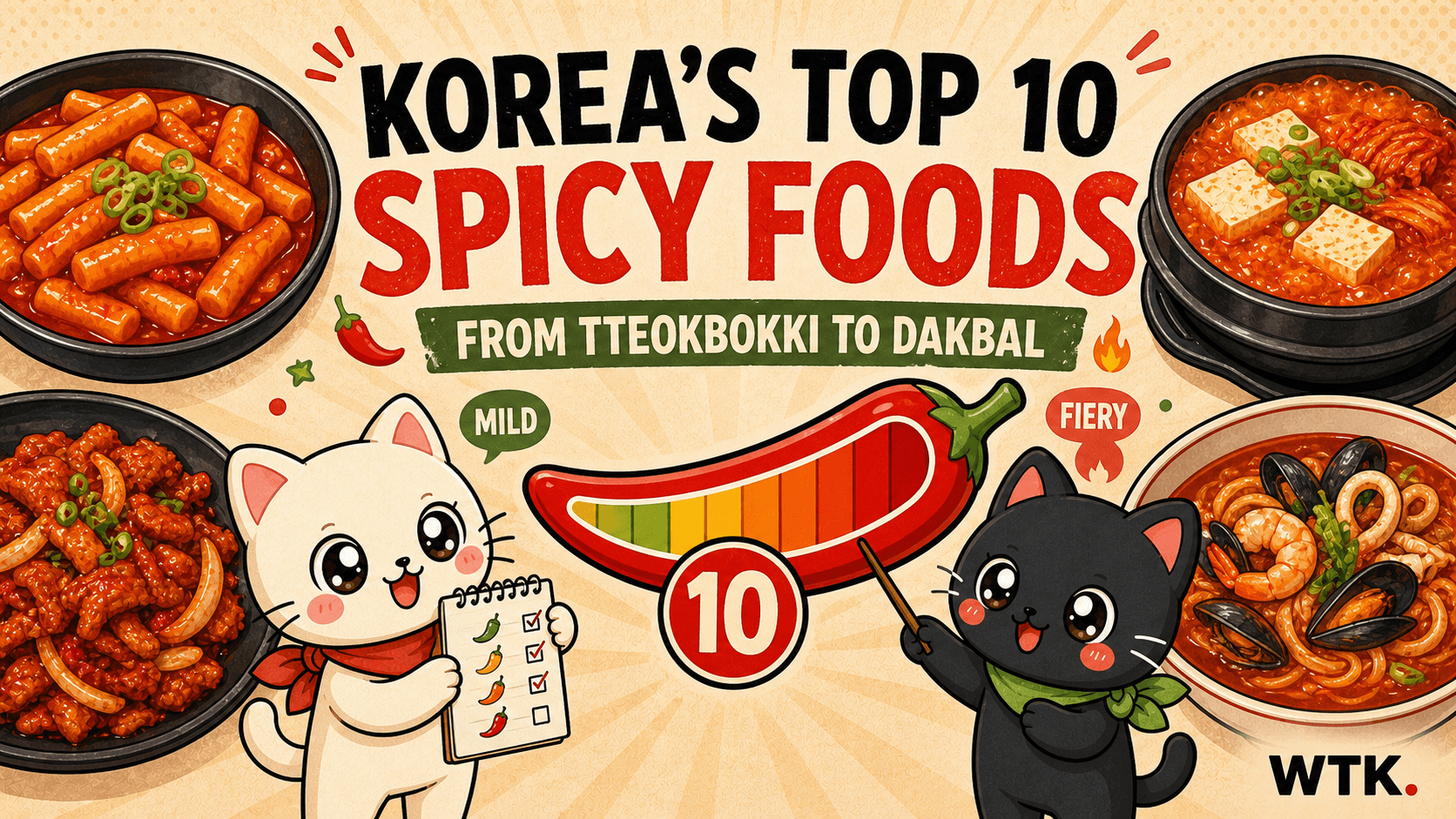
Korea's spicy-food reputation is deserved—but easy to exaggerate. Red sauces appear in street food, home cooking, late-night delivery, drinking food, convenience-store noodles, and regional specialties. At the same time, Koreans do not share one universal tolerance, and not every red dish is equally hot.
This list ranks ten spicy foods by a combination of everyday familiarity, nationwide recognition, cultural staying power, and how central chile heat is to the dish. It is not an official nationwide poll of spicy dishes. Korea Gallup's broad 2019 food survey placed kimchi jjigae first among favorite Korean foods, but no equivalent survey provides a definitive spicy-only top ten.
Think of this as the most useful tasting order—not a mathematical championship.
The top 10 at a glance
| Rank | Dish | Typical heat | Best first setting |
|---|---|---|---|
| 1 | Tteokbokki | Medium to extreme | Street-food shop or bunsik restaurant |
| 2 | Kimchi jjigae | Mild-medium to hot | Home-style restaurant with rice |
| 3 | Jeyuk bokkeum | Medium | Lunch set with rice and lettuce |
| 4 | Dakgalbi | Medium | Shared tabletop meal in Chuncheon style |
| 5 | Jjamppong | Medium-hot | Korean-Chinese restaurant |
| 6 | Spicy ramyeon | Medium to extreme | Convenience store or home |
| 7 | Jjukkumi bokkeum | Hot | Shared dinner with rice or noodles |
| 8 | Nakgopsae | Medium-hot | Busan-style shared hot pot |
| 9 | Dakbal | Hot to extreme | Late-night delivery or drinking meal |
| 10 | Maeuntang | Mild-medium to hot | Seafood restaurant after eating fish |
“Typical” is intentionally broad. One restaurant's level one can be another restaurant's level three.
1. Tteokbokki: Korea's spicy snack icon
Tteokbokki (떡볶이) combines chewy cylindrical rice cakes with a glossy red sauce usually built from gochujang, gochugaru, sweetness, and savory stock. Fish cake, boiled egg, green onion, cabbage, noodles, and fried snacks often join the pan.
Its popularity crosses generations. Schoolchildren buy it after class, adults associate it with childhood, and delivery franchises sell giant shared portions with adjustable heat. Korea.net describes it as a signature bunsik snack and notes how modern versions range from traditional red sauce to rosé, cheese, curry, black-bean, and soy-based styles.
The important warning is variation. Neighborhood tteokbokki can be sweet and gently warm; a franchise famous for extreme heat can feel like a chile challenge under the same dish name.
Beginner move: order sunhan mat (순한맛, mild), add boiled egg or cheese, and do not assume the lowest number means non-spicy.
2. Kimchi jjigae: the everyday favorite
Kimchi jjigae (김치찌개) is sour kimchi simmered with ingredients such as pork, tuna, tofu, onion, and green onion. It is red, deeply savory, and warming, but it is often less aggressively hot than its color suggests. Fermented acidity and umami can be more dominant than chile burn.
In Korea Gallup's 2019 open-response survey of 1,700 people aged 13 and older, kimchi jjigae ranked first among favorite Korean foods at 21 percent. That survey was not limited to spicy food, but it gives this stew the strongest direct popularity evidence on our list.
Beginner move: eat it with plain rice and tofu. Older kimchi makes a tangier stew, not automatically a hotter one.
3. Jeyuk bokkeum: spicy pork built for rice
Jeyuk bokkeum (제육볶음) is thinly sliced pork stir-fried with a red sauce commonly made from gochujang, gochugaru, garlic, soy sauce, and sweetness. It is a cafeteria, lunch-set, home-cooking, and office-district staple because it is fast, filling, and designed to be eaten with rice.
The pleasure is balance rather than pure pain: caramelized pork fat, garlic, onions, and sweet chile sauce. Wrap a piece in lettuce with rice for a cooler, more textured bite.
Beginner move: choose a set meal with rice, soup, and mild banchan instead of ordering extra sauce.
4. Dakgalbi: Chuncheon's shared spicy chicken
Dakgalbi (닭갈비) cooks marinated chicken with cabbage, sweet potato, rice cakes, and perilla leaves on a broad pan. The sauce is usually red and moderately spicy, while the vegetables release sweetness as they cook.
The dish is closely associated with Chuncheon. Korea.net notes that dakgalbi restaurants spread there by the 1970s as an inexpensive, filling meal for soldiers and university students. It remains a social food: diners share one pan and often finish by frying rice in the concentrated sauce.
Beginner move: ask whether cheese can cover one side of the pan and save room for the fried-rice finale.
5. Jjamppong: a red seafood noodle soup
Jjamppong (짬뽕) is a Korean-Chinese noodle soup with vegetables and often seafood or meat in a red, smoky broth. A hot wok gives cabbage and onion charred flavor before broth and chile seasoning enter.
Its spice hits differently from thick gochujang sauce: the hot broth carries chile across the mouth with every spoonful. Restaurants increasingly offer even hotter variants, but ordinary jjamppong already sits above many everyday stews.
Beginner move: share one bowl alongside non-spicy jjajangmyeon. Check seafood ingredients and allergens before ordering.
6. Spicy ramyeon: from pantry meal to fire challenge
Korean instant noodles range from gently warming soup ramyeon to concentrated fire-style stir-fried noodles. That range is why “Korean ramyeon” is not a useful heat prediction.
Products such as Buldak ramyeon turned extreme noodle heat into a global challenge, but Koreans also eat countless milder packets as quick meals. The spice level depends on the brand, flavor, sauce quantity, and whether the noodles are served with broth.
Beginner move: use part of the sauce packet, then add more. Cheese and egg change the experience, but they do not make an extreme product objectively mild.
7. Jjukkumi bokkeum: small octopus, serious heat
Jjukkumi bokkeum (쭈꾸미볶음) stir-fries small octopus with a strong red sauce. The octopus brings springy texture and seafood sweetness, while the sauce is often deliberately hot enough to encourage alternating bites of rice, bean sprouts, or steamed egg.
Restaurants may serve it on a hot plate with pork belly or let diners wrap it in perilla leaves. Fried rice commonly follows once the seafood is gone.
Beginner move: ask for the lowest heat level and confirm that “mild” is available; some specialty shops prepare one base sauce for every table.
8. Nakgopsae: Busan's bubbling trio
The name nakgopsae (낙곱새) compresses its three headline ingredients: nakji (octopus), gopchang (beef intestines), and saeu (shrimp). They simmer with vegetables, noodles, and red seasoning in a shallow pot associated especially with Busan.
It is rich as well as spicy. Gopchang contributes fat, seafood contributes sweetness and brine, and the sauce becomes more concentrated as the pot cooks. Diners spoon it over rice rather than treating it as a thin soup.
Beginner move: confirm the ingredients before ordering—this is not suitable for many seafood allergies or diners avoiding offal.
9. Dakbal: the late-night test
Dakbal (닭발) means chicken feet. The skin and connective tissue create a chewy, sticky texture that absorbs chile sauce. It may be served bone-in or boneless, grilled or saucy, and it is strongly associated with late-night delivery and alcohol.
Dakbal restaurants often make intensity part of the identity. Steamed egg, rice balls, and cool soup are not decorative sides; they give the diner breaks between bites.
Beginner move: boneless dakbal is easier mechanically, not necessarily less spicy. Do not make this your first Korean chile dish solely to prove courage.
10. Maeuntang: spicy soup after the fish
Maeuntang (매운탕) literally means “spicy soup.” Fish, radish, greens, mushrooms, and aromatics simmer in a chile-seasoned broth. At seafood restaurants, it often follows sashimi, using fish bones and remaining pieces to create the final hot course.
Compared with dakbal or extreme noodles, maeuntang may be moderate. Its heat mingles with the clean bitterness of greens, fish flavor, garlic, and a boiling-hot serving temperature. Remember that temperature and chile pungency are two different kinds of “hot.”
Beginner move: let the soup cool before judging the spice, and check what fish or shellfish the broth contains.
How this ranking was chosen
No credible current survey asks a nationally representative sample to rank only Korea's spicy dishes from one to ten. We therefore used four editorial criteria:
- Everyday reach: Is the dish commonly encountered beyond one specialist district?
- Cultural recognition: Would most Korean diners recognize the name and eating context?
- Spice identity: Is chile heat central rather than an optional variation?
- Range: Does the list represent home food, street food, delivery, noodles, seafood, regional cooking, and drinking food?
This keeps the word “popular” meaningful without pretending that dakbal beats maeuntang by a measurable national margin.
How to order without becoming a heat-challenge video
Useful Korean phrases include:
- Igeo mani maewoyo? (이거 많이 매워요?) — “Is this very spicy?”
- Deol maepge haejuseyo. (덜 맵게 해주세요.) — “Please make it less spicy.”
- Yangnyeom ttaro juseyo. (양념 따로 주세요.) — “Please put the sauce on the side.”
- Jeil sunhan mat juseyo. (제일 순한맛 주세요.) — “Please give me the mildest level.”
Some sauces are prepared in advance, so the kitchen may not be able to remove the heat. Choose another dish rather than treating “mild” as a guarantee.
And remember: Korea has plenty of people who cannot tolerate intense spice. The Korean slang word maepjjiri describes someone with a low tolerance, which is completely ordinary. Enjoying Korean food is not a contest.