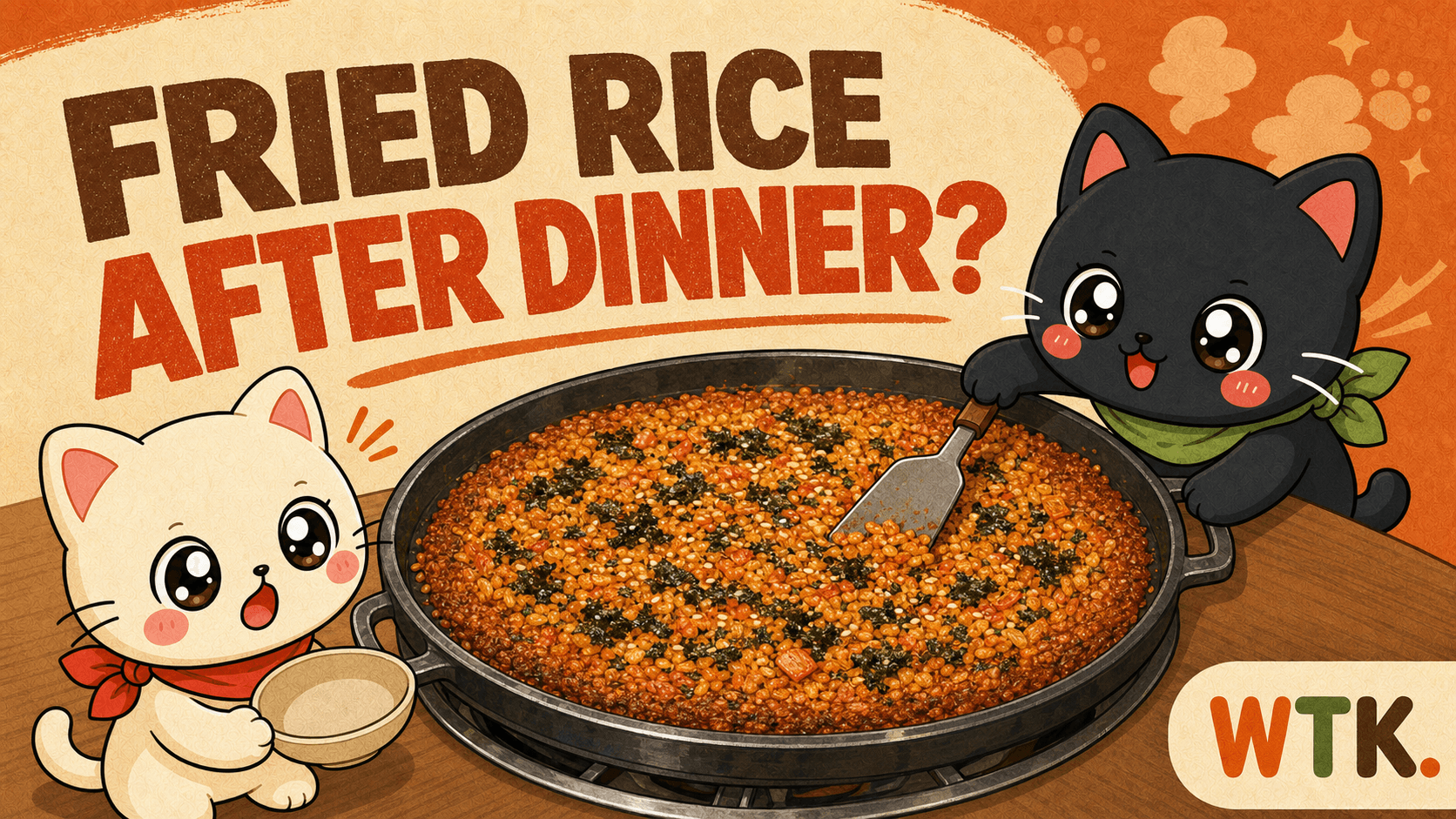
A pan of fried rice after the chicken is not necessarily a second full meal. It may be an additional rice order, part of a buffet, or something quite different from the fried-rice main on the same restaurant's menu. The useful question is not simply “Do Koreans eat rice afterward?” but “Which item am I ordering, and what does its price cover?”
We compared the Korean menus published by Yoogane and Dookki with Tongnamujip's Giheung branch page on September 4, 2026. They show different ordering structures; they do not establish one national rule. This is a menu analysis, not a restaurant visit or taste test.
Why rice can arrive after the main dish
For iron-plate dakgalbi, the Korea Tourism Organization describes rice being fried with the remaining sauce and additional seasoning after the chicken course. That explains the sequence in this particular meal: the first dish provides a base for the rice. The same guide distinguishes iron-plate dakgalbi from charcoal-grilled dakgalbi; it describes the rice ending in the iron-plate section. KTO's dakgalbi guide.
The Ministry of Culture, Sports and Tourism also uses the expression Korean-style “dessert” in an account of Cheongju-style pork belly. It describes a savory rice ending, not a sweet course or an obligation to order more food. Its local example is not a menu promise for every barbecue restaurant. MCST's Cheongju dining article.
Four menu entries that should not be treated as the same order
The table separates what the operator actually publishes from what still needs a branch answer. “Not listed” means absent from the pages we reviewed, not free, unavailable, or unrestricted.
| Operator and page scope | Published rice item or format | What this establishes | Still unconfirmed |
|---|---|---|---|
| Yoogane, Korean brand menu: 식사메뉴 | 닭갈비철판볶음밥, a chicken fried-rice main | Classified as a meal, not in the additional-menu section | Price, serving weight, minimum order and branch availability |
| Yoogane, Korean brand menu: 추가메뉴 | 볶음공기; corn and flying-fish-roe versions are also listed | A separate additional-rice category exists | Price, portion size, eligible base dishes and minimum additional order |
| Tongnamujip, Lotte Premium Outlets Giheung branch | 볶음밥 after dakgalbi on the hot iron plate | The branch itself describes a post-dakgalbi rice course | Base-meal and rice prices, minimum portions and who cooks it |
| Dookki, Korean brand introduction | Fried rice within its unlimited dining format | The rice format is included; the listed rice cheese is an extra | The chosen branch's current price and implementation |
Sources for the corresponding rows: Yoogane meal menu, Yoogane additions, Tongnamujip Giheung, and Dookki's dining information.
At Yoogane, translating both 닭갈비철판볶음밥 and 볶음공기 loosely as “fried rice” hides a useful distinction. The first sits under 식사메뉴, meaning meal menu; the second under 추가메뉴, meaning additions. Point to the exact item rather than assuming the shorter name purchases the full chicken-and-rice meal. The brand pages establish classification, not a rule that any dish can be ordered alone or in a single portion. Meal classification, additional-menu classification.
Tongnamujip's Giheung page supplies a different kind of evidence: its 볶음밥 description explicitly places it after dakgalbi. The current menu cards do not give prices or a minimum rice order. We have not filled those gaps with prices from another branch, takeaway packs, or visitor reviews. Branch menu.
What a buffet price and a cheese addition actually buy
Dookki lists a ₩11,900 general admission category, a 90-minute visit, and ₩3,000 for 50g of rice-use snow cheese. It warns that prices can vary by branch. These are brand-published terms, not a confirmed quote from a particular location. Dookki's price and time listing.
For two diners charged that general rate, our illustrative calculation is:
- Dining, with the included rice format and no paid extras: 2 × ₩11,900 = ₩23,800.
- The same order plus one 50g cheese addition: ₩23,800 + ₩3,000 = ₩26,800.
The extra ₩3,000 buys the listed cheese addition, not a standalone fried-rice meal or admission for another diner. This example assumes no other charges and that the branch applies these rates. It is not a price comparison with Yoogane or Tongnamujip: their missing prices prevent that calculation. Price inputs.
For an à-la-carte meal, keep two separate lines in your budget: the required base order and the additional rice. Do not multiply the rice price by the number of people until staff confirm how many additional portions you can order.
Who cooks the rice, and when should you ask?
Do not assume a staff member always returns to finish the pan. Dookki's guide tells diners to collect rice ingredients from the self-service counter, keep about one ladle of tteokbokki broth in the pot, and stir-fry for about two to three minutes. That is Dookki's own preparation guide, not a recipe for every restaurant, pan, or home stove. The guide does not define the ladle in millilitres. Dookki's fried-rice instructions.
By contrast, KTO's iron-plate dakgalbi account describes staff preparing an ordered rice course. This is useful context, but it does not confirm the service procedure at every branch in our table. KTO's preparation account.
Our practical suggestion is to ask while staff can still see your meal and pan, before clearing begins. Do not pour away broth or start scraping the cooking surface based on a generic online guide. For a barbecue booking, first settle the main meat order; cookware questions belong with the particular pan's instructions.
Questions that resolve the actual ordering gaps
These are our own example questions, not recorded customer conversations. Point to the menu item while asking so that “this” has a clear reference.
- 이건 식사 메뉴예요, 추가 메뉴예요? — Is this a main meal or an add-on?
- 이 메뉴 먹고 볶음밥 추가할 수 있어요? — Can we add fried rice after this dish?
- 볶음밥은 몇 인분부터 주문할 수 있어요? — What is the minimum fried-rice order?
- 두 명인데 볶음밥 한 인분만 추가해도 돼요? — There are two of us; may we add just one portion?
- 직접 볶아야 하나요? — Do we need to cook it ourselves?
- 치즈는 별도 요금인가요? — Does cheese cost extra?
These questions deliberately separate party size from rice portions. The answer may also depend on what you ordered first. If the quoted amount is unclear, confirm whether it is per person, per rice portion, or for the whole table before agreeing.
How we checked, and what this comparison cannot tell you
We selected two brands with contrasting menu structures and one explicitly named branch that describes the after-dakgalbi course. We read the operator pages, checked Yoogane's separate menu tabs in a browser, and visually inspected Tongnamujip's Giheung menu cards. Dookki's price inputs were also checked on its live page. September 4 is our reading date, not a restaurant-issued price confirmation date.
The result is a comparison of menu wording and a conditional buffet bill, not a survey of Korean dining habits. We did not visit, telephone the restaurants, weigh portions, cook, or taste the dishes. Current branch minimum orders and the missing à-la-carte prices remain unresolved. The existing character illustration is not evidence of a visit; the operator photographs remain on their own linked sites.
Sources
- Korea Tourism Organization, Dakgalbi: A Stir-Fried Delicacy on an Iron Plate, February 20, 2025.
- Ministry of Culture, Sports and Tourism, Cheongju-style samgyeopsal and its rice ending.
- Yoogane, meal menu and additional menu, Korean brand pages.
- Tongnamujip, Lotte Premium Outlets Giheung branch menu.
- Dookki, dining information and prices and preparation guide.