Buying cookware for Korean food becomes easier when you separate three questions: What is the body made from? What touches the food? What does this exact model allow? A product called “ceramic” might be a clay vessel or an aluminum pot with a ceramic coating. Even “stainless steel” does not necessarily mean an uncoated cooking surface.
To make those distinctions concrete, this guide compares manufacturer specifications for five named items from Neoflam and LocknLock. It also calculates the capacity difference between two pots sold with the same 22 cm diameter. These are document-based comparisons, not cooking tests, durability ratings, or a ranking of the best brands.
Three listings that change the meaning of a material name
The table separates the vessel body from its surface and records only permissions stated on the linked product pages. “Not stated” means the reviewed page did not answer the question; it does not mean either safe or prohibited.
| Exact item and source market | Body and surface as described by the maker | Induction | Microwave or oven | Cleaning information on that page |
|---|---|---|---|---|
| Neoflam FIKA 18 cm saucepan, EK-FG-S18I, Taiwan listing | Aluminum-titanium alloy body with ceramic surface treatment; wood handle | Listed as compatible | Neither microwave nor oven | Dishwasher use and soaking discouraged because of the wood; avoid metal abrasives |
| Neoflam Kiesel 8-inch pot, Plum / 2 QT, US listing | Heat-resistant clay with a glaze | Not stated | Microwave use described; oven rating stated as 752°F / 400°C | Dishwasher permitted, but hand-washing preferred; no metal abrasives |
| LocknLock Suit STS, 24 cm entry CSF2420, global buyer listing | Stainless-steel body with PTFE coating; stainless handle | Listed as compatible | Not stated | No cleaning instructions in the reviewed product text |
Row sources: FIKA EK-FG-S18I specifications and cautions,
Kiesel Features and Use & Care,
and Suit STS model list and Materials.
The oven conversion is arithmetic: (752 − 32) × 5 ÷ 9 = 400°C.
“Ceramic” is not one construction
FIKA and Kiesel illustrate the problem without requiring a guess about an unfamiliar marketplace seller. One uses a metal body and a ceramic surface; the other is described as clay. Their microwave, oven, and dishwasher instructions differ. The adjective on the product title cannot decide the care routine.
For a ttukbaegi-style cooking-and-serving vessel, ask which construction you are actually buying. The Kiesel example is not evidence that every Korean clay pot has the same oven rating or temperature-change tolerance. Likewise, the FIKA permission is not a claim that every coated aluminum pot works on induction. Carry the product name and model number into the next step of your search.
“Stainless” can describe the body beneath a coating
The Suit STS entry is useful because its material field explicitly includes PTFE. If your goal is an uncoated metal surface, that listing does not meet the requirement just because the range name emphasizes stainless steel. The page also identifies the origin as China: a Korean brand name is not a statement that every item was manufactured in Korea. These details come from the manufacturer's product record, not an inspection of a purchased pan.
That is a selection rule, not a claim that one coating is healthier than another. This comparison did not evaluate chemical migration, coating lifespan, or cooking performance.
Two 22 cm pots, about 81% different in listed capacity
Diameter is a useful dimension, but it is not volume. Neoflam's US FIKA four-piece set description lists a 2.7 QT stock pot and a 4.9 QT deep stock pot, both at 22 cm. The individual stock-pot and deep-stock-pot pages identify the two items separately.
| Maker-listed item | Listed diameter | Listed capacity |
|---|---|---|
| FIKA Stock Pot | 22 cm | 2.7 QT |
| FIKA Deep Stock Pot | 22 cm | 4.9 QT |
Using those published numbers, 4.9 ÷ 2.7 ≈ 1.81. The deep version has approximately
81% more listed capacity, despite sharing the diameter label. This is our calculation
from the specifications, not a measurement of either pot.
For a reader choosing between a shallow shared dish and a larger batch of soup, that difference matters more than the identical “22 cm” label. It does not establish that the deep pot cooks faster, uses the same amount of energy, or holds 81% more usable food. The cited set description does not define a safe working fill level, and foaming, stirring, and ingredients can require space above the liquid.
Nor does a rim diameter establish the diameter of the induction contact area. Record those as separate measurements rather than filling an empty specification with the number that happens to be available.
Read the Korean fields in a useful order
When a Korean listing presents a long image of specifications, look for these fields before reading its lifestyle copy:
- 품명 / 모델명 — item and model. Match the variant, not just the collection name.
- 재질 — materials. Look separately for the body, interior coating, lid, and handle.
- 사용 가능 열원 — permitted heat sources. Find the specific induction, gas, oven, or microwave statement you need. A missing answer stays unresolved.
- 크기 / 용량 — dimensions and capacity. Keep cm, height, and mL/L/QT in separate fields. The two FIKA pots show why.
- 사용상 주의사항 — precautions. Read the limitations before assuming another pot's washing or preheating method applies.
For domestic product labels, the Korean Ministry of Food and Drug Safety advises checking food-use identification, materials, manufacturer or importer information, and precautions. That is the basis for this label-first approach—not a promise that the word “Korean” guarantees a suitable product. MFDS cookware-use guidance.
For example, ask a seller: 이 모델은 인덕션에서 사용할 수 있나요? 바닥 지름은 몇 cm인가요?
This means, “Can this model be used on induction, and what is its base diameter?” It is
an example question written for this guide, not a quotation from a customer-service
exchange. Ask for the relevant manual or specification, not only a yes/no reply.
Let the cooking surface determine the care question
An old-looking gold yangeun pot and a ceramic-coated aluminum saucepan should not receive identical advice simply because both involve aluminum. MFDS describes yangeun as aluminum cookware with a treated surface and warns about acidic or salty food contact and prolonged storage. Its separate coated-pan guidance advises avoiding sharp tools and abrasive washing, replacing damaged coatings, and not heating an empty pan for a long time. Read the relevant material-specific sections.
Use that guidance to ask a more precise question: “Which surface am I cleaning?” Do not transfer an uncoated-metal scrubbing routine to a coated model, or a particular clay pot's dishwasher permission to every ceramic product.
A sotdukkeong-style grill needs its own model-level assessment too. None of the pot specifications above establishes a grill's installation, fuel, ventilation, or cleaning requirements. A shared Korean food association is not a technical compatibility statement.
What this comparison establishes—and what it does not
The documented result is narrow but useful: material names do not uniquely identify construction, and matching diameters do not establish matching capacity. Before buying, make one short record containing the exact model, body, surface, heat-source permission, capacity, and unresolved questions. If a required permission remains unresolved, do not treat it as a pass.
Sources were checked on September 4, 2026. The examples were selected because their public specifications expose different labeling problems, not because of sales rank, price, or a claim to represent every Korean kitchen. Neoflam's corporate global-network directory links the US and Taiwan stores used here. LocknLock's source is its global buyer catalog. Instructions for another country or a similar-looking revision must be checked separately.
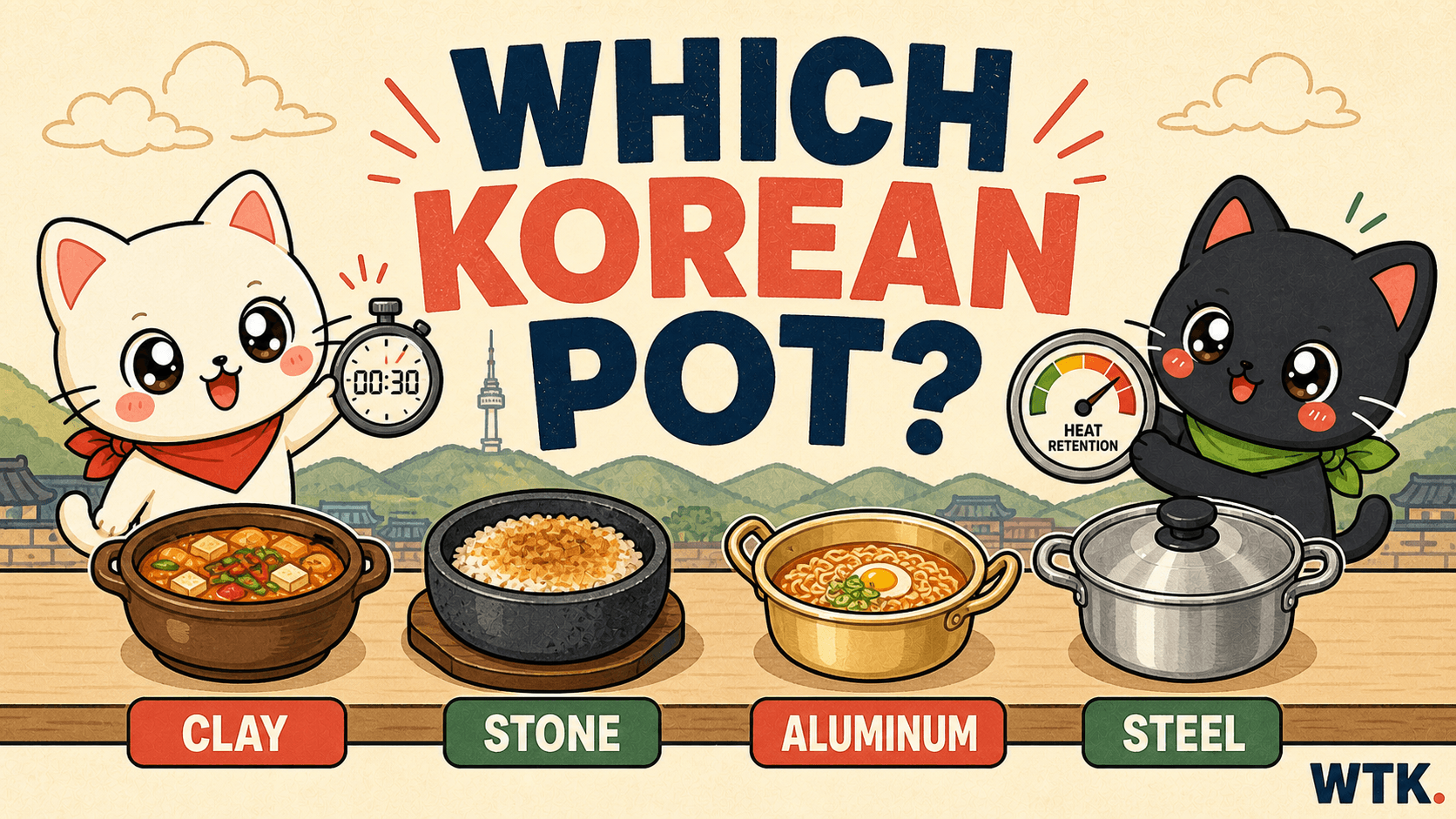
No pots were purchased, heated, weighed, or photographed for this comparison. Published capacities and permissions remain manufacturer statements; this guide does not verify their performance or certify safety. No brand was contacted to resolve missing fields. The cover is an editorial illustration, not a photograph of the compared models. Prices and stock status are intentionally excluded because they do not answer the construction and compatibility questions examined here.
Sources
- Neoflam Taiwan — FIKA EK-FG-S18I specifications and cautions
- Neoflam Americas — Kiesel 8-inch pot, Plum / 2 QT, Features and Use & Care
- LocknLock — Suit STS model list, Materials, and Functions
- Neoflam Americas — FIKA four-piece set, 22 cm pot capacities
- Neoflam Americas — FIKA 22 cm Stock Pot
- Neoflam Americas — FIKA 22 cm Deep Stock Pot
- MFDS — Using food cookware correctly, April 30, 2026
- Neoflam — Corporate global-network directory