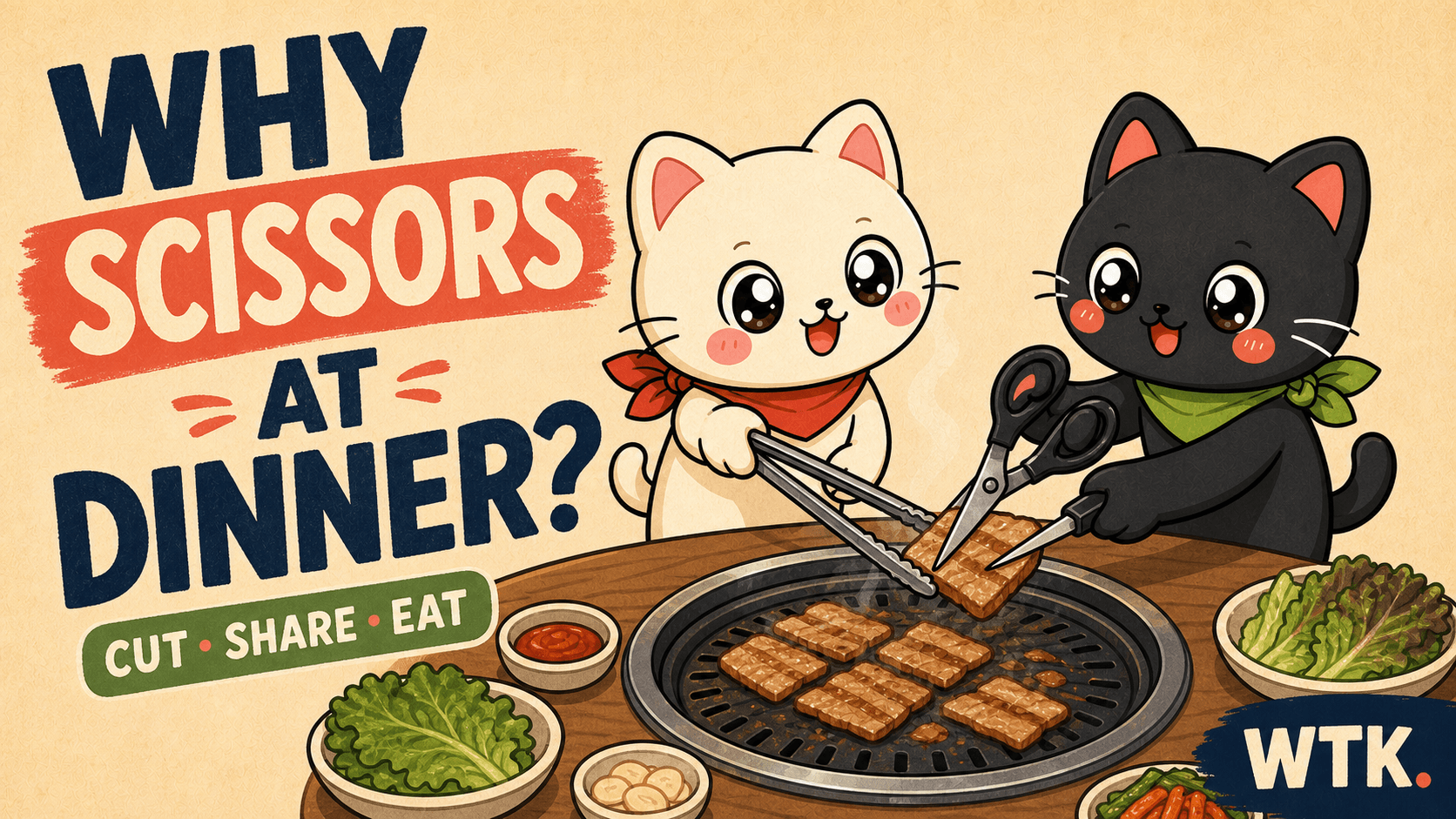
Scissors at a Korean meal are a portioning tool, not a cue to reach for the stationery drawer. Korea.net's December 2015 introduction to K-Scissors lists pork barbecue, cold noodles and kimchi as examples of food cut with scissors. That is a documented cultural use, not a claim that every restaurant handles every dish the same way. Korea.net's written introduction.
For a visitor, the useful distinction is between using a provided food tool and choosing one to take home. At the table, ask how the dish is being served. When shopping, ask what the exact model is meant to cut and how it is cleaned. A familiar shape does not answer either question.
We compared the fixed and detachable versions in DORCO's Korean Master listing. The practical finding: a removable joint is one feature, not permission to put the whole tool through any cleaning process. This is a document-based comparison, not a hands-on review.
At the table: ask about the portion, not a national rule
If you want noodles shortened, make that request before someone cuts a shared bowl. If staff are handling the grill, ask them to cut the meat rather than assuming you should take over. These are suggested ways to communicate, not observed service rules for a particular restaurant.
Three short examples, written for this guide:
- 가위 주세요. — “Scissors, please.”
- 먹기 좋게 잘라 주세요. — “Please cut it into pieces that are easy to eat.”
- 면은 자르지 말아 주세요. — “Please don't cut the noodles.”
Do not infer that cutting means the food is cooked. FoodSafety.gov recommends a food thermometer to check doneness; a scissor cut is not that check. FoodSafety.gov: Cook to the Right Temperature.
For the ordering and meal context, see our samgyeopsal guide. The question of when a specific piece is ready to eat is separate from how a restaurant portions it.
Fixed versus detachable: what the model sheet actually says
DORCO's Master page separates 120S, fixed, from 120ST, detachable. Both list stainless-steel blades and PP handles, with a 120 mm blade dimension and 246 mm overall length. Those are maker-stated dimensions, not our measurements.
| Check before buying | Master 120S | Master 120ST |
|---|---|---|
| Joint in the product sheet | Fixed; black or red | Detachable; ivory-colored example |
| Cleaning access | No take-apart feature listed | Separation shown for cleaning the joint |
| Full separation/reassembly sequence | Not applicable as a take-apart feature | Not supplied in the reviewed detail image |
| Care warning for both models | Wash after use, dry and store; avoid dishwasher use where possible because of deformation risk | Same warning; detachable is not an exception |
DORCO Master: model diagrams, 120ST feature and precautions.
The choice is conditional: if joint access is your requirement, the documented difference favors 120ST; if dishwasher cleaning is your requirement, neither listing establishes an unrestricted dishwasher option. That is a comparison of instructions, not a claim that one model cuts better or is microbiologically cleaner.
Do not try to convert the fixed model into the detachable one. For the 120ST, obtain the current instructions for separation and secure reassembly before taking it apart. The marketing photograph does not establish an opening angle, a force to apply or a safe reassembly test. None is invented here.
The page promotes heat-resistant PP handles, yet its care warning discourages dishwasher use. It also warns about blade damage from hard foods and keeping the tool away from fire. Its fine-texture feature refers to the handle, not a blade-sharpening method. DORCO Points 3–4 and precautions 2, 5–6.
Consequently, neither “kitchen,” “detachable” nor “heat-resistant” supplies a boiling protocol, a sterilization claim or permission to cut bones and frozen blocks. If those are your intended tasks, ask for explicit model-specific instructions. A larger handle is not evidence of a heavier-duty cutting rating.
Food-use identification comes before the feature list
Look for 식품용, meaning “for food use,” or the food-use symbol. Korea's MFDS specifically warns against using unmarked stationery scissors with food. Its April 2026 guidance also tells buyers to check the manufacturer or importer, material and precautions. MFDS: food-use identification panel.
For a Korean-language product search, 주방가위 means kitchen scissors; 분리형 and 고정형 distinguish detachable and fixed constructions in the DORCO sheet. Search wording is only a way to find a product, not proof of its food-use labeling. Check the actual item and packaging.
A useful question to a seller is: “이 모델의 식품용 표시와 분리·재조립 설명서를 볼 수 있나요?” — “Can I see this model's food-use labeling and separation/reassembly instructions?” This is an example request, not a customer-service response we obtained.
For the same distinction between a material name and a permitted use, see our Korean cookware comparison.
A detachable joint does not replace raw-food separation
FoodSafety.gov advises separate utensils for raw and cooked food and thorough washing with hot, soapy water after raw-food contact. FoodSafety.gov: Separate and Clean.
Applied to a barbecue table, the question is not merely “Are these scissors detachable?” It is “Has this pair touched raw meat, and is a clean tool available for food that is ready to eat?” Ask for a clean pair rather than treating a quick wipe, a brief rinse or contact with the hot grill as a verified cleaning process.
Keep two decisions separate: food-safety guidance addresses contamination; the product instructions address how the tool can be cleaned without damaging it. This guide does not substitute a dishwasher cycle, boiling time or improvised chemical treatment for either set of instructions.
How this comparison was made
On September 4, 2026, we read DORCO's Korean Master product sheet, including the fixed/detachable identifiers, dimensions, features and caution panel. We also read Korea.net's written video introduction, MFDS's food-use guidance and FoodSafety.gov's clean/separate/cook sections.
The two models were selected to isolate a joint-design difference within one series. This is not a market-wide ranking. We did not buy or handle the tools, test grip or cutting performance, measure cleanliness, inspect current retail packaging, watch the Korea.net video or obtain a complete 120ST assembly manual. The cover is an editorial illustration, not evidence of a product trial.
Sources
- DORCO: Master 120S / 120ST Korean product page — model and care comparison.
- Korea.net: K-Scissors, December 2015 — written cultural introduction, not video analysis.
- MFDS: using food-use cooking utensils, April 30, 2026 — identification and stationery-scissors warning.
- FoodSafety.gov: 4 Steps to Food Safety — cleaning, utensil separation and doneness checks.