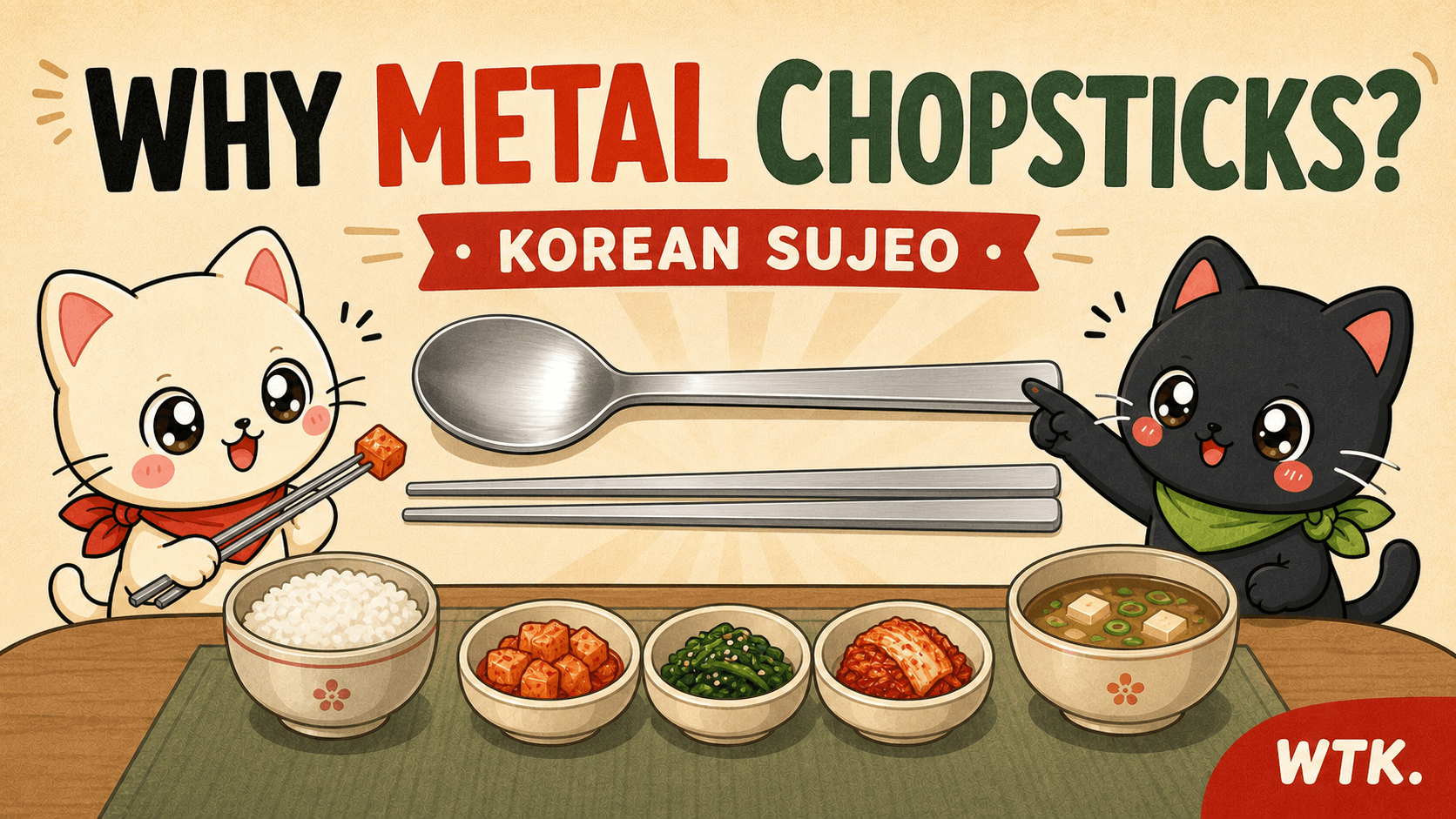
A Korean spoon-and-chopsticks set is more useful to understand as a pair of tools than as a test of chopstick skill. The Korean encyclopedia entry for 수저 (sujeo) describes the spoon handling rice and broth, and chopsticks handling side dishes. That is a conventional division of roles, not an instruction to police how another diner eats. Korean encyclopedia: sujeo.
For someone buying a set, however, “Korean metal chopsticks” is not a complete specification. We compared Tackaon's adult set with an AROPA manufacturer listing. Their stated lengths differ, and one explicitly combines metal with a plastic handle. Neither product sheet establishes which will feel easier in your hand. This guide separates those documented differences from the claims that would require a real handling test.
What the historical evidence answers—and what it does not
The National Museum of Korea catalogs an object titled Silver Spoon and Bronze Chopsticks, attributed to the Goryeo dynasty, accession Bongwan 4252. The title distinguishes the spoon's material from the chopsticks' material; it does not describe a modern stainless set. National Museum of Korea: object record.
That record supplies a concrete example of earlier metal tableware. It does not identify the first Korean chopsticks, measure how widespread metal was, or establish why modern households choose it. In particular, this object record does not establish the familiar royal poison-detection story as the origin of today's practice. We do not present that story as a demonstrated explanation.
The narrower answer is more honest: there is historical evidence of metal utensils, and the spoon-and-chopsticks pairing gives useful meal context. A single cause for modern material choice is not established by the sources reviewed here. Nor does an old bronze object prove the performance of a current stainless product.
Two product sheets: length is comparable; weight is not yet
The comparison below uses Tackaon's adult one-person set, product 202, and BOEUNTECH's AROPA listing GS2026061252026. The latter is a supplier-posted listing on GobizKorea, not an independent product test. These are two examples of different constructions, not a survey or a recommendation ranking.
| Published detail | Tackaon adult set, product 202 | AROPA, listing GS2026061252026 |
|---|---|---|
| Chopstick length | 23 cm | 24 cm |
| Material description | Stainless steel; alloy grade not stated in the reviewed detail panels | SUS304 stainless part and polycarbonate handle |
| Hollow construction | Not specified in the reviewed detail panels | Supplier says the stainless part is hollow |
| Chopstick weight | Not stated in those panels | 26 g listed; whether this means one stick or a pair is not explicit |
| Handle/finish information | Glossy or matte options; broad, flat handle faces shown | Square handle described by the supplier |
| Food-contact tip texture | No explicit texture specification found | No explicit tip-texture specification found |
Tackaon: adult set and dimension panels. AROPA: item specifics and manufacturer description.
The usable numerical result is 24 − 23 = 1 cm of stated length difference. It is not a measured difference in reach, balance or ease of use. We cannot make a corresponding weight comparison: one source omits the number, and the other leaves the counting unit unclear. Doubling or halving 26 g would invent that missing unit.
For a buyer who specifically wants to avoid a plastic handle, the AROPA description rules out that example. For a buyer who wants a declared hollow metal section, it provides that information; the Tackaon panels do not. Neither finding identifies a grip-performance winner.
The AROPA page also has an unresolved spoon-length discrepancy: 22 cm in the item specifics versus 215 mm in the product-information image. These equal 220 mm and 215 mm, a 5 mm difference. If matching the spoon to a case or organizer matters, obtain the exact variant's dimensions before ordering. Do not quietly choose whichever value fits. AROPA: text specifications and product-information panel.
Flat, hollow and textured are three different questions
Treat the visible handle shape, the internal construction and the food-contact tip as separate fields. A broad handle face does not establish whether the inside is solid or hollow. A logo near the handle end does not establish a textured food-contact tip. Our table therefore does not turn an appearance into an unreported construction or grip specification.
If you have a pair you already find comfortable, bring its measurements when shopping. Compare length and the weight of one complete pair without the spoon or packaging. That is a proposed comparison method, not a test we performed. If a store permits handling, check the actual item; our document comparison cannot tell you how your hand will respond.
We have not measured slippage with noodles, tofu or any other food. Claims such as “flat is lighter,” “etched tips are easier for beginners,” or “metal is always harder to use than wood” are not conclusions of this research. Ask what was measured, on which products and under which conditions before relying on such rankings.
Read care guidance at the product level
Tackaon's packaging panel advises a soft scrubber for glossy utensils to avoid scratching. Its older general FAQ answers yes to dishwasher use, then discusses exceptions for other product categories; it does not identify adult set 202. We therefore leave that set's current, specific dishwasher conditions unconfirmed. AROPA's supplier description says its product is dishwasher compatible, but it does not provide a cycle specification. Tackaon: packaging care panel. Tackaon: product-use FAQ, C-Q2. AROPA: supplier care statement.
Do not replace missing instructions with a material's advertised heat tolerance. The whole utensil—including the handle and joint—is the item you will clean. This guide supplies no boiling, sterilizing or chemical-treatment procedure. Our food-scissors comparison shows why a construction feature and a cleaning permission need separate checks.
Two seller questions, written as examples for this guide rather than taken from customer-service correspondence:
- “젓가락 한 쌍만의 무게가 몇 그램인가요?” — “How many grams does just one pair of chopsticks weigh?”
- “이 모델 전체를 식기세척기에 넣어도 되나요? 제한 조건이 있나요?” — “Can this whole model go in a dishwasher? Are there restrictions?”
For a wider kitchen purchase, the same distinction between a material label and permission for a particular use appears in our Korean cookware comparison.
How this comparison was made
On September 4, 2026, we read Tackaon's three product/packaging images and its general use FAQ, AROPA's supplier text and five detail panels, the museum object record and the encyclopedia's sujeo entry. We selected the products to compare different published constructions, not because we had tested them.
All dimensions and material labels remain source statements. Some AROPA listing assets have AI-generation filenames, so we did not use their appearance as physical evidence of tip geometry. We did not purchase samples, weigh a pair, test grip or washing, inspect current packaging, or obtain seller clarification. The cover is an editorial illustration, not a photograph of a product trial.
Sources
- Korean encyclopedia: sujeo — conventional utensil roles, not a national behavior survey.
- National Museum of Korea: Silver Spoon and Bronze Chopsticks — cataloged object, not proof of a single origin story.
- Tackaon: adult one-person glossy/matte set — product, dimensions and packaging images.
- Tackaon: general product-use FAQ — C-Q2; not a model-202-specific manual.
- AROPA / BOEUNTECH: Lightweight Chopsticks and Spoons 3 — supplier-posted specifications, construction and care claims.