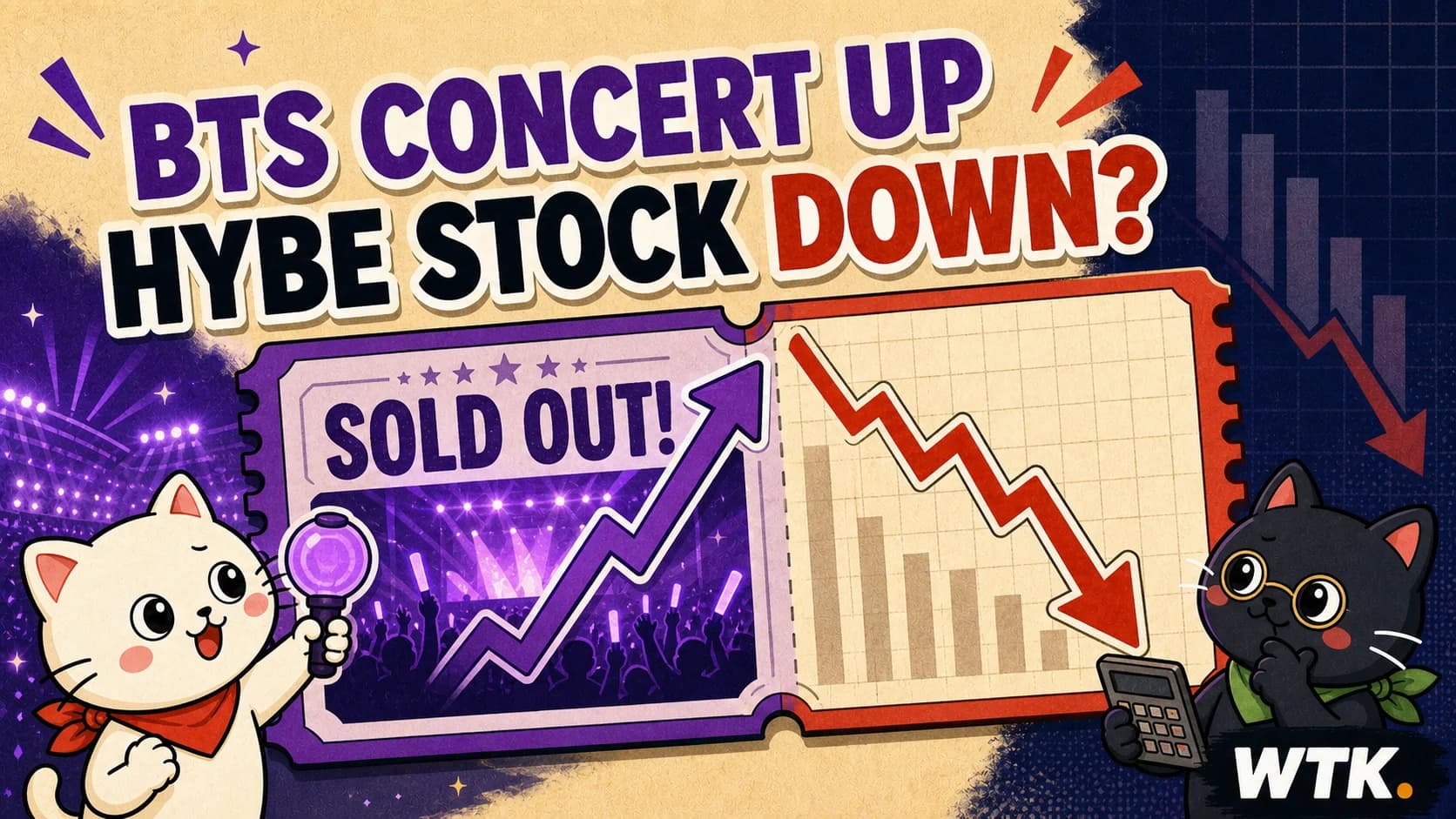
BTS can fill a stadium with purple light on Saturday—and HYBE stock can still open red on Monday. To a fan, that sounds absurd. To the market, it can be perfectly ordinary.
The ARIRANG world tour gives us a fascinating way to ask whether BTS concert dates
move HYBE stock. The surprising answer is that concerts matter, but the date printed
on the ticket is rarely the only date investors care about. Announcements, ticket
sales, merchandise, earnings, expectations, and the wider market all run on different
clocks.
Important: This article is for cultural and educational analysis only. It is not investment advice. A short-term price move cannot prove that one concert, artist, or headline caused a company's shares to change.
The fan calendar and the market calendar
A fan sees a clean sequence:
tour announced → ticket secured → concert night → unforgettable memories
An investor sees several possible information events:
comeback confirmed
→ tour cities and show count announced
→ presales and sellouts reported
→ merchandise demand appears
→ concerts take place
→ revenue enters a financial quarter
→ HYBE reports results and updates its outlook
The market does not politely wait for the encore. Share prices reflect what buyers and sellers expect about the future, so a credible announcement can matter before a single stage is built. By concert night, much of the good news may already be in the price.
This creates the first rule of K-pop stocks: the event that earns the money and the event that changes expectations may not be the same event.
January: the tour schedule arrives, and expectations jump
BTS announced the 2026–2027 world-tour schedule in January, with more than 70 dates across Asia, the Americas, Europe, and Australia. The plan marked the group's return to headline touring after the members completed their military-service period.
HYBE shares reportedly rose 9.5% after the tour announcement, reaching their highest level in more than four years. Securities analysts raised forecasts and target prices after the schedule exceeded some previous assumptions about the tour's size and duration.
Why can a calendar move a stock? Because it turns a vague sentence—“BTS will tour”—into inputs that analysts can model:
- number of shows
- venue capacity
- regions and currencies
- likely ticket-price ranges
- merchandise opportunities
- fan-club and Weverse activity
- livestreaming or other digital products
- production, travel, and artist-related costs
The schedule did not guarantee profit. It reduced uncertainty. Investors could replace some guesses with a larger set of educated guesses.
March: a comeback celebration, then a stock selloff
The stranger case came after BTS's March comeback. The group released ARIRANG and
performed a highly promoted free show at Seoul's Gwanghwamun Square. It was a major
cultural event, streamed internationally and surrounded by enormous attention.
On the next trading day, HYBE shares fell sharply—more than 13% in early trading and as much as roughly 15% intraday, according to contemporary reports. Headlines connected the drop to turnout estimates below some advance expectations and to concern that there was no immediate new catalyst after the comeback.
That does not prove that the performance damaged HYBE.
The official seated viewing zone, surrounding street crowds, online viewers, public safety limits, and optimistic citywide estimates were different measurements. Analysts quoted afterward called the market reaction confusing and argued that the much larger world tour mattered more to future earnings.
The episode demonstrates a classic market phrase: sell the news. Traders may buy during months of anticipation, then sell when the famous event finally arrives—even if the event itself goes well. The stock is reacting not to whether fans were happy but to the gap between expectation and new information.
A sold-out sign is revenue evidence—not a share-price command
A sold-out stadium is commercially meaningful. It signals demand and gives a company ticket revenue, merchandise opportunities, content, and a platform for future fan activity. But it does not issue an instruction that says “stock must rise today.”
Consider four scenarios:
| Concert result | What the market expected | Possible reaction |
|---|---|---|
| Sold out quickly | A slow or partial sellout | Positive surprise |
| Sold out quickly | An instant sellout was assumed | Little new information |
| Extra show added | No extra capacity expected | Forecasts may rise |
| Great performance, high costs | Strong profit margin expected | Revenue can impress while profit disappoints |
This is why the ticketing battle matters but tells only part of the financial story. Our guide to why K-pop tickets sell out in seconds explains presales, cancellation tickets, scalping, and the macro tools that complicate the visible demand signal.
When does a BTS concert become HYBE revenue?
The accounting clock adds another delay. A concert date can generate ticket and venue revenue in the quarter when the performance occurs, while merchandise preorders, memberships, licensing, or other products may appear on different schedules depending on when obligations are fulfilled and revenue is recognized.
HYBE reported nearly 700 billion won in first-quarter 2026 revenue, with Yonhap reporting that artist indirect-participation revenue—including merchandise, licensing, content, and fan-club membership—rose 65.5% to 294.7 billion won. Tour-related goods and presales for the BTS tour contributed even though the main tour concerts began in the second quarter.
That distinction is the whole article in miniature:
- fans had not yet attended the main tour
- tour-related commercial activity had already begun
- some expectations had entered the share price months earlier
- later concert revenue would appear in later reporting periods
One “BTS effect” therefore appears on several dates rather than one magical date.
HYBE stock is not a BTS scoreboard
HYBE is strongly associated with BTS, but a share of HYBE is not a point awarded to BTS for a successful show. HYBE is a listed entertainment company with multiple businesses and risks.
Its stock can respond to:
- activities by BTS and other HYBE artists
- album, streaming, concert, and merchandise performance
- Weverse users and monetization
- artist contracts and availability
- new-group launch costs
- production and stadium expenses
- overseas labels, acquisitions, and restructuring
- currency movements
- management, legal, and regulatory news
- interest rates and the wider Korean equity market
A BTS concert may be the largest headline on a given weekend while another financial factor dominates Monday's trading.
There is also a denominator problem. If HYBE shares have already climbed for months on comeback expectations, an additional concert success may be too small to change the total valuation story. A disappointment does not have to be large to trigger profit-taking after a large run-up.
How to test the “BTS concert effect” without fooling yourself
Drawing a purple concert marker on a stock chart is fun. Calling every nearby move a cause is not analysis. A fair event study would separate different kinds of dates and compare HYBE with the market.
| Event type | Example question | Useful window |
|---|---|---|
| Official announcement | Did the schedule exceed expectations? | Previous close to 1–3 trading days after |
| Ticket-sale result | Was demand stronger than assumed? | Announcement day and next trading day |
| Concert date | Did attendance or execution reveal something new? | Previous and next trading days |
| Earnings release | Did recognized revenue and profit beat forecasts? | Release day and following session |
Then calculate a simple relative move:
HYBE return − KOSPI return
That does not solve causation, but it helps distinguish a company-specific move from a day when the entire Korean market rose or fell. A stronger analysis would also compare other entertainment companies and check whether HYBE disclosed unrelated information in the same window.
Most importantly, choose the event list before looking at the chart. Otherwise it is easy to circle only the dates that make a good story and ignore the concerts followed by nothing unusual.
What ARIRANG means to a fan—and to a spreadsheet
The world tour's name carries cultural meaning far beyond finance. Arirang is a
living family of Korean folk songs associated with separation, endurance, longing, and
return. Our guide to
the Korean song behind BTS's tour explains
why thousands of regional variations can share one identity.
An analyst's spreadsheet sees something else: cities, capacities, quarters, currency, average spending, and margin. Neither perspective cancels the other. They answer different questions.
Fans ask whether the performance was moving. Investors ask whether the company's future cash flows now look different from what the market had already priced. That is how a stadium can be full, the audience can be thrilled, revenue can be real—and the stock can still fall.
The honest answer
Do BTS concert dates move HYBE stock? Sometimes they sit near important price moves, especially when the event reveals information about demand, scale, execution, or future revenue. But the strongest reactions may occur on the announcement date, the ticket-sale date, or the earnings date instead of concert night.
The January rally and March selloff are not proof of a reliable BTS trading strategy. They are proof that pop culture and financial markets run on different definitions of success.
For ARMY, a sold-out show can be a historic night. For HYBE's share price, the harder question is always: historic compared with what investors expected yesterday?
This article does not recommend buying, selling, or holding HYBE shares. Verify current prices, disclosures, and financial statements through official market sources before making any investment decision.
Sources
- BIGHIT MUSIC: BTS ARIRANG World Tour Schedule
- Associated Press: BTS Announces Its 2026–2027 World Tour
- Korea Exchange KIND: HYBE Public Disclosures
- Yonhap: HYBE Reports Nearly 700 Billion Won in Q1 Revenue
- Korea JoongAng Daily: Analysts Debate HYBE's Post-Concert Selloff
- Asia Business Daily: Analysts Raise HYBE Targets After the Tour Announcement
- Bloomberg: HYBE Shares Fall After the Seoul Comeback Show