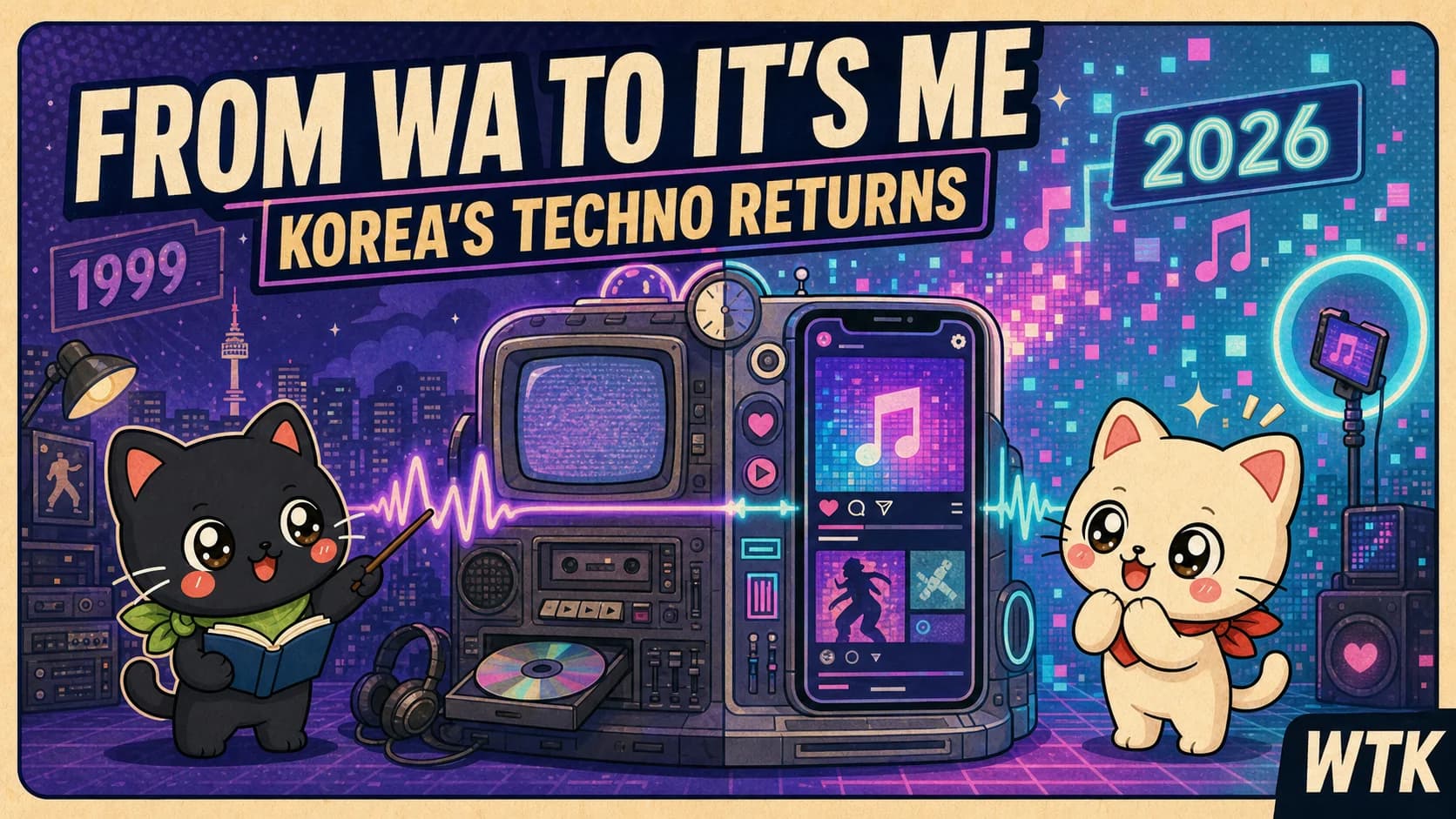
To a young listener, ILLIT's “It's Me” sounds like an unexpectedly sharp new turn: a confident techno pulse, a compact hook, and choreography built to repeat on a phone. To many Koreans who were watching television in 1999, it also triggers a memory: Lee Jung-hyun's “Wa” (와), one of the performances that made techno feel like the future of Korean pop.
The two songs are not separated by a secret only producers understand. ILLIT eventually posted an official “It's Me × Wa” challenge with Lee Jung-hyun herself. The fun is not in accusing one song of copying another. It is in hearing how K-pop takes an old engine, rebuilds the body, and sends it back onto a completely different screen.
The 1999 song that made techno look enormous
Lee Jung-hyun released her first album, Let's Go to My Star, in October 1999. Its hits “Wa” and “Bakkwo” (바꿔, “Change”) helped introduce techno as a full pop spectacle in Korea, earning her the nickname Techno Warrior (tekno yeojeonsa, 테크노 여전사).
“Wa” was more than a fast electronic track. The performance was a complete character: dramatic styling, a small finger microphone, a fan, controlled hand movements, and an almost otherworldly intensity. Late-1990s Korean television compressed a futuristic club fantasy into a music-show stage.
That scale matters. First-generation K-pop often had to announce a concept immediately to viewers flipping through broadcast channels. Lee did not merely sing over techno. She made techno visible.
The Korean Film Council describes her debut album as one of 1999's biggest musical sensations and credits “Wa” and “Change” with introducing techno music in Korea. The songs arrived near the millennium, when electronic sound, cyber imagery, and the fear and excitement of a new century were easy to package together.
What ILLIT changed in “It's Me”
ILLIT released “It's Me” on April 30, 2026 as the lead track from its fourth mini album, MAMIHLAPINATAPAI. Contemporary coverage identified it as a techno song inspired by 1990s dance music. The lyrics frame the moment of defining a relationship after a first date, delivered with a cheeky confidence that fits ILLIT's younger voice.
The old ingredients are recognizable:
- a steady electronic pulse
- synthetic hooks that announce themselves quickly
- repetition designed for physical movement
- a performance concept as important as the audio
- a direct, commanding central phrase
But the delivery belongs to 2026. “It's Me” runs about two and a half minutes. Its hook is clean enough to isolate for a challenge, and its choreography can be understood in a vertical clip before someone hears the entire track.
Where “Wa” used television spectacle to make viewers stop changing channels, “It's Me” uses short-form precision to make viewers stop scrolling.
“Wa” versus “It's Me”: the same machine, new interface
| Element | Lee Jung-hyun's “Wa” (1999) | ILLIT's “It's Me” (2026) |
|---|---|---|
| Main screen | Broadcast music show | Phone-first short-form feed |
| Techno mood | Millennium futurism and dramatic intensity | Retro confidence with playful polish |
| Performance hook | Fan, finger mic, hand gestures, full stage persona | Repeatable point choreography and member-focused clips |
| Vocal impression | Forceful, theatrical, almost confrontational | Light, cheeky, cool, and self-assured |
| Viral mechanism | Television replay, imitation, public recognition | Challenges, remixes, memes, algorithmic repetition |
| Core message | A dramatic demand inside a breakup song | “Choose me”—confidence after a first date |
Calling this merely “retro” is too vague. K-pop constantly borrows older clothing, cameras, synths, and graphic design. The more specific connection is that both songs turn techno into identity performance. The beat does not sit behind the singer. It helps create the character standing in front of us.
Is “It's Me” sampled from “Wa”?
This is where the language needs to be careful.
A sample uses part of an existing sound recording. A remake creates a new recording of an existing composition. An interpolation re-performs a recognizable melody or musical passage. These are credit and rights questions, not just descriptions of two songs feeling similar.
The publicly discussed connection between “It's Me” and “Wa” is a shared techno lineage and an official promotional mashup. Unless an official credit identifies a sample, remake, or interpolation, it is safer and more accurate to call “It's Me” a modern song that revives the language of Korea's late-1990s techno boom.
That distinction makes the story better. Direct copying would connect two recordings. A genre revival connects two eras of Korean pop culture.
The challenge that confirmed everyone heard it
In May 2026, ILLIT posted a short-form video with Lee Jung-hyun combining “It's Me” and “Wa.” Lee appeared in styling that recalled her famous techno era, while ILLIT performed the new choreography beside the artist who embodied the older wave.
It worked as promotion, but it also functioned as a tiny history lesson. Younger fans met the original Techno Warrior. Older viewers saw that the resemblance was not an awkward comparison the new group wanted to avoid. It was something both generations could play with.
This is one reason short-form challenges have become more than advertising. They can create a visible line of succession. Instead of a label writing “inspired by first- generation techno” in a press release, the artists place the two beats and two bodies in the same frame.
Why 1990s Korean dance music keeps returning
The late 1990s offer current K-pop producers something useful: electronic music that already feels Korean to domestic listeners but still sounds surprising to younger global fans.
Several forces make that archive attractive:
- Twenty-year nostalgia has matured. The teenagers who watched “Wa” now have cultural memory and spending power, while younger listeners encounter the sound as discovery rather than childhood.
- Techno works with choreography. Strong pulses and repeated phrases translate easily into point moves and challenges.
- Early K-pop concepts were unmistakable. Bold stage characters provide more to reference than a generic vintage filter.
- Digital feeds reward instant recognition. Sounds designed to seize attention on television can be rebuilt to seize attention in the first seconds of a reel.
- K-pop now has its own history. New groups no longer need to look only to American, European, or Japanese pop archives for retro material. Korea's earlier generations are an archive too.
This historical confidence also appears outside electronic music. BTS's use of
ARIRANG brings a much older Korean song tradition into a global stadium project; our
guide to the Korean song behind the BTS tour
explains how heritage changes without losing its identity.
From broadcast replay to algorithmic replay
The biggest difference between 1999 and 2026 may not be audible. It is the distribution system.
“Wa” became unavoidable through music shows, variety appearances, live events, styling, and imitation. A nation watched many of the same television channels. Repetition was scheduled.
“It's Me” travels through personalized feeds. One viewer sees the official choreography, another sees a celebrity challenge, another a comedy edit, and another the Lee Jung-hyun mashup. Repetition is algorithmic and participatory.
The promotional unit has also changed. In 1999, the full stage was the main object. In 2026, a few seconds of point choreography can circulate independently from the song, then lead viewers back to the music video and streaming track.
That system helps explain why K-pop objects and gestures become collectible. Fans save not only albums but member-specific moments, outfits, clips, and photocards. “It's Me” is designed for that fragmented attention while still working as one group performance.
K-pop did not forget techno—it learned to remember itself
ILLIT's “It's Me” is not interesting because a new group accidentally sounds old. It is interesting because Korean pop now has enough history to quote itself, invite the older artist into the joke, and deliver that memory to fans who were born long after 1999.
Lee Jung-hyun used a broadcast stage to make techno feel like an alien transmission from the future. ILLIT uses the same genre family to create something lighter, shorter, and optimized for a feed. One demanded the whole television screen. The other keeps reappearing inside the screen in your hand.
Twenty-seven years apart, “Wa” and “It's Me” show the same K-pop instinct: find a sound with physical energy, build a character around it, and make the audience want to copy the move.
The technology changed. The techno impulse did not.
Sources
- ILLIT Weverse: Official “It's Me” Fan Chant and Release Material
- Apple Music: ILLIT “It's Me,” Released April 30, 2026
- The Korea Times: ILLIT's Techno Transformation and 1990s Dance Influence
- Korean Film Council: Lee Jung-hyun and the 1999 Techno Sensation
- Mnet Plus: ILLIT Performs “It's Me” on M Countdown
- ILLIT Official TikTok Account