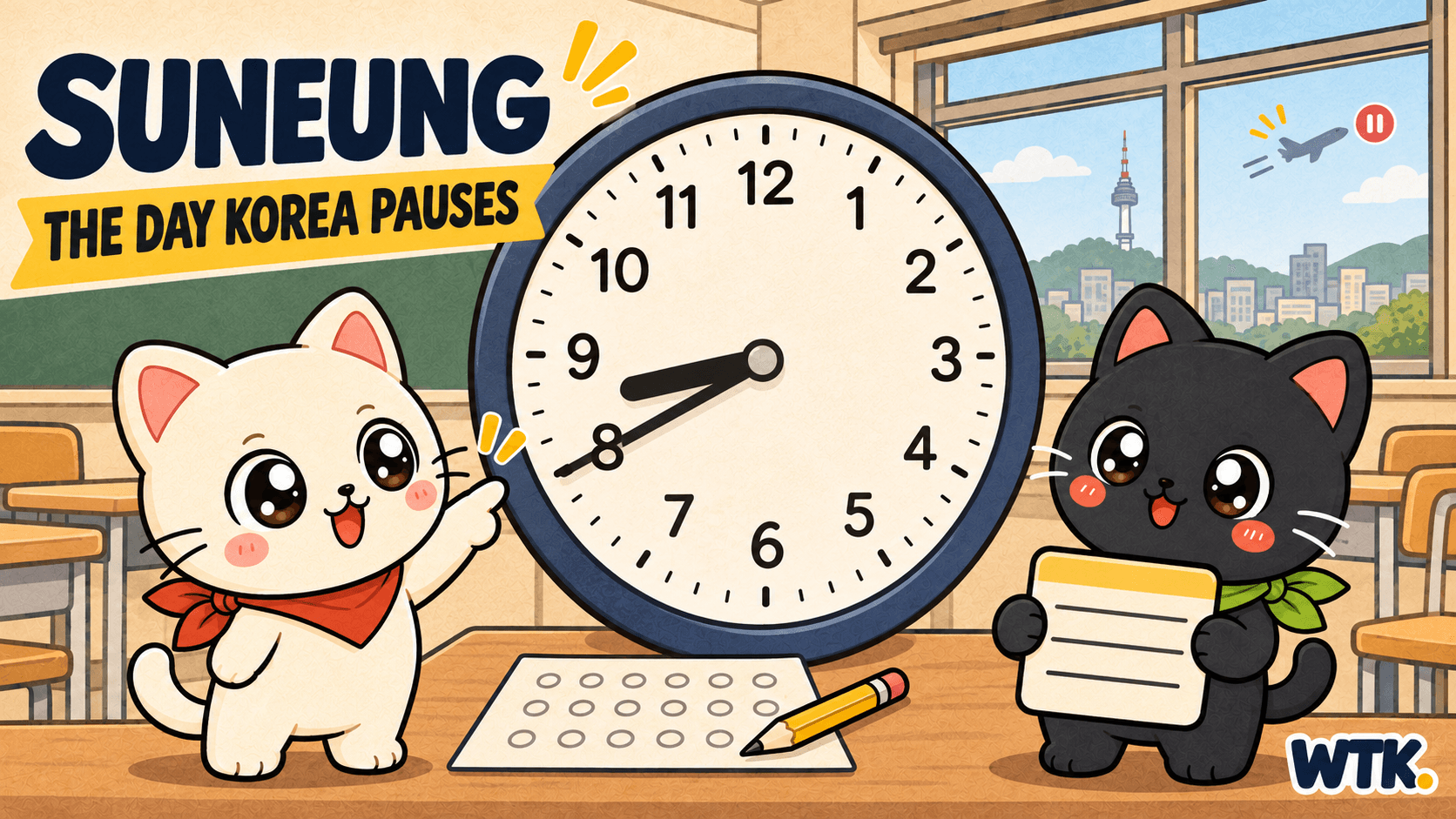
At 1:05 p.m. on November 19, 2026, scheduled aircraft takeoffs and landings across Korea were restricted for 35 minutes. The reason was not a military exercise or a weather emergency. Candidates were taking the English listening section of Suneung, Korea's national college entrance examination.
The pause is real. The familiar claim that one test single-handedly decides every Korean student's future is not. This guide separates the national exam, the way universities use its scores, and the exam-day measures that make Suneung visible even to people who are not taking it. It is part of our broader K-Life coverage of the systems behind everyday life in Korea.
What Suneung actually is
Suneung (수능) is the everyday abbreviation for Daehak Suhak Neungnyeok Siheom (대학수학능력시험), the College Scholastic Ability Test. The Korea Institute for Curriculum and Evaluation's 2027 plan defines its purpose more precisely: measure the academic ability needed for university education, align questions with the high-school curriculum, and provide objective material for admissions.
Calling it “the Korean SAT” helps a new reader identify the topic, but it can also hide three important differences. Suneung is a national examination administered on one main date. Its subjects and score report are centrally defined. Universities, however, decide how those results enter their own admissions formulas.
For the 2027 academic year, the test was held on November 19, 2026 and score reports were scheduled for December 11, 2026. The year in the exam's name refers to the university-entry year, not the calendar year in which students sit the test. The official registration result was 551,864 applicants; that is a count of applications, not a claim that every registered person completed every section. KICE's registration release also shows that 173,706 were high-school graduates rather than current students. The exam is therefore not limited to one graduating class.
The 2027 Suneung day, period by period
The official detailed plan sets the national timetable. Every candidate, including one who does not select the first period, must finish entering the test site by 8:10 a.m.
| Period | Area | Official time | What the timing means |
|---|---|---|---|
| 1 | Korean | 08:40–10:00 | 45 questions in 80 minutes |
| 2 | Mathematics | 10:30–12:10 | 30 questions in 100 minutes; 30% short-answer |
| 3 | English | 13:10–14:20 | 45 questions; 17 listening questions begin at 13:10 |
| 4 | Korean History and inquiry | 14:50–16:37 | Korean History first, followed by one or two selected inquiry subjects |
| 5 | Second foreign language or Classical Chinese | 17:05–17:45 | Optional; 30 questions in 40 minutes |
Korean History is compulsory. The other areas may be selected in whole or in part, subject to the detailed eligibility and university requirements. Korean and mathematics each combine common content with one elective for this exam year. In social and science inquiry, candidates can choose up to two subjects from a combined list of 17.
The table also explains why “Suneung lasts all day” is true for some candidates but not all. A student who takes the fifth period finishes at 5:45 p.m.; another candidate may leave earlier because the later area is not part of the registered selection. Lunch falls between mathematics and English, but the government timetable does not turn lunch customs at an individual test site into one nationwide menu or ritual.
Why flights, traffic and office hours change
The most dramatic Suneung stories are not urban legends; they are coordinated public measures with defined times and scope.
For the 2027 exam, the Ministry of Land, Infrastructure and Transport restricted aircraft takeoffs and landings from 13:05 to 13:40, a five-minute buffer on each side of the listening segment described in the exam plan. The ministry said 130 flights had their operating times adjusted. Aircraft already in the air were to wait at designated altitudes rather than land during the restricted window. The transport ministry's notice supports a narrower conclusion than “Korea closes its entire sky”: the measure targets noise during a specific listening period, with aviation safety procedures and exceptions handled by the authorities.
The Ministry of Education's exam-day support notice asked government offices and companies to move starting times to 10 a.m. or later, added Seoul metropolitan subway service during the 06:00–08:10 arrival window, positioned emergency transport, and restricted vehicle entry from 200 metres before test sites. It also requested slower vehicles and trains, restrained horn use, and reduced construction and event noise near testing sites during English listening. Those measures are government arrangements for one examination day, not evidence that every private workplace closes or that every street in Korea becomes silent.
If you are visiting Korea on Suneung day, the practical effects are modest but real: morning transit patterns can change, roads immediately around test sites may be controlled, and a domestic flight schedule can shift. Check your airline and local transport notices instead of relying on the national headline alone. The delayed start request also makes more sense when you know how Korean workplaces are organized; our explainer on Korean corporate titles covers a different part of that office context.
One national test, several admissions decisions
This is the distinction most English-language summaries miss:
| Layer | Who sets it? | Fixed nationally or variable? |
|---|---|---|
| Test date, subjects and score report | KICE and education authorities | National for the exam year |
| Exam-day transport and noise measures | National and local authorities | Coordinated nationally; implementation has local details |
| Which Suneung areas count for an application | Each university and department | Variable |
| Score conversion, weights and minimum thresholds | Each university and admissions route | Variable |
| School record, essay, interview or practical test | Each admissions route | Variable |
The Korean Council for University Education's official rules describe susi (수시, early admission) as mainly school-record, essay, or practical-skill routes, while jeongsi (정시, regular admission) is mainly Suneung-based. “Mainly” matters. It is not a promise that every susi route ignores Suneung or that every jeongsi department uses the same formula. The 2027 basic rules and the council's 2027 admissions plan both preserve the broad pattern: student-record routes dominate early admission, and Suneung-based routes dominate regular admission.
There is therefore no single national “passing score” for university. A score becomes an admissions result only after a university applies the rules for that year, department and route. A candidate may also face minimum grade combinations, subject requirements, bonus points or practical tests. Anyone making an actual application decision should read the current university guide rather than treating a news report's cutoff estimate as an official offer threshold.
What appears on the score report
The 2027 detailed plan states that score reports carry standard scores, percentiles and grades for the applicable areas. English, Korean History, and the second-foreign-language/Classical-Chinese area are different: their reports show only the grade produced by fixed raw-score bands under absolute evaluation.
That distinction prevents a common mistake. A “grade 1” in an absolute-evaluation area and a grade in a relative-evaluation area may look alike on a summary graphic, but they are not generated by the same reporting method. Universities can also translate those results into their own points. Comparing applicants therefore requires the university's conversion table, not just a screenshot of one grade.
The same official plan lists electronic devices—including phones, smartwatches, Bluetooth-capable items, electronic displays and rechargeable devices—as prohibited at the test site. If brought unavoidably, they must be submitted before the first period. A permitted watch must be analog and lack payment, communication and electronic-display functions. These are exam rules with serious consequences, so a candidate should use the current official candidate notice rather than this cultural overview as a checklist.
The system changes after the 2027 exam
The 2027 academic-year Suneung was the final exam under the then-current elective structure for Korean, mathematics and inquiry. The Ministry of Education's 2028 reform notice removes those electives and introduces an integrated structure for the next cohort.
This matters for evergreen explanations. The cultural pattern—a nationally visible exam day—may continue, but subject lists, score uses and university formulas can change. Always pair the term “Suneung” with an exam year before treating a timetable or preparation guide as current.
Suneung makes Korea pause because many independent systems coordinate around the same high-stakes event. That does not make the exam the only path into university or one score the sole measure of a student. The accurate picture is more interesting: one national test, many institutional decisions, and one unusually visible day on the Korean calendar.
Sources
- KICE: 2027 Suneung basic plan
- KICE: 2027 Suneung detailed implementation plan
- KICE: 2027 Suneung application results
- Ministry of Education: 2027 exam-day support measures
- Ministry of Land, Infrastructure and Transport: aircraft restrictions during English listening
- Korean Council for University Education: 2027 basic admissions rules
- Korean Council for University Education: 2027 admissions plan
- Ministry of Education: 2028 university-admissions reform