K-pop is usually described as an export: a song is released in Seoul, proves itself in Korea, and then travels abroad through fandom, touring, and social media.

ATEEZ's “BAD” tells a less linear story. The group entered the comeback with years of international scale already behind them. The new album became their third No. 1 on the Billboard 200. Then one tightly controlled movement from San escaped the choreography, spread through short-form video, crossed into Korean sports, acting, comedy, and corporate culture, and accompanied the group's biggest Korean streaming breakthrough. Those Korean versions then returned to global feeds as fresh material.

Calling this a “reverse import” captures part of the surprise: a group long labeled stronger overseas finally became unavoidable at home. But the better image is a loop. Global attention helped Korea look again; Korean participation gave the trend new meanings; global platforms carried those meanings outward once more.

This article reflects chart and media information available on August 26, 2026. Short-form view counts and chart positions can change after publication.

The short version

StageWhat happenedWhy it mattered
Global foundationATEEZ entered the comeback with a large touring and album-buying audience abroad“BAD” did not begin from zero outside Korea
Release“BAD” arrived on June 26 as the title track of GOLDEN HOUR : Part.5Its Brazilian funk rhythm and performance structure suited short clips
The clip escapesSan's chest-pop, pause, gaze, and restrained delivery circulated across multiple platformsViewers could recognize the moment without knowing the whole song
Korean localizationIdols, actors, comedians, dancers, athletes, staff members, and executives joined or parodied itThe challenge became a general internet reference, not only fan promotion
Domestic chart climb“BAD” rose from No. 81 to a No. 8 peak on Melon's TOP 100ATEEZ translated global-scale awareness into a Korean digital career high
Re-exportKorean collaborations, jokes, reactions, and chart news returned to international feedsEach market supplied the next market with new content

The sequence is useful, but it is not a laboratory experiment. It shows correlation and distribution, not proof that every listener arrived through the same video.

What exactly is the “BAD” challenge?

“BAD” was released on June 26, 2026, with ATEEZ's 14th EP, GOLDEN HOUR : Part.5. The track uses Brazilian funk-influenced electronic percussion and an aggressive bass line. That gives the choreography a clear tension-and-release structure: hard rhythm, a sudden pocket of control, then a gesture viewers can anticipate.

The viral unit was not an entire chorus taught step by step. It was a performance moment. In the widely circulated close-up, San sharply moves his chest, holds control through a brief pause, and completes the effect with expression and eye contact. The move looks simple when reduced to a few seconds, but the timing and restraint make imitation revealing. A skilled dancer can make it magnetic; a comedian can make the same mechanics absurd; an ordinary participant can communicate the reference with one pose.

That flexibility is ideal for an algorithmic challenge. It offers three levels of entry:

  1. Watch: the original works as a self-contained performance clip.
  2. Copy: the movement is recognizable without learning a long routine.
  3. Transform: parody, costume, occupation, age, setting, or personality can become the new joke.

Korea JoongAng Daily reported that the moment spread across X, TikTok, Instagram Reels, and YouTube Shorts, accumulating millions of views through edits, reposts, and reactions. Once a clip exists in all four systems, there is no single “viral platform” or national border left to follow.

Why San's version broke out of fandom

Idol challenges are often polished exchanges between artists promoting at the same time. Fans enjoy them, but many remain inside people who already follow K-pop accounts. San's clip had qualities that could survive outside that network.

It worked without context

A viewer did not need ATEEZ lore, member knowledge, or lyrics. The body language delivered the point immediately. That matters in a feed where the first second decides whether a person scrolls away.

It offered intensity without complicated footwork

The signature is concentrated in posture, timing, and expression. The camera can stay close. A participant does not need a dance studio, eight members, or a wide frame.

It could be admired or parodied

Some challenges have one correct tone. “BAD” could be seductive, serious, awkward, deadpan, exaggerated, or deliberately underperformed. Each variation preserved the reference while reaching a different audience.

San was already built for the close-up

ATEEZ's reputation rests heavily on live performance. San's ability to change tension, facial expression, and movement quality inside a short phrase turned choreography into a reaction object. The clip did not merely demonstrate a dance; it invited viewers to study why copying the steps did not automatically reproduce the effect.

This is the same logic behind the K-pop ending fairy: a full stage can be condensed into one face, one camera, and one replayable moment.

The Korean relay changed the challenge

The trend broadened when participation stopped looking like a scheduled idol-only promotion circuit. News1 documented versions involving actor Lee Sang-yi, singer Sunmi, comedian Kwak Beom, comedian Lee Sun-min, dancer Leejung, and even ATEEZ's security team. Other idol collaborations kept the choreography connected to K-pop, while actors and comedians gave non-fans familiar entry points.

Sports made the crossover even clearer. Kiwoom Heroes player Son Him-chan reproduced the move during the 2026 KBO Futures League All-Star Game on July 10. At that point, the gesture could function as a stadium reference: brief, legible at a distance, and funny because it appeared outside an idol stage.

The most revealing versions were not necessarily the most technically accurate. A celebrity who danced unexpectedly well generated admiration. A comedian who emphasized the awkwardness generated parody. Staff participation lowered the distance between performer and workplace. Each version answered a different question: “Can this person do San's move?”

That question is broader than “Do you like ATEEZ?” It is how a fandom object becomes a public meme.

The chart climb made the domestic turn measurable

ATEEZ did not need “BAD” to prove international demand. GOLDEN HOUR : Part.5 debuted at No. 1 on the Billboard 200 dated July 11, giving the group its third chart-topper. Billboard reported 228,000 equivalent album units in its first U.S. week, including 223,000 album sales. It was ATEEZ's ninth consecutive top-10 album on the chart.

The Korean digital story was different—and that difference is why “BAD” matters.

According to chart reporting available by August 20, the song entered Melon's TOP 100 at No. 81, later peaked at No. 8, reached No. 9 on the daily chart, and No. 10 on the weekly chart. It also reached No. 1 on YouTube Music Korea's weekly popular songs chart for August 14–20. Circle Chart reported that “BAD” topped its June monthly Download Chart, while the album's POCA version led the Retail Album Chart.

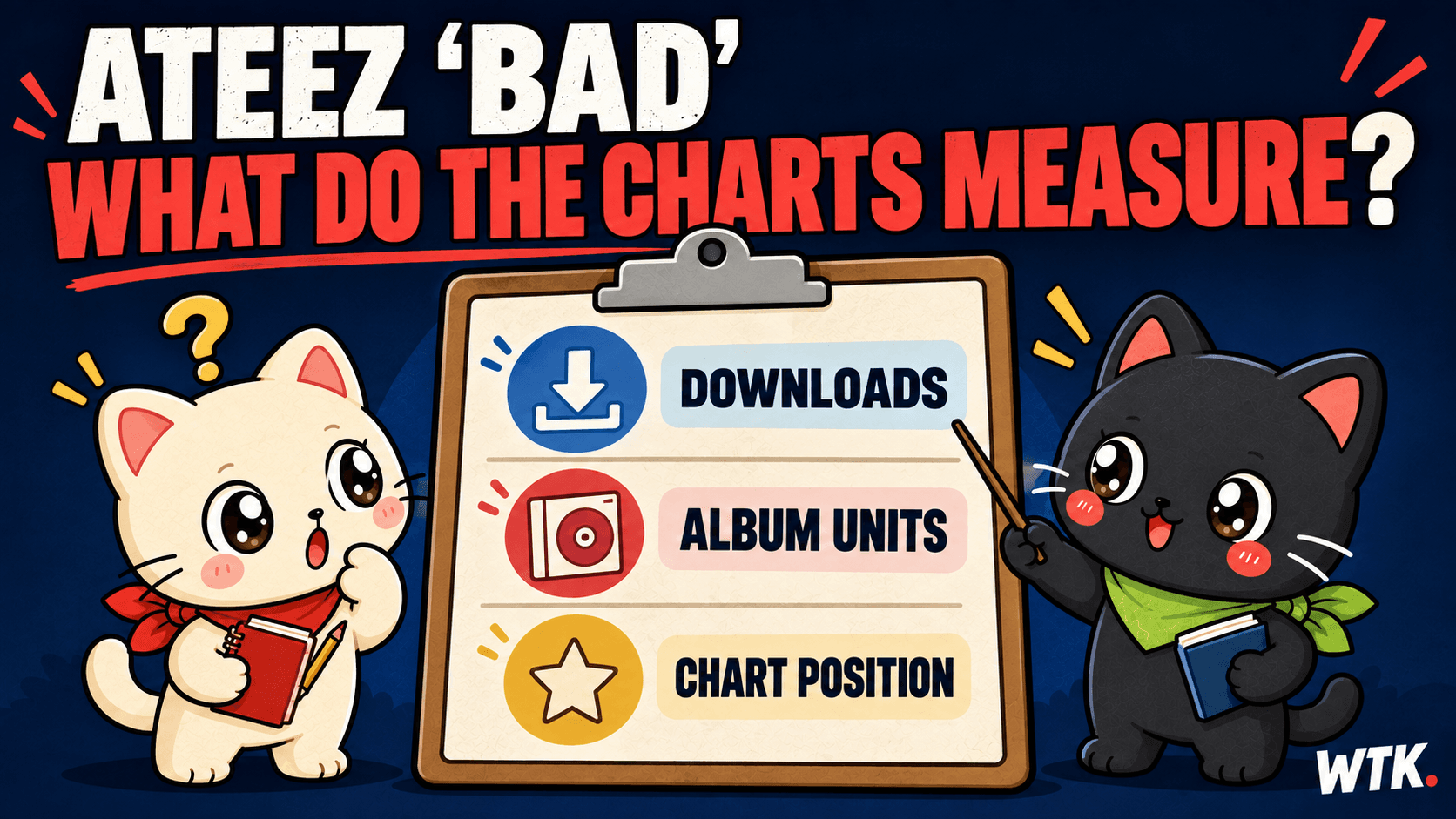
These are different metrics:

  • Billboard 200 measures U.S. album consumption, combining sales and streaming units.
  • Melon TOP 100, daily, and weekly charts reflect listening within one major Korean platform using different time windows.
  • Circle Download Chart measures paid downloads, not the same behavior as streaming.
  • YouTube Music Korea captures another slice of Korean listening and video-linked discovery.

Combining them into one victory number would be misleading. Read together, however, they show a rare alignment: ATEEZ's existing global album power and a new level of Korean song consumption happening around the same release.

Did the challenge cause the hit?

It is tempting to draw a straight arrow from viral clip to chart peak. The timeline supports the challenge as a major discovery engine, but it does not isolate causation.

Several forces moved together:

  • ATEEZ's international fandom supplied immediate views, purchases, edits, and reposts.
  • Music-show stages created new high-quality performance clips.
  • Celebrity challenge partners exposed the song to separate audiences.
  • News coverage told people that a viral event was happening, which created more curiosity.
  • The choreography gave listeners a specific moment to wait for in the full track.
  • Chart milestones themselves became shareable news and encouraged repeat attention.

The best conclusion is narrower: the challenge converted a performance asset into a discovery format at exactly the moment ATEEZ needed a bridge between global fandom scale and Korean general-public listening. It was not the only bridge, but it was the most visible one.

Why “reverse import” is useful—and where it fails

The Korean media has often described ATEEZ as an “overseas-strong” group. Before “BAD,” their international touring, Billboard results, and physical sales could feel larger than their presence on Korea's mainstream streaming charts. In that context, “reverse import” describes recognition returning home after being validated abroad.

But the metaphor can erase Korean labor and audiences. “BAD” was created by a Korean group, released through a Korean company, promoted on Korean music shows, and made viral through a performance by a Korean member. Korean viewers, collaborators, and platforms were not passive recipients of something invented elsewhere.

A feedback loop is more accurate:

global fandom base
        ↓
fast cross-platform circulation
        ↓
Korean non-fan discovery and participation
        ↓
domestic chart and media visibility
        ↓
new Korean challenges, parodies and headlines
        ↓
global redistribution

No stage belongs to only one country. A Korean actor's challenge can reach a drama fan in Brazil; a London performance clip can send a Korean viewer to Melon; a Japanese-language version can renew the sound in another market; an international reaction can return to a Korean community as proof that the trend has traveled.

This is less like exporting a finished product and more like passing a signal around a network.

“BAD” also reverses the usual promotional hierarchy

Traditional comeback promotion asks viewers to care about the whole package: concept photos, teaser schedule, music video, album, stage, then challenge. Short-form culture can invert that order. Many viewers meet the five-second physical hook first and only later learn the song title, group, album, or release date.

That changes what counts as the front door:

  • For a fan, the clip is one piece of an anticipated comeback.
  • For a casual Korean viewer, it may be “that San chest-pop video.”
  • For an actor's fan, Lee Sang-yi may be the entry point.
  • For a baseball viewer, the KBO recreation may come first.
  • For a global Shorts user, the remix, parody, or reaction may precede the original.

The original performance remains essential, but it no longer controls the order in which people encounter it.

Our article on why K-pop idols film dance challenges in stairwells explains the production logic behind these compact collaborations. “BAD” shows the next stage: the promotional unit can detach from the comeback calendar and become a cultural format of its own.

What the breakthrough changes for ATEEZ

One hit does not erase the distinction between a fandom-driven album market and Korea's general streaming public. The meaningful question is whether “BAD” changes the group's baseline after the challenge fades.

Watch four signals:

  1. Catalog discovery: Do new listeners move from “BAD” to older ATEEZ songs?
  2. Follow-up streaming: Does the next title track enter Korean charts higher and hold longer without needing the exact same meme?
  3. Public recognition: Do members appear more often in non-idol variety, advertising, sports, and general entertainment contexts?
  4. Audience conversion: Do challenge viewers become concert listeners, album buyers, or long-term followers rather than one-clip participants?

The strongest legacy would not be another chest-pop challenge. It would be a larger domestic audience ready to listen before the next viral moment arrives.

What “BAD” says about K-pop in 2026

K-pop no longer moves neatly from Korea to “the world.” Songs, clips, jokes, and status signals travel in different directions at different speeds. An act can top a U.S. album chart while still seeking a Korean streaming breakthrough. A Korean performance detail can become global, return as outside validation, be transformed by Korean popular culture, and leave again within weeks.

“BAD” is compelling because all of those layers became visible at once. ATEEZ's global success gave the release scale. San gave the algorithm a moment. Korean participants gave that moment social range. The chart climb gave the story a measurable domestic result. International feeds then carried the expanded story onward.

That is not simply reverse export. It is K-pop behaving as a circulation system—and, for ATEEZ, the loop finally passed through the Korean mainstream.

Sources