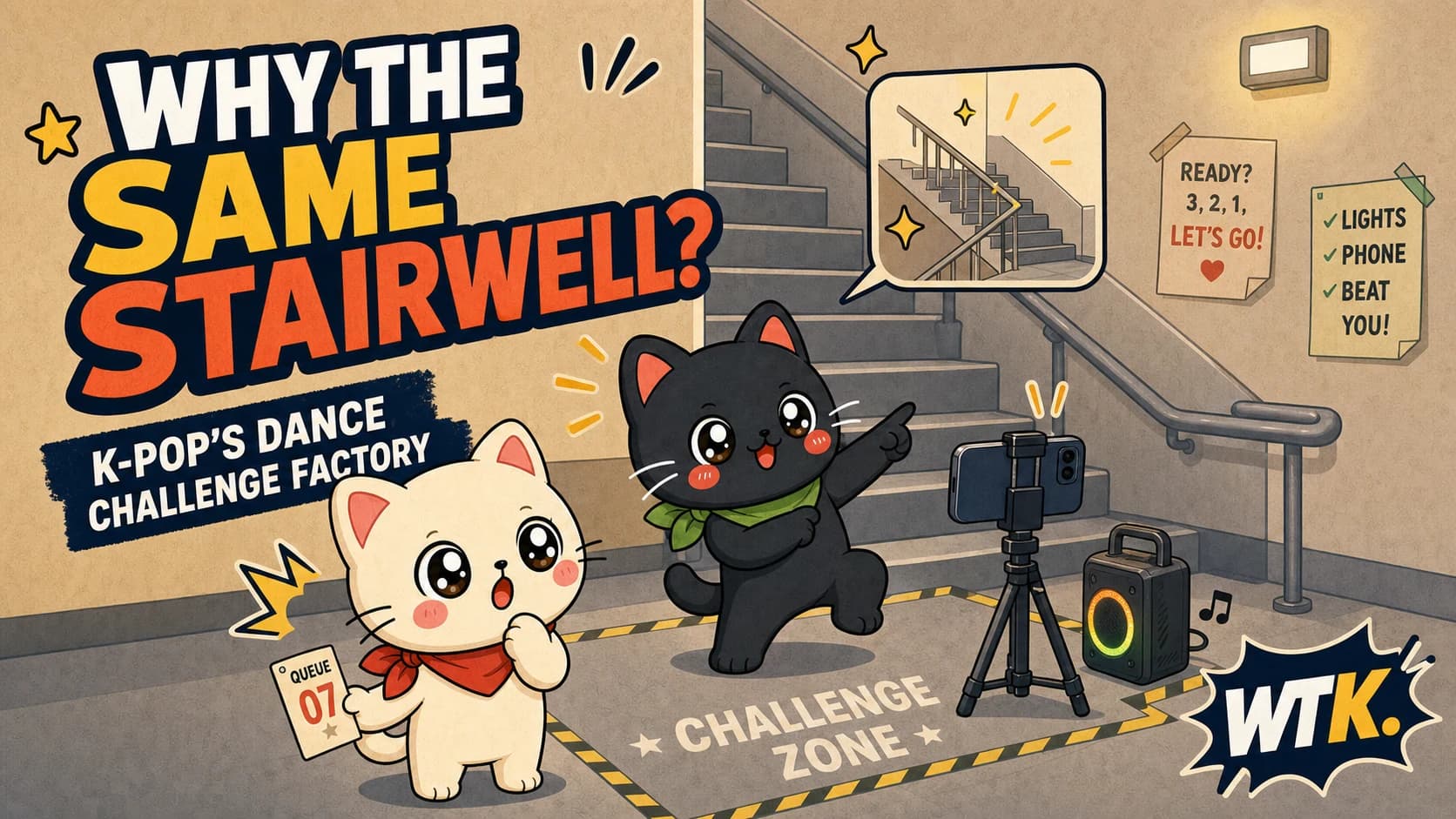
Two idols from different companies appear beside a beige staircase. One teaches a ten-second move, the other learns it suspiciously fast, and by dinner the clip has a million views. Fans see an unexpected friendship. The K-pop industry also sees a tiny, highly efficient studio hiding inside a broadcast station.
That repeated stairwell is not a visual trend that every group independently discovered. It is part of the backstage infrastructure behind the daenseu chaellinji (댄스 챌린지, dance challenge): a promotional format so important that comeback teams now plan the song segment, point choreography, partners, and posting schedule around it.
What is the K-pop stairwell challenge zone?
Yes—the specific stairwell behind the best-known “everyone films here” story is identified as a KBS Music Bank location. The original source is Super Junior's Leeteuk, who explained the setup on episode 860 of MBC's Radio Star, broadcast on March 27, 2024. Reports translating his account consistently identify a designated chaellinji jon (챌린지 존, challenge zone) in front of a Music Bank staircase.
That makes it more precise to say “the Music Bank challenge-zone staircase inside KBS's broadcast facilities” than simply “the famous KBS stairs.” Music Bank is KBS2's weekly music program, and a 2026 artist attendance notice placed a broadcast at KBS facilities in Seoul. However, KBS has not published a public location guide naming the exact stairwell, floor, or backstage route. It is a working broadcast area, not a tourist photo spot.
| What the evidence supports | What it does not prove |
|---|---|
| Leeteuk identified a Music Bank stairwell challenge zone in 2024 | That every stairwell challenge online was filmed at KBS |
| Artists queued and used phones in a designated filming area | That the same queue system and exact spot are unchanged in 2026 |
| Music Bank is produced and recorded at KBS facilities | The exact building, floor, or public access route to the staircase |
When several actively promoting artists record at the same broadcaster on the same day, the building becomes the easiest cross-company meeting place in the industry. A corridor or stair landing can do what weeks of emails cannot: put many polished, camera-ready performers within a few floors of one another.
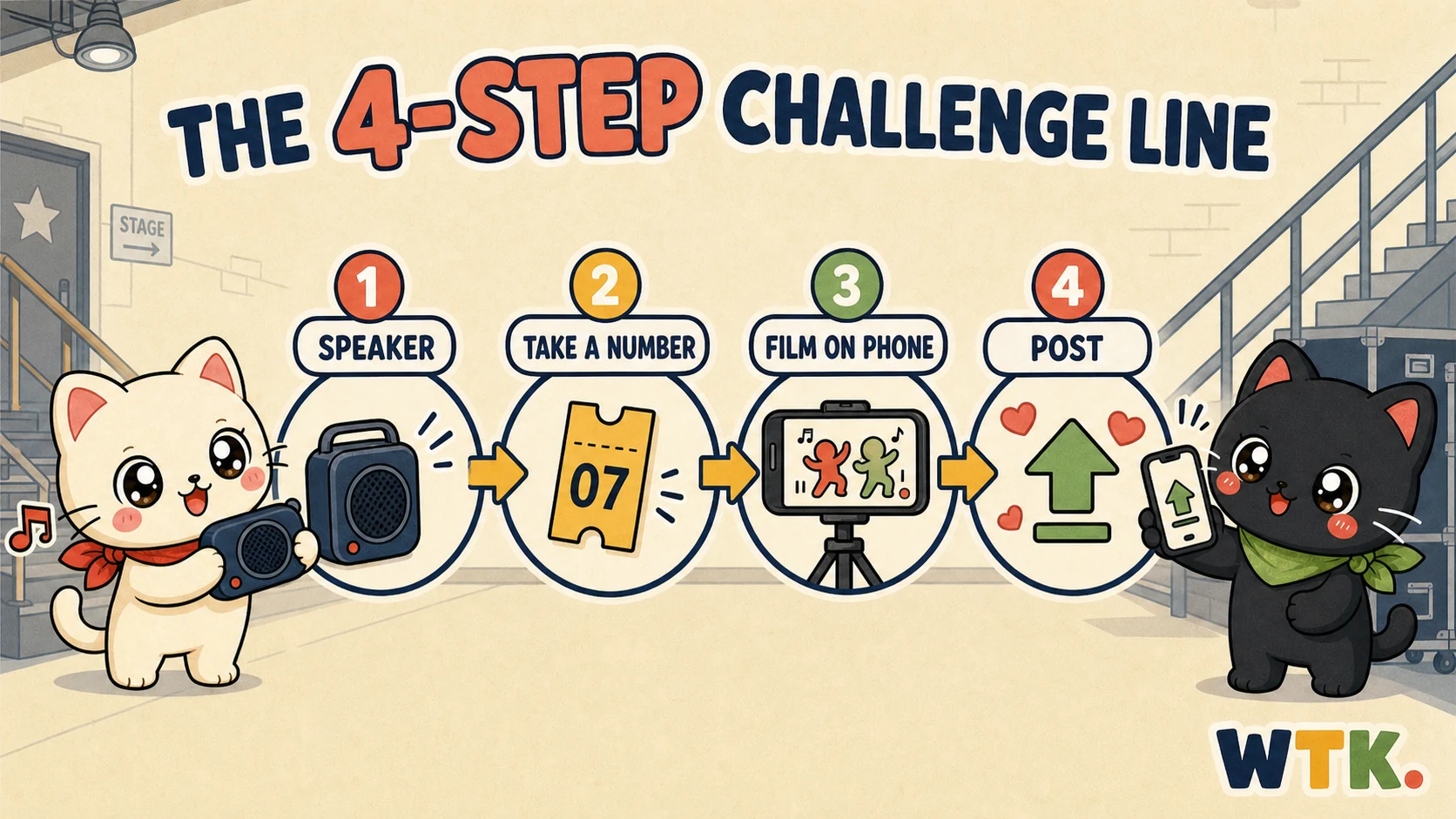
Leeteuk's wonderfully unglamorous description adds the production details. According to reports of his comments, artists prepared a portable speaker, took a number because so many teams wanted to film, waited for their turn, and recorded the video on a phone rather than a broadcast camera.
That is a description of the setup he encountered in 2024, not a promise that every station followed the same procedure in 2026. Not every beige wall online is Music Bank, either. Similar clips are filmed in waiting rooms, practice rooms, corridors, loading areas, and any clean corner with enough space for two people to move.
Still, the stairwell explains the basic logic perfectly. The full music-show stage may require cameras, lighting, rehearsals, and dozens of crew members. The short-form studio requires a phone, a song, two idols, and an empty rectangle of floor.
How a 20-second collaboration actually gets arranged
The finished clip looks like one idol bumped into another and said, “Want to dance?” Sometimes an artist really does suggest a partner. But the reliable version involves managers, social-media teams, and a gap in the broadcast schedule. The useful version for viewers is much shorter than a company operations manual:
- Choose the hook. Before comeback week, the team isolates roughly 15–30 seconds of chorus, rap, or killing part (킬링 파트, most memorable section) that works in a vertical frame.
- Find an available partner. Staff check the chulyeonjin (출연진, performer lineup) and ask an artist whose music-show schedule overlaps. Friends, labelmates, seniors, rookies, and deliberately surprising combinations all create different stories.
- Meet at the challenge zone. Between sajeok nokhwa (사전 녹화, prerecording), rehearsals, interviews, and the live show, the two teams find a short shared window. At the 2024 Music Bank setup described by Leeteuk, that also meant taking a number and waiting at the stairwell zone.
- Teach, rehearse, and film. The artist whose song is playing teaches the point move, starting count, direction, and expression. A staff member records vertically and checks the framing. Several practice runs or takes can sit behind one effortless upload.
- Swap songs and post later. If both artists are promoting, they often reverse roles and film a second clip. Each company can then release its own song's version on a separate schedule.
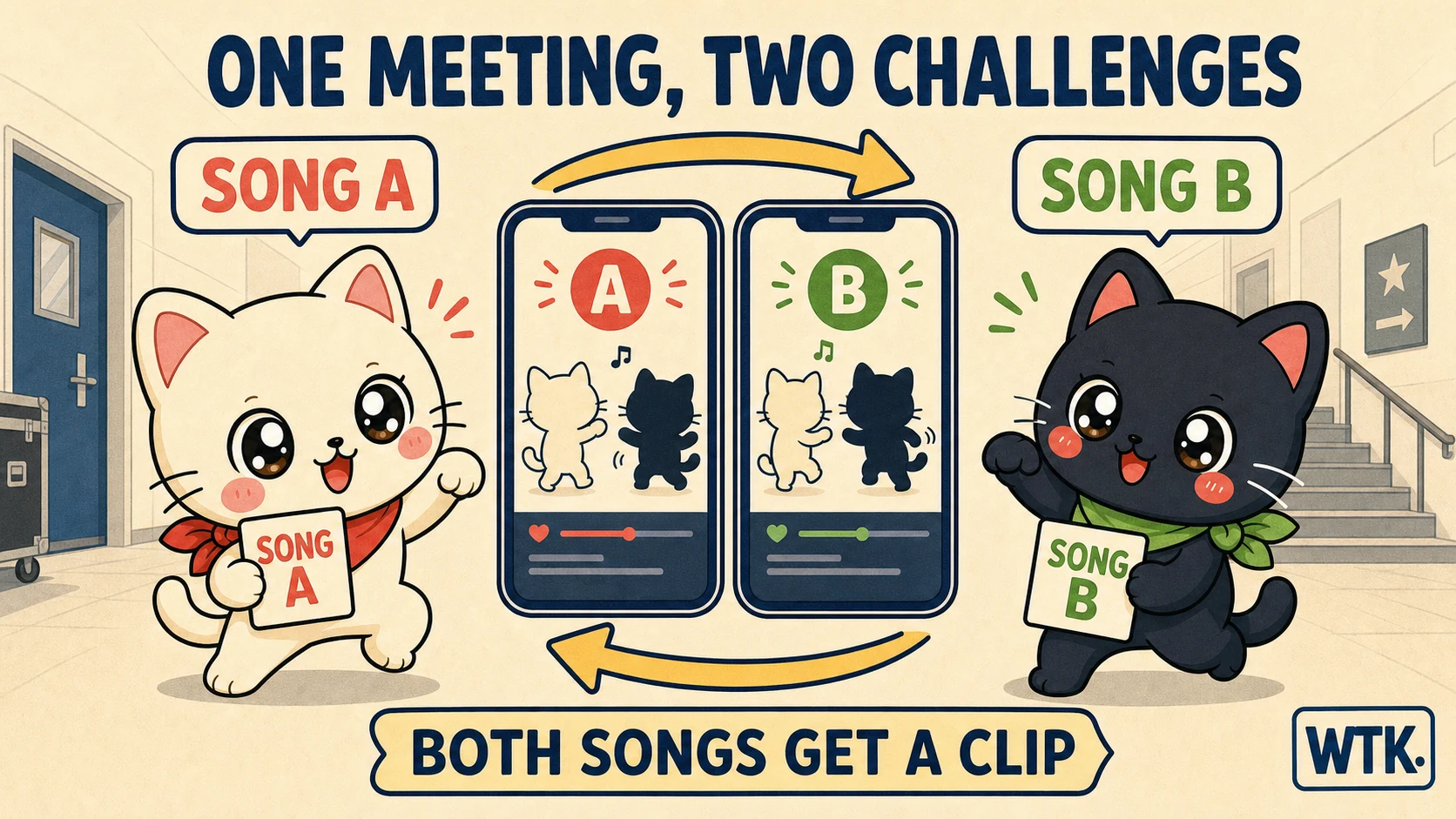
The transaction is not necessarily cold. Friends can joke, senior artists can encourage rookies, and dancers can genuinely enjoy learning one another's work. The useful distinction is that real chemistry and planned distribution can exist in the same video.
Why K-pop point choreography looks deceptively easy
In July 2026, Korean business outlet Bizhankook described dance challenges as a central hit-making device rather than a bonus promotion. Its reporting noted that agencies often plan a challenge-specific song section and choreography around a release. The clip is usually about 30 seconds, built around a chorus or a repeatable point move.
That does not mean the whole dance has become easy. It means a comeback often needs two levels of choreography:
| Layer | What it must do |
|---|---|
| Full stage choreography | Showcase the group's skill, formations, concept, and live performance |
| Challenge hook | Be recognizable in seconds, fit a vertical frame, and survive imperfect imitation |
Performance directors interviewed by Marie Claire made the trade-off clear when discussing KATSEYE: choruses can be simple, catchy, and replicable, while verses still carry the show-stopping choreography. The challenge is an invitation, not the entire dance.
This is why a small hand sign can matter as much as a difficult turn. A successful killing part (킬링 파트, the most memorable moment) works at three speeds: an idol can perform it sharply, another artist can learn it quickly, and a fan can recognize it before scrolling away.
The same design helped ILLIT connect a new song to an older Korean pop era. In our story of “It's Me” and Lee Jung-hyun's “Wa”, the official mashup challenge became a 20-second pop-history lesson.
What one dance challenge actually does for a comeback
The visible product is dancing. The real product is a chain of effects that moves a song, an artist, and two fandoms through the same 20-second clip.
1. It introduces a song without asking anyone to search for it
A conventional advertisement says, “This artist released a song—please click.” A challenge gives the viewer the chorus first. The song arrives inside entertainment, friendship, surprise, or comedy, so someone can learn the hook before knowing the title or group.
That reversal matters. The viewer does not begin as a fan searching for a comeback. The clip finds the viewer, repeats the recognizable section, and only then creates curiosity about the full track, stage, or music video. The challenge is therefore less like a miniature performance and more like a portable sample of the song's identity.
2. It connects two fandoms that may never share a feed
When Artist A posts with Artist B, both fandoms have a reason to watch, identify, clip, translate, and repost. Artist B's name pulls their followers toward Song A; a reciprocal clip later carries Artist A's audience toward Song B.
This is why the strangest pairing can be more useful than the technically best dance. Two labelmates are easy to arrange, but two artists with opposite concepts create a question: “What do they look like together?” The collaboration earns attention before the music even starts.
| Pairing | Effect created |
|---|---|
| Senior + rookie | The senior lends recognition and a visible gesture of support |
| Friends or former trainees | Fans receive a reunion story, not just choreography |
| Idol + actor or comedian | The song reaches beyond the normal K-pop audience |
| Strong dancer + unexpected song | Viewers watch for reinterpretation and skill |
| Opposite concepts | Contrast creates humor and shareable surprise |
| Two simultaneous comebacks | Each artist can exchange access to the other's fandom |
The result is a temporary bridge between communities that platforms would otherwise keep in separate recommendation bubbles.
3. It transfers status and social proof
A challenge partner is also a public endorsement. When an established artist learns a rookie's choreography, the clip quietly tells viewers that the newcomer is worth their time. When a respected dancer joins, the point move receives a performance credential. When the original choreographer or an older-generation singer participates, the clip can act as a tiny seal of authenticity.
The effect does not require anyone to say, “I recommend this group.” Simply spending limited backstage time on the song is enough to signal recognition. In an industry where dozens of acts can promote in the same month, that borrowed attention is valuable.
The official “It's Me × Wa” clip discussed in our ILLIT and Lee Jung-hyun techno story did more than promote a hook. It made the connection between a 2026 song and Korea's 1999 techno wave visible in one frame.
4. It turns an idol image into a small story
Music videos present controlled characters. Challenges let those characters bend. A serious performer smiles after missing a move. A powerful dancer makes a cute chorus look sharp. A shy rookie receives encouragement from a senior. A height difference or last-second improvisation becomes the detail fans remember.
These moments create chemistry content: viewers rewatch not only to learn the dance but to inspect eye contact, timing, laughter, and who helped whom. One recording can produce reaction posts, translated captions, friendship compilations, and memes far beyond the original account.
This also softens K-pop's public image of nonstop rivalry. Charts, awards, and concert ticketing encourage fans to think of groups as competitors. A challenge temporarily replaces that frame with cooperation: “I will enter your concept, and you can enter mine.”
What it does not prove is a private relationship. One clip cannot establish that two artists are best friends, dating, or secretly feuding because someone looked awkward. Fans are reading a promotional artifact, not security-camera footage.
5. It crosses language borders more easily than an interview
A dance hook does not need subtitles. The song, guest face, repeated gesture, and visual reaction can make sense before a viewer understands one Korean lyric. Fans can also participate without translating a full verse: copy the move, use the official sound, and add a personal variation.
That low language barrier gives one Korean broadcast-day clip several lives. It can be watched as idol interaction in Seoul, imitated by a dance creator in Bangkok, turned into a comedy edit in Mexico City, and used as a tutorial sound in Paris. The same gesture becomes a distribution format.
6. It can extend—or even change—the life of a song
Comeback promotion normally has a short clock. Challenge clips let a company release new pairings across several weeks without filming a new music video each time. Every guest creates a slightly different entry point into the same chorus.
The audience can also reject the planned hook and choose another part. A rap line, facial expression, or fan-made move may outperform the official version, leading the artist's team to make follow-up clips around what viewers actually adopted. Older songs can return when a new meme gives one forgotten section a repeatable action.
The challenge therefore works in both directions:
Company plans a hook → idols demonstrate it → fans copy or remix it
                         ↑                         ↓
                  later posts adapt ← audience chooses the memorable part
The company starts the experiment, but it does not fully control the result.
The hidden labor behind the casual phone video
The plain wall makes everything look effortless. That is part of the format's charm—and its trick.
An idol may have started hair and makeup before sunrise, completed multiple stage rehearsals, performed the same title track several times for broadcast editing, greeted fans, recorded interviews, and learned several other groups' hooks before filming the clip you see. Styling must remain camera-ready. Staff must find the partner, clear the music, manage the queue, hold bags and coats, and fit two bodies into a vertical frame.
For rookies, a challenge with a famous senior can be exciting and terrifying. For veterans, the expanding number of requests can turn a playful idea into another obligation. The queue ticket in Leeteuk's story is funny because it reveals the scale: spontaneity became popular enough to need traffic control.
There is also no guarantee of equal payoff. A clip can be lovingly arranged and receive modest attention. Another can escape its marketing plan because of a mistake, facial expression, height difference, or unexpected chemistry. K-pop companies manufacture the opportunity; audiences decide which detail becomes the story.
What happens after the challenge is posted?
The clip enters a recommendation system that rewards clear, immediate signals. TikTok explains that its For You feed weighs user interactions, video information such as sounds and hashtags, and whether viewers finish watching. Follower count is not itself a direct recommendation factor.
That makes the K-pop challenge unusually well adapted to short-form distribution:
- the familiar sound identifies the comeback
- the point move gives viewers something to anticipate
- the guest artist pulls in a second audience
- the short runtime encourages completion and replay
- fan covers generate more videos using the same sound
- comments and shares tell the platform which pairing is worth spreading
The promotional loop can continue beyond the official account. Fans imitate the move, dance crews improve it, comedians break it, and other idols personalize it. A song may reach viewers who never searched for the group and do so without requiring translation.
Views are not identical to chart success, however. Music royalties, platform creator revenue, label benefits, and artist compensation follow different contracts and distribution systems. Korean industry reporting emphasizes that companies value challenges mainly for exposure and voluntary participation, even though music usage can also generate rights revenue. A viral clip is a doorway to a song—not proof that everyone who watched streamed it afterward.
How to read a K-pop challenge like an insider
The next time two idols appear in a suspiciously familiar corridor, look for production clues rather than treating the clip as a random encounter:
- Whose song is playing? That artist is the promotional host.
- Does a second clip exist? Reciprocal challenges suggest a planned exchange.
- Are they in stage outfits? The video was probably captured during a shared music-show day.
- Who confidently leads the move? Usually the artist whose choreography is being promoted, though famous dancers sometimes learn so quickly that this becomes hard to tell.
- When was it posted? A delayed upload may be filling a carefully planned comeback calendar.
- What is genuinely spontaneous? The schedule may be arranged while the joke, mistake, or personal flourish is completely real.
K-pop's stairwell challenge is a perfect miniature of the industry. It combines strict scheduling with apparent casualness, difficult training with an easy hook, competition with cooperation, and a broadcast building with a global phone feed.
The staircase is not glamorous. That is exactly why it works. For 20 seconds, the smallest studio in K-pop makes the entire industry look like everyone simply met between floors and decided to dance.
Sources
- MBC: Radio Star episode 860 with Leeteuk, March 27, 2024
- AND2BLE Weverse notice: 2026 Music Bank broadcast at the KBS Annex
- Weverse Magazine: Five K-pop short-form trends on TikTok
- Bizhankook: How dance challenges became essential K-pop marketing
- Koreaboo: Leeteuk describes Music Bank's stairwell challenge zone
- TikTok Newsroom: How the For You recommendation system works
- Marie Claire: KATSEYE's performance directors on replicable chorus choreography