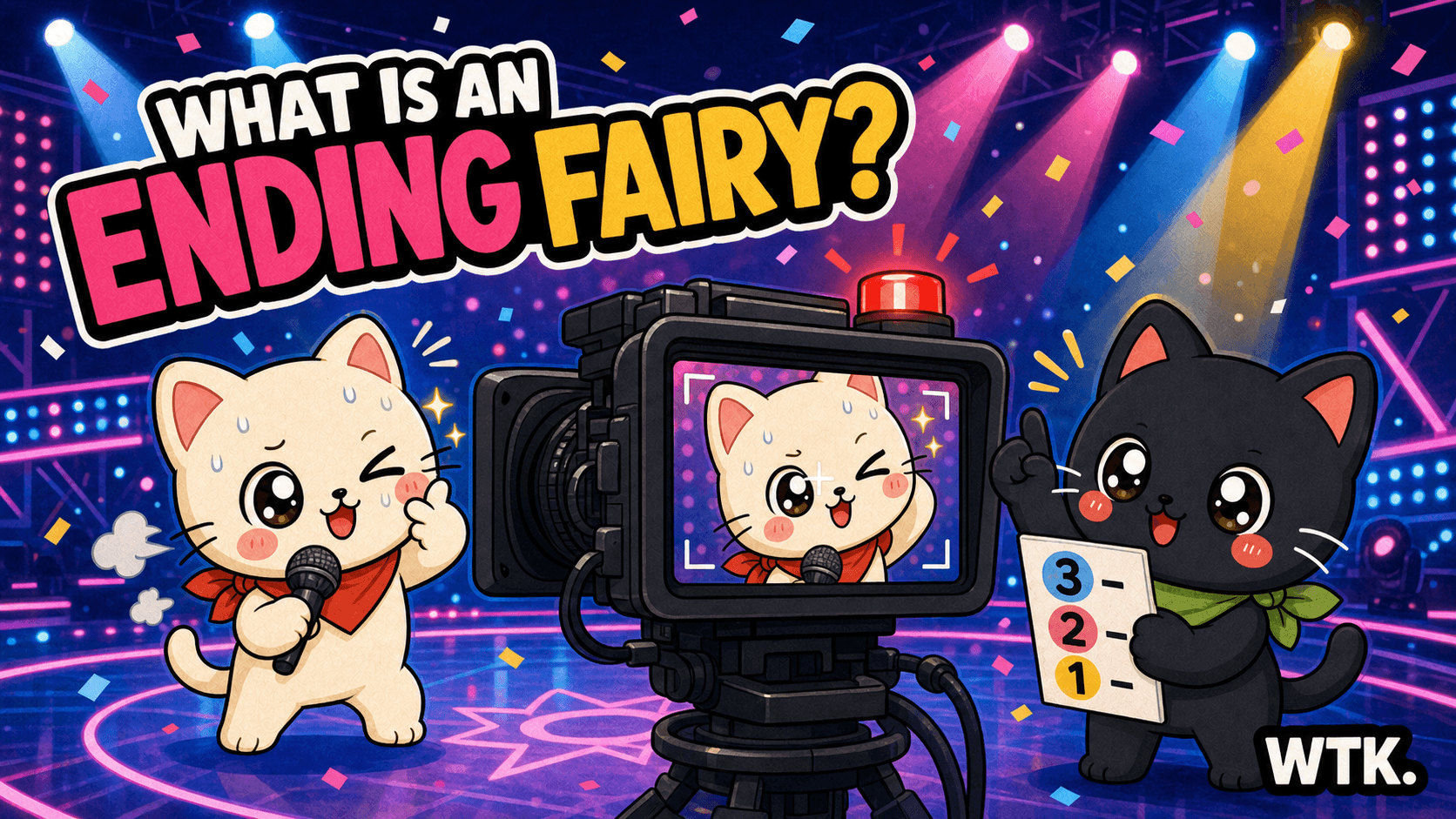
The song stops. Thirty dancers freeze. Then the camera ignores almost everyone and parks inches from one idol's face while they stare, wink, gasp, or pretend not to be fighting for oxygen.
That tiny post-song performance is the ending fairy (엔딩 요정, ending yojeong). It lasts only a few seconds, but it can produce the most replayed GIF, screenshot, or meme of an entire comeback.
What exactly is a K-pop ending fairy?
An ending fairy is the person featured in the last close-up of a Korean music-show stage. It is not a formal position like leader, main vocalist, or center. It is a camera assignment—and the assignment can change from one performance to the next.
The basic recipe is beautifully awkward:
- Finish a choreography designed to raise your heart rate.
- Find the correct camera immediately.
- Hold a flattering expression while visibly breathing.
- Add a wink, heart, prop, joke, or plot twist before the director cuts away.
The Korean word yojeong (요정) literally means “fairy,” but Korean entertainment language also uses it playfully for someone who owns a particular moment. An idol does not grow wings at the end of the song. They become the magical little face viewers remember after everything else disappears.
This is different from a dance challenge filmed backstage. A challenge is a separate promotional clip. An ending fairy is built into the broadcast performance itself.
The close-up existed before the nickname
It is tempting to ask who “invented” the ending fairy, but two ideas often get mixed together. Television directors had used final close-ups long before the term became standard. What changed was that one close-up became famous enough to turn an ordinary camera choice into a named ritual.
During the first season of Produce 101 in 2016, Jung Chaeyeon ended a performance of Girls' Generation's “Into the New World” with a calm, breathless close-up. The image spread widely, and viewers attached the ending fairy nickname to her. Later that year, Chaeyeon herself recalled receiving an unusually strong response and being called the ending fairy.
The survival-show setting mattered. On Produce 101, a trainee did not need three minutes of center time to change her ranking story. A few perfect seconds could become a GIF, a search term, and a reason for viewers to remember her before voting. The following season made the final shot feel even more like a miniature audition, with trainees competing through winks, smiles, and direct eye contact.
So Chaeyeon is best understood not as the inventor of ending a song on a face, but as the person whose viral moment popularized the modern format and name.
Who chooses the ending fairy?
Fans sometimes imagine a camera operator suddenly falling in love with one member at the last second. The real process can be much less romantic.
When NMIXX asked KBS staff how Music Bank chooses an ending fairy, the production team described a planned discussion. The program's producer proposes candidates, senior camera staff compare opinions, and the selection is finalized around the recording. Different shows and stages may work differently, but the explanation confirms one important point: the final face is often part of the shot plan.
That makes sense. Music-show camera crews rehearse where members will stand, how the choreography moves, and which lens must be ready. Missing the idol at the ending pose would leave viewers admiring an empty patch of stage.
The choice can reward the song's center, highlight a member with a killing part, rotate attention across a promotion cycle, or simply favor the person who best matches that day's concept. It is valuable screen time, but it is not a scientific ranking of who is the prettiest or most popular.
Five seconds became a comedy genre
Once everyone knows the rule, breaking it becomes funnier than following it.
The classic ending fairy holds a beautiful expression while panting. SHINee's Key turned that convention into comedy by exaggerating the breathing and treating the close-up like an endurance event. On another stage, he held a handwritten sign joking that he was retiring from ending-fairy duty. WINNER's Yoon used a sign to ask for “one more second,” extending the joke beyond the time the show had given him.
Other idols have stared blankly, passed the camera to a member, pulled objects from behind their backs, or built multi-person endings that feel like a tiny sketch. The format works because the audience already understands the invisible instruction: look impossibly perfect now. Every refusal, failure, and overreaction becomes a punchline.
It is similar to decorating a K-pop photocard. The frame is tiny and standardized, so personality comes from what an idol manages to do inside it.
Why ending fairies still matter
An ending fairy turns a live television ending into a vertical-video-ready unit. The close-up is easy to crop, loop, caption, and share. It gives fans a clean reaction image and gives casual viewers one face to connect with a group.
But its real charm is the clash between polish and reality. K-pop performance promises perfect synchronization; the ending close-up catches the second immediately after that perfection, when an idol is sweaty, winded, and still expected to act charming. The camera asks for fantasy at the precise moment the body reveals the work.
That is why the best ending fairies are not always the prettiest still images. Sometimes they are the ones that admit how strange the whole assignment is.
How to watch an ending shot like part of the performance
The useful question is not only “who got the camera?” Watch how the idol connects the final pose to the song. A dramatic track may end with held eye contact; a playful comeback may use a prop, joke, or deliberately exaggerated breathing. Group members can coordinate a chain of poses, while a solo close-up may reward the performer who carries the final musical line.
Compare the broadcast stage with a full-cam or rehearsal when available. The wide view shows where members were standing and how quickly the selected idol had to find the lens. The broadcast edit shows the producer’s story: which face closes the performance, how long the shot lasts, and whether the camera cuts among members. That comparison makes the ending fairy a lesson in live television rather than a popularity scoreboard.
Selection practices vary by program and recording. A staff explanation from one music show should not be generalized into a permanent rule for every network. Line distribution, choreography, promotion plans, camera rehearsal, and day-of-recording decisions can all affect the final frame. For another piece of music-show infrastructure that viewers often mistake for spontaneity, see why idols film dance challenges in the same stairwell.
A repeatable way to compare two stages
Write down the program, air date, song section, camera duration, and whether the clip is a broadcast edit, fancam, or rehearsal. Then compare the final eight counts: who finishes the choreography, when the close-up begins, whether the performer addresses the lens, and where the edit cuts. Do not infer popularity from one frame without checking line distribution and stage blocking. These notes turn a viral moment into an observable production choice and make comparisons across comebacks possible without pretending to know an unseen producer's motive.
Sources
- Soompi — Jung Chaeyeon recalls being called the “ending fairy” after Produce 101
- Soompi — Jung Chaeyeon's famous ending is revisited during Produce 101 Season 2
- Allkpop — Music Bank staff explain how ending fairies are selected
- StarNews — SHINee's Key discusses the pressure and fun of ending-fairy poses (Korean)
- YG LIFE — WINNER's Yoon asks for one more second in his Inkigayo ending