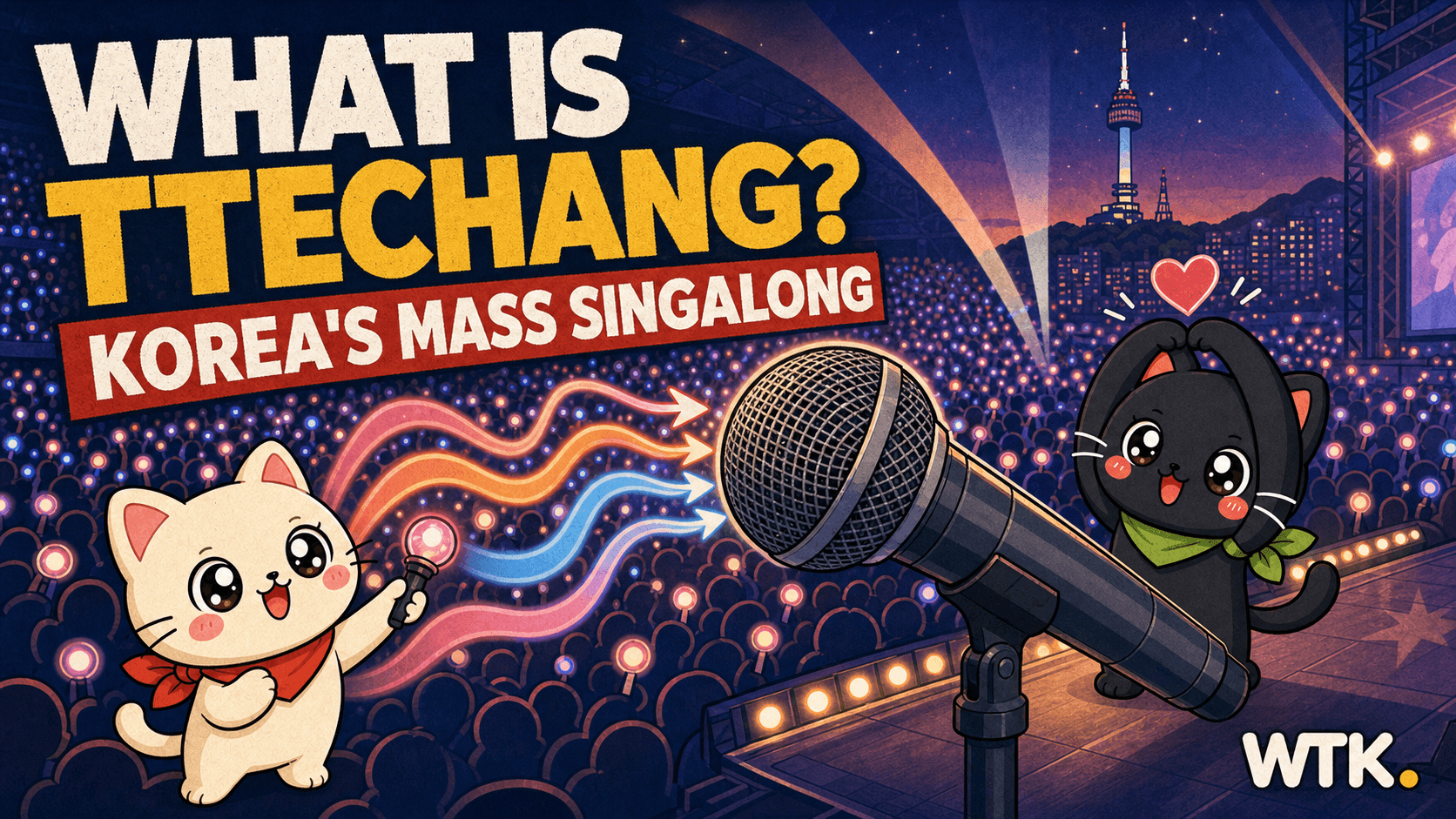
The singer stops. The band keeps playing. Instead of a few voices filling the gap, thousands of people deliver the next line together—sometimes in a language they do not speak in daily life.
Koreans call this ttechang (떼창), the mass singalong that has become a signature of concerts in Seoul. It can turn an international star's familiar hit into a startling new experience: the artist hears the song coming back from the audience as one enormous voice.
What does ttechang actually mean?
Tte (떼) means a group, crowd, or swarm. Chang (창) refers to singing. Put them together and ttechang means collective singing by a large group.
At a concert, the word usually describes more than joining an obvious chorus. A Korean audience may sing verses, backing lines, instrumental hooks, and transitions with remarkably consistent timing. The performer can lower the microphone and let the crowd carry a full section.
It is not uniquely Korean to sing at a concert. Football terraces, gospel churches, festivals, musical theater audiences, and rock stadiums around the world all have powerful communal singing traditions. What visitors notice in Korea is the combination of preparation, precision, volume, and willingness to sing foreign-language lyrics from beginning to end.
Korean has several nearby concert words:
- Ttechang (떼창) is mass singing.
- Eungwonbeop (응원법, fan-chant method) is a planned set of responses at exact moments in a song.
- Changtta (창타), less essential for visitors, can refer to rhythmic chant-like participation in some fan contexts.
- Slogan event (슬로건 이벤트) is a coordinated moment when fans raise paper banners carrying one message.
These practices can appear in the same show, but they are not interchangeable.
Ttechang versus a K-pop fan chant
A K-pop fan chant functions almost like an additional arrangement. The agency or fan community marks the lines, names, or syllables the audience should shout. Fans may call all members' names in order, echo the final word of each line, or fill a gap deliberately left in the track.
Ttechang is less surgical. The audience sings the song itself.
| Audience action | Fan chant | Ttechang |
|---|---|---|
| Member names shouted in a fixed order | Yes | Not required |
| Selected words placed between vocal lines | Yes | Sometimes |
| Full verse or chorus sung with the artist | Usually no | Yes |
| Official practice video may exist | Common in K-pop | Rare |
| Can happen at a foreign artist's concert | Occasionally | Very common |
The distinction explains why an international musician can encounter “K-pop-style” audience energy without performing K-pop. Korean fans transfer skills learned from domestic fandom—memorizing cues, coordinating projects, treating audience response as part of the show—to rock, hip-hop, R&B, and pop concerts.
How Korean audiences prepare one giant voice
The effect sounds spontaneous from the stage, but much of the infrastructure exists before the doors open.
Fans circulate likely set lists from earlier tour stops. They make playlists in concert order, post lyric translations and phonetic guides, and identify the sections where an artist usually points the microphone outward. Fan accounts announce banner projects or recommend a song for the encore wait. Friends practice in line.
This preparation does not mean every attendee has rehearsed formally. Korea has a dense noraebang (노래방, singing-room) culture, and popular foreign songs circulate through advertising, films, television, cafés, streaming charts, and karaoke. By concert night, thousands of individual listening histories can lock into the same tempo.
Language works differently in a song. A fan may not hold a conversation in English but can memorize sound, rhythm, and meaning through repetition. Noel Gallagher noticed exactly this: Korean fans were chanting complete English songs written decades and thousands of kilometers away.
Ne-Yo in 2008: “Do you really know my songs?”
One revealing early example came at Ne-Yo's first Seoul concert on April 6, 2008. The American R&B singer arrived unsure how deeply the audience knew his work. According to The Korea Times' concert report, he playfully tested the crowd by asking people to sing if they recognized songs he had written for other performers.
The response surprised him. The report described a loud reception and said Ne-Yo promised he would return. The important detail is the initial doubt: international chart success did not automatically tell a touring musician in 2008 whether a Korean audience had absorbed the catalog beyond one single.
Ttechang converted invisible listening into evidence. A crowd singing material beyond the most obvious hit told the songwriter that his work had traveled further than sales figures could make emotionally real.
Eminem in 2012: the rapper who made overhead hearts
Eminem's first Korean concert produced one of the most replayed ttechang stories. More than 20,000 people filled the auxiliary stadium at Seoul's Jamsil Sports Complex on August 19, 2012, for the final stop of his Recovery Tour.
Rap makes mass singing technically difficult: lyrics arrive faster, contain more words, and leave fewer sustained vowels for a crowd to share. Yet contemporary reports said the audience followed songs including “Stan,” “The Way I Am,” and “Love the Way You Lie.” Korean coverage also listed “Sing for the Moment,” “Toy Soldiers,” “Not Afraid,” and “My Name Is” among the loudest moments.
The Korea Times wrote that Eminem appeared visibly touched. The famously guarded rapper repeatedly raised both arms over his head to form heart shapes—a gesture Korean reports interpreted as thanks for the mass singalong. Photographs and accounts from the night also noted the unusual sight of him smiling.
It would be excessive to claim that ttechang transformed his personality. What can be verified is simpler and more striking: an artist not known for sentimental stage gestures answered a Korean crowd's word-for-word rap with multiple giant hearts.
Coldplay in 2017: Seoul finally joins the tour map
Coldplay played its first concerts in South Korea on April 15 and 16, 2017, at Seoul's Olympic Stadium. Demand led to a second date, and the stadium repertoire—“Yellow,” “Fix You,” “Viva la Vida,” and “A Sky Full of Stars”—was almost engineered for collective voices.
During the shows, Chris Martin repeatedly praised the Korean audience and improvised a short song for Korea. The Korea Times' review reported that he called the crowd the tour's best audience more than once.
Coldplay already knew stadium singalongs from around the world, which makes the reaction meaningful in a different way from Ne-Yo's surprise. Seoul was not teaching the band that audiences can sing. It was demonstrating how much pent-up participation had built up while Korean fans waited years for a local show.
The relationship later deepened through Coldplay's collaboration with BTS on “My Universe.” Ttechang did not cause that project, but the Seoul concerts showed the shared idea at its center: English and Korean voices can occupy one pop song without one language needing to disappear.
Noel Gallagher in 2019: every English word, decades later
Noel Gallagher may be the foreign rock musician most closely associated with Korean ttechang. Oasis songs, particularly “Don't Look Back in Anger,” function as communal standards in Korean rock audiences. Fans do not wait for the chorus politely; they know the catalog.
After Noel Gallagher's High Flying Birds performed in Seoul in May 2019, he described Korean fans through a comparison with Irish audiences in Europe. He said both possessed spirit, emotional depth, a love of singing, and a certain joyful craziness.
His most revealing observation concerned age. Gallagher saw young Korean listeners cry while singing Oasis songs released before many of them were born. In his interview with The Korea Times, he marveled that a song written for young people in Manchester could move teenage girls in Korea more than three decades later.
That is what ttechang reveals to a songwriter. Streaming data can show that an old song still plays. A room of young people singing every word shows that the song has escaped its original generation, country, and accent.
Gallagher's repeated Korean visits, rapidly sold-out shows, and playful relationship with local fans grew around that feedback loop. The audience loved singing the songs; he clearly enjoyed handing the songs back to them.
MIKA in 2023: 10,000 voices after a seven-year wait
MIKA returned to a Korean audience at the Seoul Jazz Festival on May 26, 2023, after a seven-year gap that included a pandemic-canceled show. Around 10,000 people gathered in the Olympic Gymnastics Arena.
The reunion was unusually physical. MIKA crossed barriers and entered the standing crowd twice, shrinking the distance between stage and audience. Fans sang “Lollipop,” “Big Girl,” “Tomorrow,” “Underwater,” and other songs, including passages that demand high sustained notes.
Yonhap reported that he briefly struggled to continue while recalling the canceled concert. He told the audience that after seven years they had become even better than before and repeatedly showed his happiness as the arena sang. He closed with “We Are Golden.”
MIKA had experienced Korean ttechang on earlier visits and discussed his affection for it in interviews. This performance therefore was not the shock of a first encounter. It was recognition: the artist and crowd resumed a relationship by proving they still knew how to sing together.
Kawasaki Takaya in 2026: emotion crossing Japanese and Korean
The clearest recent first-person explanation came from Japanese singer-songwriter Kawasaki Takaya after the 2026 Seoul Jazz Festival. About 3,000 people attended his stage, where he performed hits including “Magic Carpet” and prepared a cover of Paul Kim's Korean ballad “Every Day, Every Moment.”
In a May 21 interview published after the festival, Kawasaki called Korea's singalong culture both surprising and moving. He contrasted it with his experience in Japan, where audiences generally begin singing together after the performer explicitly asks them to. Korean fans, he observed, participate proactively and make themselves part of the performance.
His explanation goes beyond volume. Fans told him they had connected with lyrics written in Japanese. To Kawasaki, their response showed that emotional understanding can cross a language boundary. He answered with the same gesture in reverse: learning a Korean song for the Seoul stage.
This is ttechang at its most interesting. It is not Korean listeners proving they can pronounce foreign words. It is artist and audience taking turns traveling toward each other.
Why ttechang can move even stadium veterans
Artists hear singing audiences around the world, so why does the Korean version so often produce visible surprise?
First, the language gap changes the meaning. When thousands of people rap Eminem verses or sing an Oasis B-side in English, the preparation is audible. The crowd is not merely responding to a beat; it has carried the work across translation.
Second, Korean concert participation often feels organized without a conductor. The same fandom networks that coordinate ticket information, light-stick colors, birthday projects, and dance challenges also distribute the knowledge needed for a singalong.
Third, the crowd gives the performer a measurable pause. An artist can stop singing and hear whether the song survives. When the next line lands at full volume, the emotional message is direct: we did not come only to watch you; we brought the song with us.
Is every Korean concert one nonstop singalong?
No. “Korean audiences always sing every lyric” is a romantic stereotype, not a rule.
The atmosphere varies by genre, venue, fandom, age, seating policy, and the artist's own preferences. Ballad audiences may listen quietly during delicate verses. K-pop fans may prioritize official chants so they do not cover the singer. Classical and jazz settings follow different etiquette. Phone recording can also reduce visible participation.
There is an important courtesy line. Loudly singing a soft song directly into another person's ear is not automatically good fandom. Watch the stage and surrounding section: if the artist extends the microphone, the crowd surges, or a project has been announced, join in. If the room becomes silent, let silence be part of the arrangement.
Visitors should also distinguish participation from performance quality. A quiet crowd may be intensely attentive; a loud crowd can sing out of time. Ttechang is powerful when collective timing serves the concert rather than competing with it.
Practice ttechang with a home karaoke microphone
The easiest place to learn a chorus is a noraebang, but you do not need to recreate an entire singing room at home. A portable Bluetooth karaoke microphone combines a microphone, small speaker, rechargeable battery, and simple echo controls in one device. Connect a phone for the backing track, open the likely concert set list, and practice the chorus and cue lines with friends.
This is a home practice and party tool, not concert equipment. Most venues prohibit outside amplification, and holding up a microphone in the audience can block views or confuse security. Take the lyrics you learned to the show; leave the device at home.
Before buying, check what the listing actually includes:
- Speaker built in: Some products called “wireless microphones” require a separate receiver or speaker. A one-piece karaoke mic should state that it has its own speaker.
- Playback method: Confirm Bluetooth audio works with your phone. Bluetooth devices need compatible profiles, so a version number alone does not guarantee every feature.
- Charging connection: USB-C is convenient, but verify the supplied cable, required input, battery condition, and seller's charging instructions.
- Controls: Separate microphone volume, music volume, and echo controls are more useful than decorative voice effects.
- Condition and returns: For a used unit, ask whether the battery holds a charge and whether the speaker distorts at normal volume.
Small all-in-one microphones favor convenience over sound quality. They are suitable for learning timing in a living room, not recording studio vocals. Keep the volume reasonable, use the supplied or manufacturer-approved charging equipment, and stop using a device that becomes unusually hot, swollen, damaged, or difficult to charge.
How to join ttechang at a concert in Korea
You do not need perfect Korean or English. Preparation matters more than accent.
- Check the artist's recent set lists and build a playlist in show order.
- Search the song title with
응원법for an official or fan-made chant guide. - Search the title with
떼창 구간(ttechang gugan, singalong section) for likely audience moments. - Learn choruses and signature lines first rather than memorizing every verse badly.
- Follow the performer's microphone and the rhythm of the people around you.
- Keep your own voice below the level that ruins the recording—or hearing—of the person next to you.
Light sticks, ending poses, and chant guides can make Korean concerts look highly programmed. Yet the most memorable moment is often the one no production company can fully manufacture: the band falls quiet, the audience keeps the song alive, and the artist's face changes.
That face—Eminem forming a heart, MIKA grinning into 10,000 voices, Noel Gallagher listening to teenagers sing his youth back to him—is the simplest definition of ttechang.
For a different kind of song shared across generations rather than one concert crowd, continue with our guide to Arirang and BTS's tour title.
Join the crowd without competing with the performance
Check the organizer's rules before bringing a light, sign, microphone, or recording device. Learn
the chorus and any official fan project, but follow the room: some songs invite full-volume singing,
while a quiet opening or artist speech does not. Keep aisles clear, do not raise a phone or slogan
over another person's view, and protect your hearing in a loud venue. 떼창 names a collective
moment, not a demand that every attendee know every lyric. The best participation supports the song
and the people around you rather than proving who is the biggest fan.
Sources
- Korea JoongAng Daily: How K-pop Fan Chants and Concert Projects Developed
- Munhwa Ilbo: Kawasaki Takaya on Korea's Moving Ttechang Culture
- Yonhap: MIKA Reunites With 10,000 Korean Fans After Seven Years
- The Korea Times: Noel Gallagher on Korean Fans Singing Every Word
- The Korea Times: Eminem's First Seoul Concert and the 20,000-Person Singalong
- Korea Economic TV: Songs Korean Fans Sang at Eminem's 2012 Concert
- The Korea Times: Coldplay's First Seoul Concert
- The Korea Times: Ne-Yo's First Seoul Concert
- Korea JoongAng Daily: Harry Styles Encounters Korean Fan-Chant Culture
- Korea JoongAng Daily: Lauv's Seoul Crowd Sings in the Rain
- Bluetooth SIG: Bluetooth Profile Specifications and Device Compatibility